Low AI adoption
Do you want to explore and implement AI into your business and tech, but aren’t sure where to start, where it can create real value, or which parts of your advertising technology should incorporate it?
We can help.

Are you stuck between AI experimentation and AI implementation?
Identify the right AI use cases and integrate them into your advertising technology and workflows to automate processes, improve existing products, create new capabilities, and drive measurable business value.
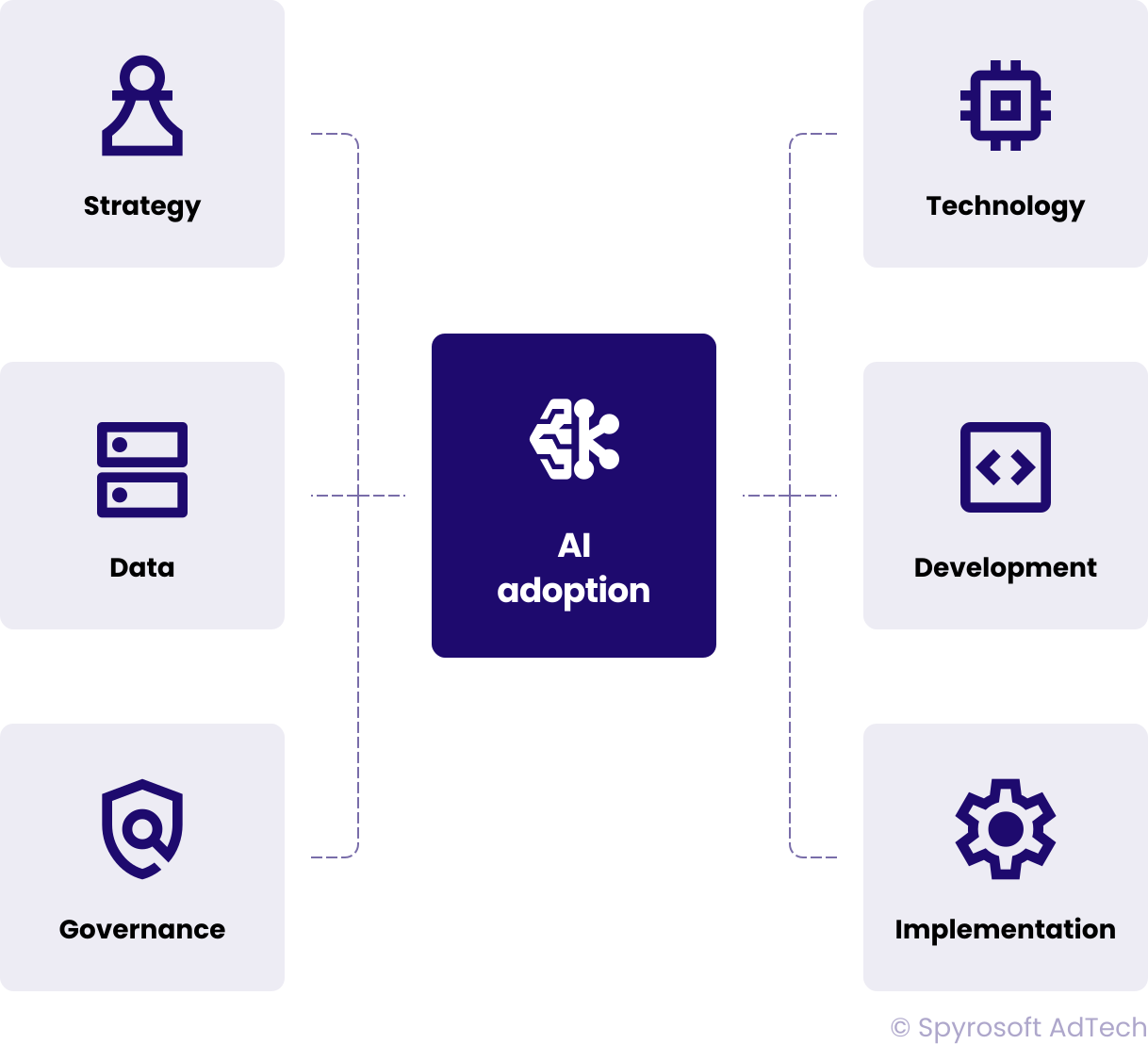
arrow_circle_right AI ADOPTION
What does AI adoption mean for an advertising business?
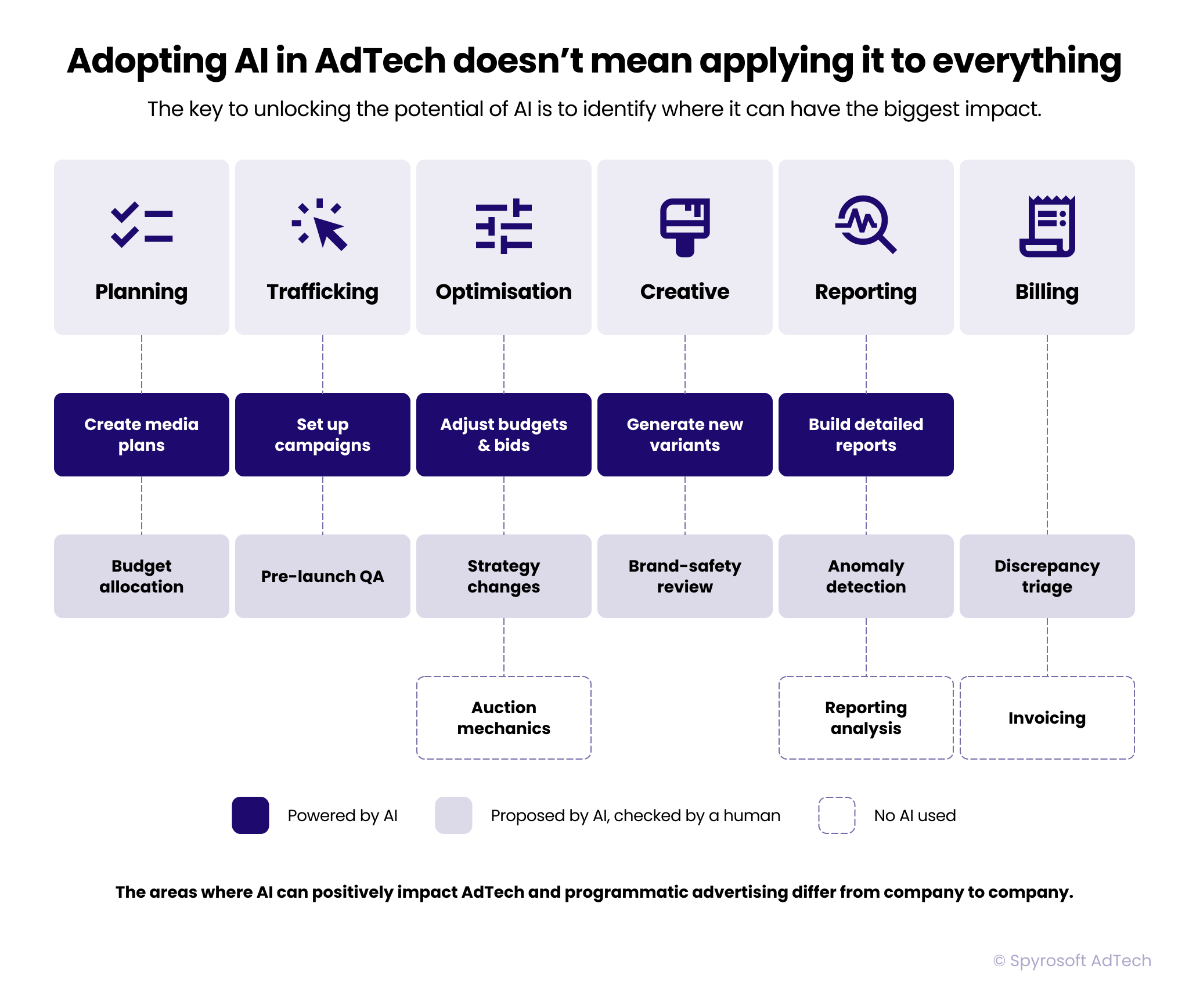
AI adoption isn’t about adding AI to every part of your technology.
It’s about identifying the problems AI is best suited to solve and implementing it where it can deliver measurable value.
Across an advertising business, that could include:
- Automating manual and repetitive workflows
- Improving media planning and campaign management
- Analysing large volumes of advertising data
- Optimising bidding, budgets, and performance
- Generating images, video, and other advertising creatives
- Introducing AI assistants and autonomous agents
- Developing new AI-powered products and features
arrow_circle_right SYMPTOMS
How do you know if you have an AI adoption problem?
If you’re struggling to adopt AI effectively, then you’ll likely be experiencing one or more of the following:
You don’t know where to start with AI
You know AI could improve your advertising business and technology, but you’re unsure which problems, processes, or opportunities to focus on first.
You’re not sure where you should incorporate AI
You know AI will play a role in your technology, but you’re unsure where it belongs and which problems are better solved without it.
Your AI initiatives never make it into production
Your teams have built prototypes and PoCs, but turning them into secure, reliable, production-ready technology is proving difficult.
Different teams are adopting AI independently
Teams are experimenting with different models, tools, and approaches without a shared strategy, architecture, or governance framework.
Your existing technology and data aren’t ready for AI
Legacy systems, fragmented data, and limited integrations make it difficult to introduce AI into your existing technology and workflows.
You’re struggling to demonstrate ROI from AI
You’re investing time and money in AI initiatives but can’t clearly demonstrate how they improve efficiency, advertising performance, products, or revenue.
Experiencing any of the problems above?
Get in contact with our team and find out how we can help you adopt and implement AI into your advertising technology and business.
arrow_circle_right THE CAUSES
Why do companies struggle to adopt AI?
True AI adoption involves getting both the technology and business aspects aligned.
It becomes difficult when companies try to introduce rapidly evolving AI capabilities into existing technology, data, and processes without the right organisational structures and governance.
No clear AI strategy
Teams experiment with AI without clearly defining the business problems they want to solve, the outcomes they expect, or which use cases should be prioritised.
Legacy technology and architecture
Existing advertising platforms may not have been designed to support AI models, agents, real-time data access, or the integrations needed to introduce new AI capabilities.
Fragmented or inaccessible data
AI systems need access to reliable, relevant, and well-governed data, but that data is often distributed across disconnected platforms and databases.
Lack of AI expertise
Building production-ready AI requires a combination of AI, software engineering, data, infrastructure, and advertising technology expertise that can be difficult to assemble internally.
Rapidly evolving AI technology
Models, tools, frameworks, and capabilities are evolving quickly, making it difficult to decide which technologies to invest in and how to build solutions that won’t quickly become outdated.
Unclear AI governance
Companies lack clear policies around data access, privacy, security, model usage, human oversight, and what AI systems should be allowed to do autonomously.
Prototypes are easier than production systems
AI tools make it relatively easy to demonstrate an idea, but building a secure, reliable, scalable solution that integrates with production technology is much harder.
arrow_circle_right THE BUSINESS IMPACT
How ineffective AI adoption impacts your business
Failing to identify and implement the right AI opportunities can increase costs, slow innovation, reduce competitiveness, create unnecessary risk, and prevent your business from realising the potential value of AI.
Wasted investment
Time and money are spent on AI tools, prototypes, and initiatives that never reach production or deliver meaningful business value.
Higher operational costs
Teams continue performing repetitive, manual work that could be automated or accelerated with the right combination of AI and automation.
Slower product development
Without a clear approach to AI, teams spend time experimenting with technologies and use cases instead of developing capabilities that can be deployed and scaled.
Missed product and revenue opportunities
Competitors can introduce AI-powered features, products, and services faster, while opportunities to improve your existing offering or create new revenue streams go unrealised.
Reduced competitiveness
If competitors adopt AI more effectively, they can automate processes, develop new capabilities, and improve their products faster while your business struggles to keep pace.
Increased security, privacy, and governance risk
Introducing AI without appropriate controls can expose sensitive data, create compliance issues, and give AI systems access to information or actions they shouldn’t have.
arrow_circle_right SOLUTIONS TO THE PROBLEM
How we can help you adopt AI
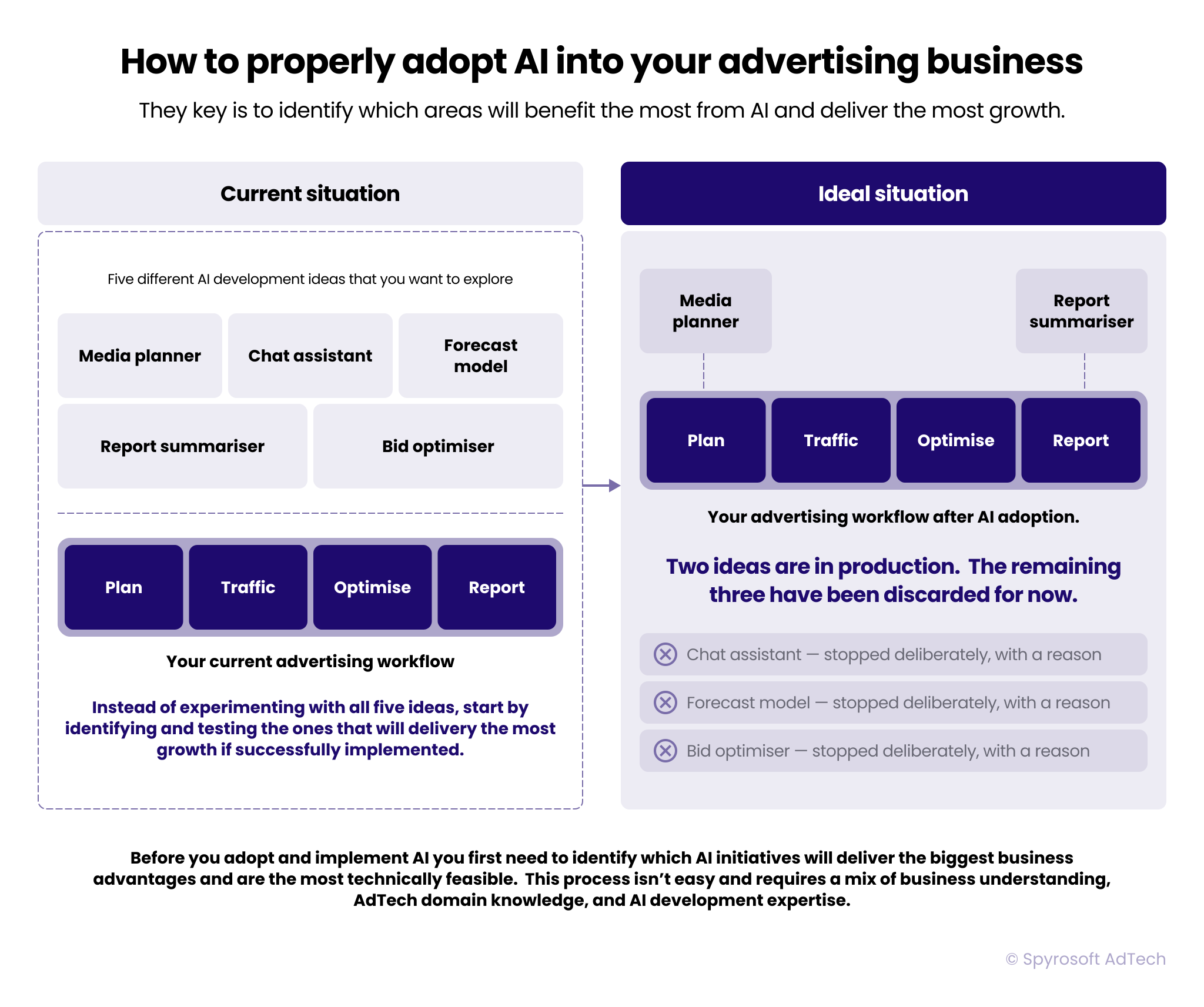
01. Discover
Identify where AI can create genuine value across your advertising business.
We can work with your business and technical teams to:
- Identify problems and opportunities.
- Explore potential AI use cases.
- Determine where AI should—and shouldn’t—be used.
- Prioritise use cases based on value and feasibility.
- Define expected business outcomes.
- Create an AI adoption roadmap.
Output: A prioritised AI use-case portfolio and adoption roadmap.

02. Assess and design
Determine what is needed to turn your highest-priority AI use cases into working solutions.
We can assess and design the required:
- Data and integrations.
- Architecture and infrastructure.
- AI models and technologies.
- Security and privacy controls.
- Governance and human oversight.
- Integration with existing technology and workflows.
Output: A technical blueprint for implementing your selected AI use cases.

03. Build and integrate
Turn AI ideas and prototypes into production-ready technology.
We can design, build, and integrate:
- AI-powered features and products.
- AI agents and assistants.
- Workflow automation.
- Generative AI capabilities.
- Predictive and optimisation models.
- Custom AI applications.
- Integrations with existing advertising technology.
Output: Secure, scalable AI solutions integrated into your technology and workflows.

04. Govern and scale
Establish the controls and foundations needed to use AI safely and expand successful implementations.
We can help you establish:
- AI governance and policies.
- Access and permissions.
- Monitoring and observability.
- Human oversight and approval processes.
- Model and system evaluation.
- Performance and cost monitoring.
- Processes for scaling successful use cases.
Output: A governed AI foundation that can evolve as your business and AI technology change.

Need help adopting AI into your advertising technology and business?
Get in contact with our team and find out how we can help you.
arrow_circle_right EXPECTED OUTCOMES
What outcomes can you expect from adopting AI effectively?
Identifying and implementing the right AI opportunities can deliver positive outcomes across your business, operations, products, and technology.
Business outcomes
Lower operational costs
Increased productivity
Faster product development
New product and revenue opportunities
Improved customer experience
Faster decision-making
Greater competitiveness
Technical outcomes
Production-ready AI
AI-enabled products and platforms
Automated workflows
AI-ready architecture
Secure access to data
Clear AI governance
Scalable AI foundation
arrow_circle_right CASE STUDIES
Examples of projects we’ve worked on



arrow_circle_rightContact us
Need help with adopting AI into your advertising technology and business?
Get in contact with our team and find out how we can help you.

Radosław Kostecki
Business Unit Director