Key Use Cases of Agentic AI in Commerce Media

As the experimentation and implementation of agentic AI increases, so too do the use cases. In commerce, there are six distinct things agentic AI can do today. Some are in production, while others are in early deployment. The gap between them matters, especially if you’re deciding where to put resources.
The previous article covered why agentic AI fits commerce media — faster decisions, better margin use, less manual overhead.
These use cases work because of how commerce media is built: closed-loop purchase data, retailer-controlled inventory signals, and a direct path from ad exposure to sale.
Together, they create an environment where agents can act on real signals, not assumptions.
The six use cases are:
- Campaign planning
- Product-level bidding
- Budget reallocation
- Cross-channel coordination
- Inventory-linked advertising
- Creative adaptation
01. Campaign planning: How does agentic AI improve campaign planning in commerce media?
Agents interpret a campaign brief, identify relevant audience segments from first-party purchase data, and return targeting recommendations. You don’t need to pull reports or build configurations manually.

In practice: A strategy agent reads the brief and maps objectives to available inventory. An audience intelligence agent surfaces purchase-based segments. A targeting agent then produces keyword, product-level, or category options. The process runs without the usual handoffs between teams.
Example: Walmart Connect’s Marty handles campaign strategy queries via a conversational interface. According to Walmart Connect, 97% of those queries are unique — illustrating the sheer range of planning decisions agents need to handle.
Status: Live with human supervision. Agents surface recommendations and people approve and launch campaigns.
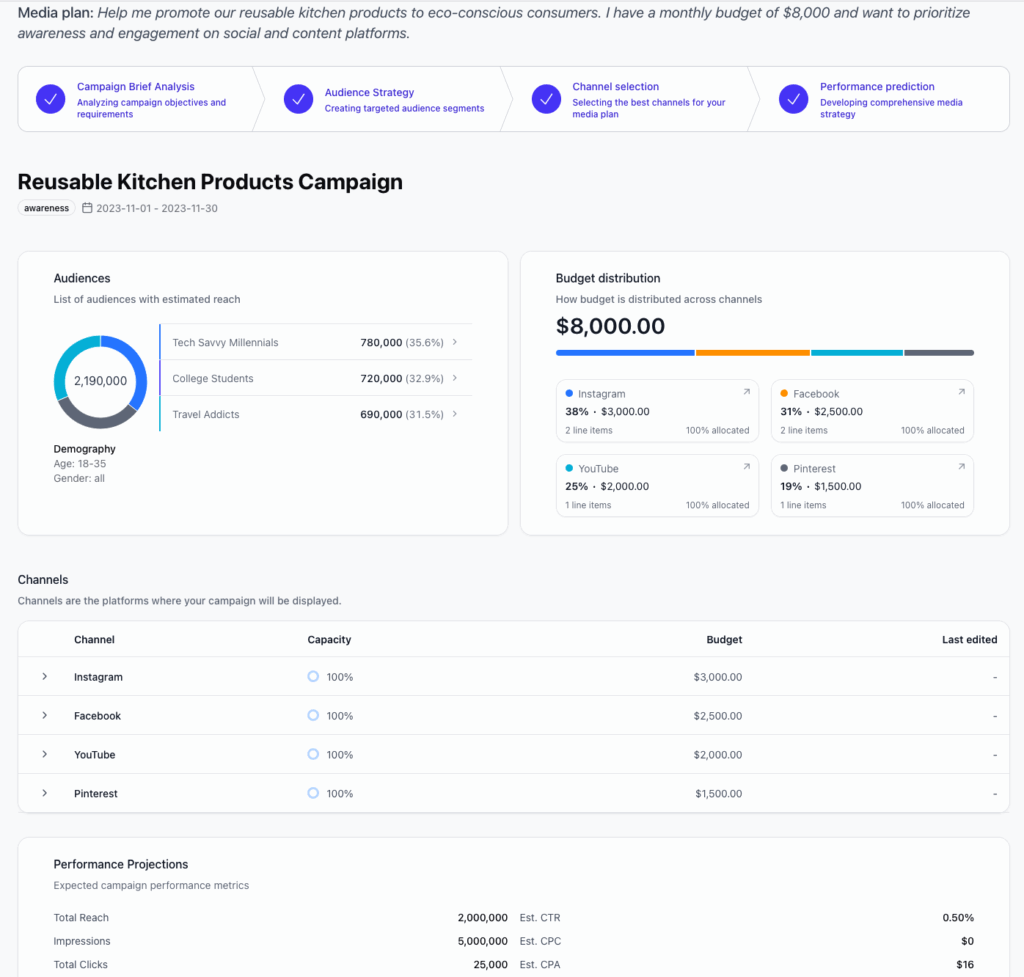
An example of how agentic AI is used to generate full media plans from campaign briefs.
Source: Spyrosoft AdTech’s AI Media Planner
Related article: Agentic AI in AdTech: 7 Use Cases
02. Product-level bidding: What is product-level bidding and how does agentic AI handle it?
Product-level bidding involves setting and adjusting bids at the individual SKU level rather than at campaign or category level. This means a high-margin, in-stock, fast-converting product gets a different bid than a low-margin, overstocked one.

Why it matters: A retailer with 50,000 active SKUs can’t review individual bid performance manually. One bid across an entire category treats a $200 pair of headphones and a $2,500 DSLR camera identically, resulting in wasted budget in both directions.
In practice: Agents monitor live signals per SKU, including real-time conversion data, inventory feeds, competitor pricing, and margin targets. Bids adjust continuously within human-set guardrails, e.g. maximum bid, minimum ROAS, and excluded SKUs.
Example: Amazon Ads’ dynamic bidding adjusts in real time based on conversion likelihood. Third-party platforms Skai and Pacvue apply similar logic across multiple retail media networks, extending SKU-level bid management to advertisers who sell across several retailers simultaneously.
Status: Not only is this implementation live today, but it’s also one of the most mature use cases in production today.
03. Budget reallocation: How does agentic AI handle budget reallocation in commerce media?
Agentic AI shifts spend between campaigns, products, or placements in real time, rather than relying on delayed, manual optimisation.

In practice: An agent monitors conversion rates by placement, ROAS by product, competitor pricing, and stock levels continuously. When it detects a meaningful shift – e.g. such as a competitor going out of stock, a product’s click-through rate spiking, or a placement’s cost-per-acquisition dropping — it reallocates budget automatically, within pre-set thresholds.
Example: Butler/Till and PubMatic launched the first AdCP-enabled agentic AI campaign in December 2025, using Anthropic’s Claude to interpret briefs and activate media autonomously. The campaign cut intermediary fees by over 80% and achieved a 98% video completion rate.
Status: Although it’s live in early deployments, most organisations still require human sign-off above defined reallocation thresholds.
04. Cross-channel coordination: How does agentic AI coordinate commerce media across multiple channels?
Agentic AI manages ad delivery and spend across a retailer’s full channel mix — website, app, email, in-store screens, off-site inventory — as a unified operation rather than separate siloed teams.

Why it matters: Without coordination, the same customer sees the identical creative three times in an afternoon while a high-value customer in another segment is missed entirely.
In practice: Agents monitor exposure and engagement signals across all channels simultaneously, adjust frequency and format allocation in real time, and shift spend toward wherever conversion probability is highest at that moment.
Example: Criteo’s Commerce Max connects on-site and off-site retail media inventory, enabling budget shifts between channels based on live performance. Yahoo DSP is testing six embedded optimisation agents across its buying platform. The IAB’s Agentic RTB framework provides the emerging technical standard for agent-to-agent trading that underpins cross-network coordination.
Status: While it’s an emerging use case, some agentic cross-channel coordination is available in early platform deployments, full coordination across multiple retail media operators remains nascent.
05. Inventory-linked advertising: How does agentic AI connect inventory data to advertising decisions?
This use case involves agents reading live product stock signals and automatically adjust ad spend to match, helping to increase bids on products with healthy inventory and available margin, while pausing or reducing items approaching stock-out.

Why it matters: Standard digital advertising has no access to inventory data. Commerce media does. The retailer controls both the ad environment and the product catalogue. Connecting the two prevents a common and costly failure mode: spending budget to drive demand for a product you can’t fulfil.
In practice: Inventory feeds connect directly to campaign management. When stock crosses defined thresholds, bids adjust automatically.
Example: Amazon’s campaign tools pause or reduce sponsored product spend when inventory drops below seller-defined thresholds. This logic is available via API to third-party platforms building on Amazon’s retail media infrastructure.
Status: This use case is live on many major commerce media networks and advertising platforms.
06. Creative adaptation: How does agentic AI handle creative adaptation in commerce media?
Creative adaptation refers to agents that generate, test, and serve ad creative variants — copy, imagery, format, promotional messaging — based on live performance signals, adapting to stock changes, pricing shifts, and seasonal context in real time.

Why retail advertising is different: Creative goes stale fast in this environment. A promotion ends, a product sells out, a competitor cuts their price. Where a human workflow takes days to respond, agents can update what’s running within minutes.
In practice: Agents test variants against live audiences and serve the best-performing version automatically. They also pull signals from the product catalogue — current price, availability, review score — to keep creative factually accurate.
Example: Amazon’s dynamic creative tools adapt sponsored product ads by audience segment and browsing behaviour. Walmart Connect’s Automated Creative Generator claims an 80% reduction in creative production time during beta testing.
Status: It’s live on major platforms for format and copy variants. Fully autonomous creative strategy remains human-led.
Which agentic AI use case should retailers and brands try first?
There’s no single right answer, but there is a practical sequence.
- Start with product-level bidding if you manage a large SKU catalogue and have clean product data. It’s the most mature use case and offers the clearest ROI signal.
- Start with campaign planning if your main bottleneck is time and coordination. Planning agents reduce effort without directly impacting spend decisions.
- Start with inventory-linked advertising if stock-outs are a recurring issue. The logic is simple, and the cost of inaction is easy to measure.
One useful filter across all use cases is the type of product.
Agents perform best where purchase decisions are repeatable and signal is clear, such as everyday essentials. In categories driven by browsing or inspiration, you’ll need stronger creative oversight.
Across all six use cases, one prerequisite remains the same: clean, structured first-party data. That’s what enables everything else.
FAQ
The six main use cases are:
1. Campaign planning: Agents interpret briefs and surface audience and targeting recommendations.
2. Product-level bidding: Agents set and adjust bids per SKU based on live performance signals.
3. Budget reallocation: Agents shift spend in real time based on conversion and inventory data.
4. Cross-channel coordination: Agents manage ad delivery across all retail touchpoints as a unified system.
5. Inventory-linked advertising: Agents pause or adjust spend based on live stock levels.
6. Creative adaptation: Agents generate, test, and serve ad variants automatically.
Product-level bidding is the most mature use case in commerce media, with live deployments on Amazon Ads, Walmart Connect, and third-party platforms including Skai and Pacvue.
Campaign planning agents are also in active deployment, with media agencies reporting early results. Cross-channel coordination and fully autonomous creative strategy are at earlier stages.
No. Third-party platforms make most of these use cases accessible without large in-house teams.
The readiness requirement is clean, structured data — SKU-level product attributes, inventory feeds, and first-party audience signals — not headcount or enterprise infrastructure.
About the author
Get more articles like this sent to your inbox
If you want to learn more about the world of AdTech and AI, then fill in the form and we’ll send you our latest articles, videos, and industry reports.