Challenges and Limitations of Agentic AI in Commerce Media


Given all the noise and hype around agentic AI, you’d think that it’s a silver bullet to all of commerce media’s problems. While agentic AI is certainly transforming certain areas of retail and commerce media, it still faces various challenges and limitations across the board.
The gap between having the technology and making it work in your organisation is where most implementations succeed or fail.
When it comes to adopting and implementing agentic AI into commerce media, five challenges stand out:
- Data quality
- Attribution breakdown
- Governance
- Operational change
- Technology maturity
01. Data quality: What data quality challenges does agentic AI face in commerce media?
AI agents are only as good as the data they act on.
A product-level bidding agent reading a stale inventory feed will confidently increase bids on a product that’s been out of stock for three days.
A budget reallocation agent working from a mismatched attribution model will shift spend toward the wrong channel. Both feel like agent failures. Usually, they’re data-related failures.
According to IDC research reported in BizTech, many retail data sets are not yet modernised, and by 2027, 80% of agentic AI use cases will require real-time, contextual data access that most organisations don’t currently have.
In commerce media advertising, failure points cluster around four areas:
- Stale inventory feeds: SKU-level stock not updating in real-time.
- Inconsistent product taxonomy: The same product ID mapping differently across systems.
- Missing margin data: Agents bidding without knowing which products are actually profitable to advertise.
- Fragmented audience signals: Purchase data siloed between online and in-store.
Before deploying any agent, audit your data pipeline. The question isn’t “do we have data?“, it’s “is our data accurate, current, and consistently structured?”
02. Attribution breakdown: Why is attribution breaking down in agentic commerce media?
Commerce media’s closed-loop measurement, the ability to connect an ad to a sale, is one of its structural strengths. However, agentic commerce is putting pressure on that loop.
When a purchase completes inside a shopping agent, say a customer asks Walmart Sparky or ChatGPT to find and order a product and the agent handles the transaction, the sale may never register on the retailer’s standard attribution model.
Only the ad that influenced the decision becomes invisible.
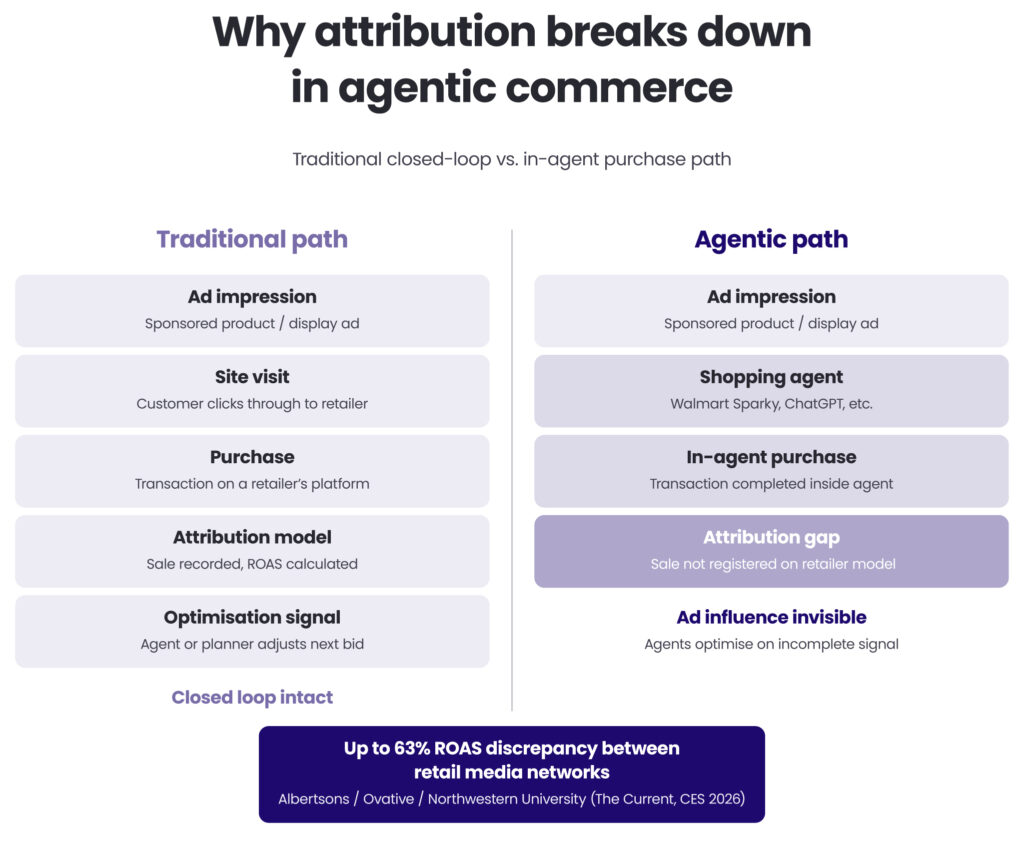
The scale of the problem is significant.
An Albertsons study with Ovative and Northwestern University found up to a 63% difference in ROAS metrics between retail media networks, driven by differences in measurement methodology, attribution windows, and untraceable sales.
That’s not a rounding error.
Campaigns are being optimised against a signal that can vary wildly depending on how you measure it. Agents optimise toward what they can measure, so if the measurement is incomplete, they’ll confidently optimise toward the wrong outcome.
There’s no clean industry solution yet as attribution methodology needs to catch up with how purchases are actually being made.
03. Governance: What governance challenges does agentic AI create in commerce media?
Agentic AI introduces a new category of problem: decisions made by a system rather than a person.
When an agent overspends by reallocating budget toward a signal that turns out to be noise, or runs creative that violates brand guidelines, or bids aggressively on a product that shouldn’t have been advertised, who is accountable?
The data is stark.
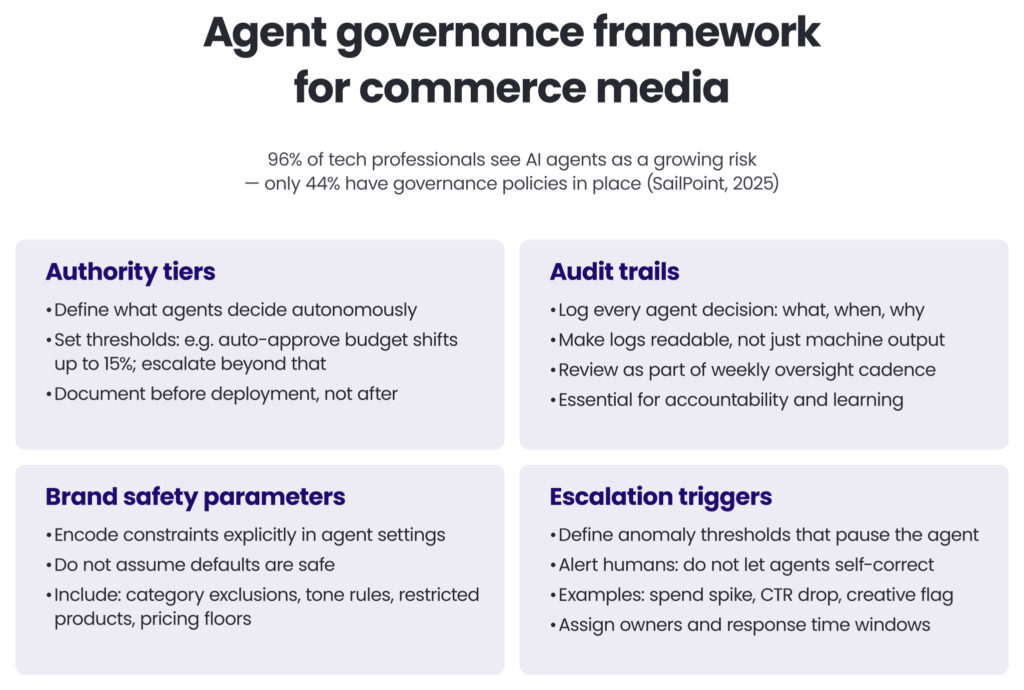
SailPoint’s AI Agents: The New Attack Surface found that 96% of technology professionals view AI agents as a growing risk, yet only 44% of organisations have policies in place to govern them.
Governance in commerce media advertising requires four specific things:
- Agent authority tiers: Defined thresholds for what agents can decide autonomously versus what requires human sign-off, for example auto-approve budget shifts up to 15% and escalate beyond that.
- Audit trails: A readable log of what each agent decided, when, and why.
- Brand safety parameters: Explicit constraints built into the agent’s settings, not assumed.
- Escalation triggers: Conditions that automatically alert a human rather than allowing the agent to continue.
There’s also a question worth raising directly with vendors: what is this agent’s objective function and who set it?
If an agent is aligned with the platform rather than the advertiser, it will drift.
Over time, you’ll see more pay-to-win placements and engagement-driven creative. Not because anyone decided it should, but because that’s what it was built to do. Transparency here isn’t just a trust issue. It’s a performance issue.
Most organisations deploying agents today haven’t written these policies yet. That’s the gap, and it’s operational, not technical.
04. Operational change: How does agentic AI change how commerce media teams work and operate?
The shift from manual campaign management to agent-supervised campaigns is a role change, not just a tool change.
Teams built to execute, building campaigns, pulling bids, trafficking creative, need to rebuild around oversight. Reviewing what agents have done, setting the parameters they operate within, and handling the exceptions they escalate are all part of the new commerce media roles.
The required skills are different, and so are the rhythms. Weekly campaign reviews become exception management. Bid management becomes parameter governance. Creative production becomes guardrail setting.
Only 15% of IT application leaders are currently considering, piloting, or deploying fully autonomous AI agents, which suggests most organisations haven’t yet experienced what this change feels like in practice.
The risk for those who move without preparation: agents running in the background while teams continue working the old way, producing neither the efficiency of full automation nor the quality of full human management.
Define what oversight looks like for your team before you deploy agents, not after. Who reviews what each day? Who has authority to override an agent decision?
05. Technology maturity: What agentic AI capabilities in commerce media are not yet mature?
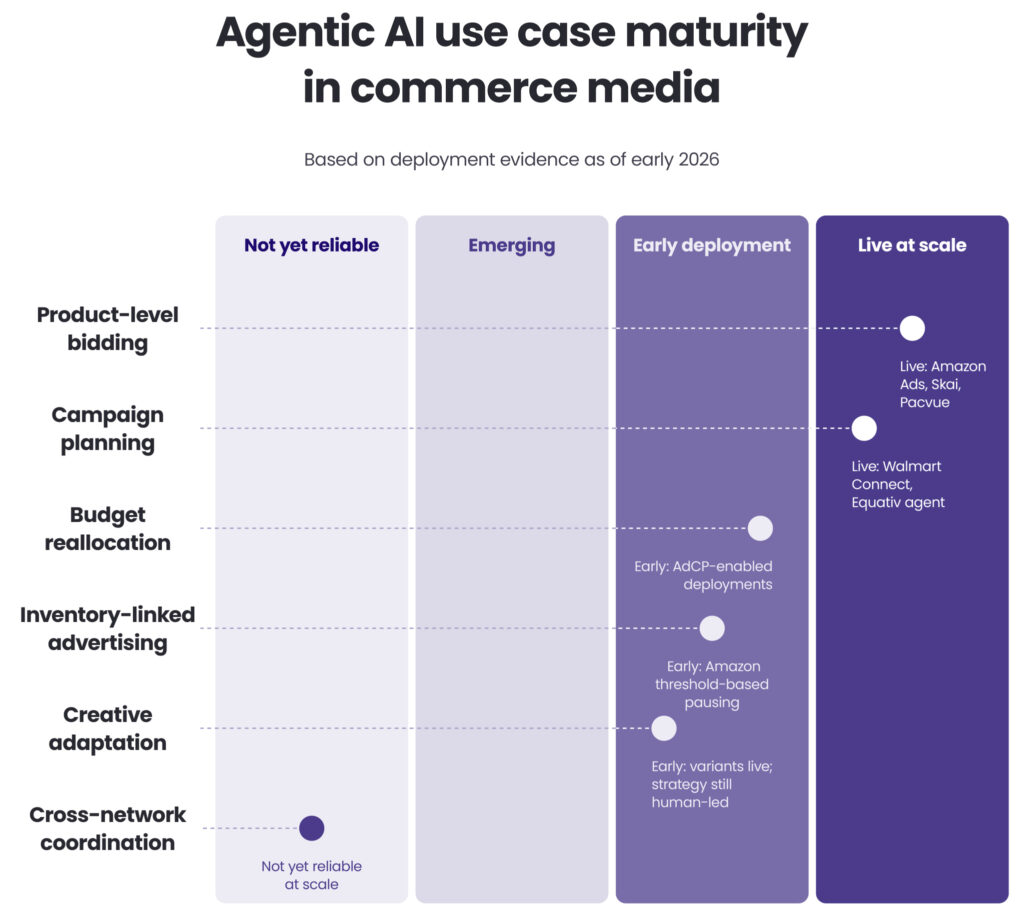
Not all six agentic AI in commerce media use cases covered in the previous article are at the same stage. Knowing which are reliable at scale and which aren’t matters for any organisation making investment decisions.
Three capabilities aren’t yet reliable at scale:
- Fully autonomous cross-network campaign management: Coordinating across multiple retail media operators without human oversight.
- In-agent purchase attribution: Connecting a completed ChatGPT or Walmart Sparky transaction back to a specific ad impression.
- Creative strategy autonomy: Agents deciding creative direction, not just variants.
Forrester principal analyst Emily Pfeiffer put it plainly:
The experiences that are out there today, in my opinion, are extremely premature. That’s a useful calibration. Not a reason to wait, but a reason to pilot carefully with human supervision rather than deploying at scale immediately.
A useful historical comparison is the smart fridge.
It was supposed to auto-order milk, but it didn’t. Not because it was technically impossible, but because the friction it removed was friction people didn’t mind having.
Agentic commerce faces the same test.
A system optimised for decisions people don’t want automated will be adopted slowly regardless of technical readiness.
When evaluating vendors, ask specifically which features are in production at scale and which are in beta or on the roadmap.
What should retailers and brands do to address agentic AI challenges in commerce media?
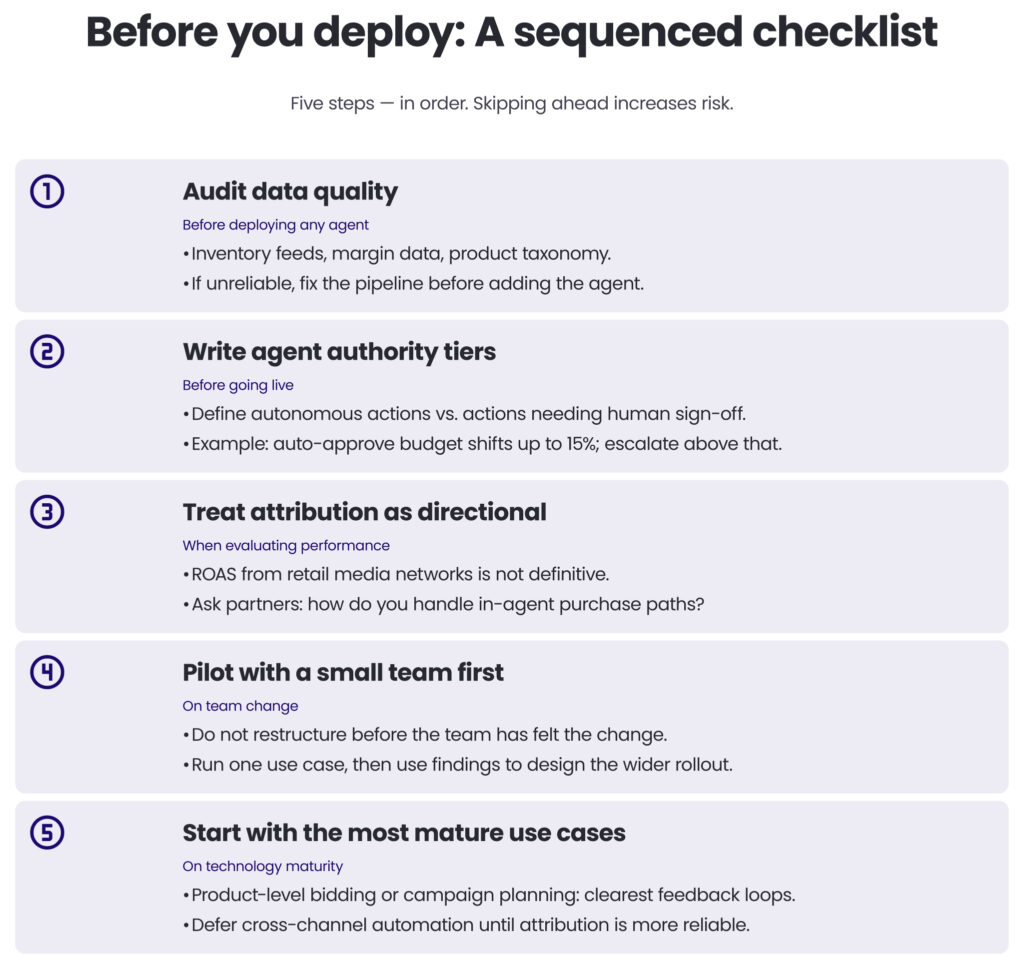
These challenges aren’t reasons to avoid agentic AI in commerce media. Instead, they’re a checklist.
Before deploying any agent: Audit your SKU-level data quality, inventory feeds, margin data, product taxonomy. If this data is unreliable, fix it first. An agent can’t improve on the inputs it receives.
Before going live: Write your agent authority tiers. What can agents decide autonomously, and what needs a human? This takes an afternoon to define. Not having it costs considerably more.
When evaluating attribution: Treat ROAS figures from retail media networks as directional, not definitive. Ask partners directly how they handle in-agent purchase paths. If they don’t have an answer, that is the answer.
On team change: Pilot one use case with a small team before restructuring. Let the team experience the oversight role before defining what it looks like at scale.
On maturity: Start with product-level bidding or campaign planning. They’re the most mature use cases with the clearest feedback loops. Defer fully autonomous cross-channel management until the attribution problem has a better solution.
These challenges are solvable.
The retailers and brands that get there first won’t be the largest; they’ll be the ones that did the data work, wrote the governance policies, and piloted carefully before scaling.
If you want to assess where you stand, let’s talk. Spyrosoft’s commerce media team is a good place to start.
FAQ
Five challenges stand out:
1. Data quality: Agents produce bad outputs from bad inputs.
2. Attribution breakdown: Purchases completing inside shopping agents break the standard closed-loop measurement model.
3. Governance: Most organisations lack policies defining what agents can decide autonomously and who is accountable when they get it wrong.
4. Operational change: Teams need to restructure around oversight rather than execution.
5. Technology maturity: Several use cases, including cross-network coordination and in-agent attribution, are not yet reliable at scale.
When a customer completes a purchase inside a shopping agent, such as Walmart Sparky or ChatGPT, the transaction may not register on the retailer’s standard attribution model.
The ad that influenced the decision becomes invisible.
An Albertsons study found up to a 63% ROAS discrepancy when comparing measurement methodologies across retail media networks.
Agents that optimise based on this incomplete signal will optimise toward the wrong outcome.
Define agent authority tiers before deployment:
1. Specify what agents can do autonomously, for example budget shifts up to 15%, and what requires human approval above that threshold.
2. Build audit trails so teams can review agent decisions.
3. Set explicit brand safety parameters.
4. Create escalation triggers for anomalous behaviour.
Most organisations deploying agents today haven’t written these policies yet.
Doing so is the most important governance step.




Get more articles like this sent to your inbox
If you want to learn more about the world of AdTech and AI, then fill in the form and we’ll send you our latest articles, videos, and industry reports.