Data and Identity
We research, design and build solutions that explore how data and identity can power the next generation of advertising.
From data integrations and identity resolution to privacy-first data architectures and AI-ready data foundations.

Building the data and identity foundations for the future of advertising
Data sits at the centre of modern advertising — powering audience creation, targeting, personalisation, optimisation, measurement and increasingly AI.
But that data is often fragmented across platforms, channels and databases, while changes to privacy, consent and identity make connecting and activating it increasingly complex.
Advances in data infrastructure, identity technology and AI are creating opportunities to build a more integrated approach.
arrow_circle_right DATA & IDENTITY EXPLAINED
What is the role of data and identity in advertising?
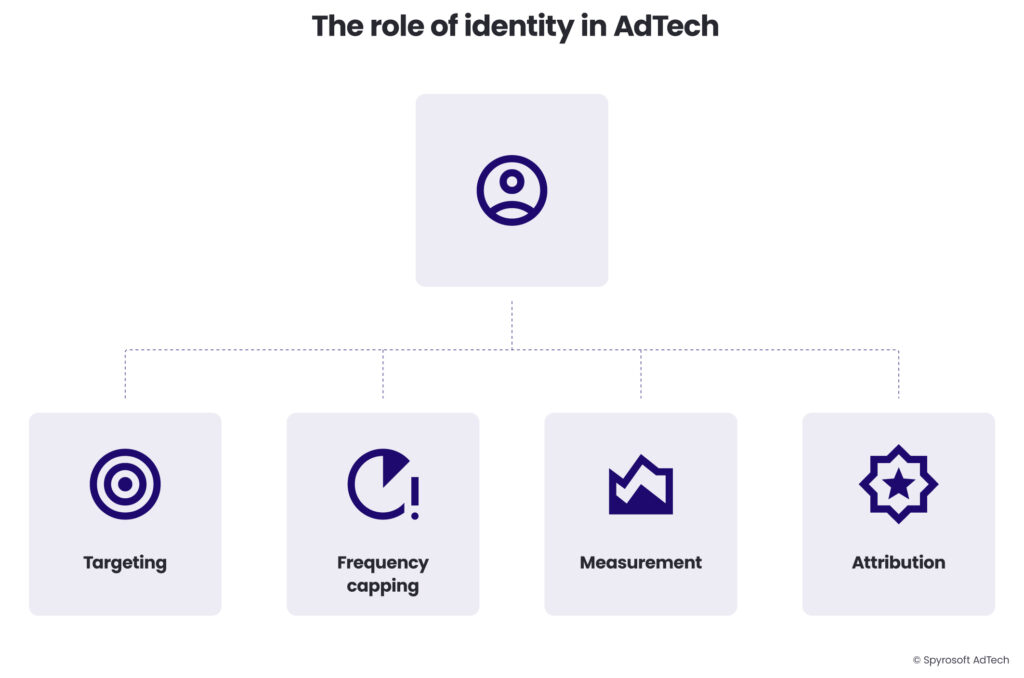
Data and identity are the foundations that allow advertising systems to understand audiences, connect interactions across channels and activate relevant advertising experiences.
Advertising data can include:
- First-party customer data
- Behavioural and contextual signals
- Campaign data
- Transaction data
- Other information used for targeting, personalisation, optimisation and measurement.
arrow_circle_right THE FUTURE OF DATA & IDENTITY
Data and identity underpin the future of advertising
The advertising ecosystem generates enormous amounts of data, but having more data does not necessarily mean being able to use it effectively.
Data and information are often fragmented across advertising platforms, while different identifiers and data models make it difficult to connect. At the same time, privacy requirements and the growing use of AI are increasing the importance of data governance.
Greater emphasis on first-party data
Advertisers, publishers, retailers and other organisations are placing greater value on the data generated through their own customer relationships. Connecting CRM, transactional, behavioural, advertising and other first-party data can create a richer foundation for audience creation, activation and measurement.
Connecting fragmented advertising data
Campaign, audience, customer, inventory and measurement data often exist across separate platforms and databases. Modern data architectures can bring these sources together, standardise them and make them available across advertising workflows.
Evolving approaches to identity
Advertising increasingly operates across environments where different identifiers, authentication methods and privacy constraints apply. Identity strategies can combine first-party identifiers, identity graphs, clean rooms and other approaches to help organisations connect data and audiences across systems while respecting applicable permissions and controls.
Privacy and consent built into the data layer
Privacy can no longer be treated as something applied after data has been collected. Consent signals, permissions, retention rules and data-access policies can be incorporated directly into data architectures so that information is used according to the rules associated with it.
Data governance for advertising and AI
As more systems and teams use advertising data, organisations need clearer rules around ownership, quality, lineage, access and permitted use. AI makes this especially important because models and agents may be able to access and combine data at a scale that would be difficult for humans to manage manually.
Building AI-ready data foundations
The effectiveness of AI systems depends heavily on the data they can access. Connected, well-structured and governed advertising data can provide the context needed for AI to analyse performance, answer questions, generate recommendations and support increasingly agentic advertising workflows.
Looking for data and identity solutions?
Get in contact with our team and find out how we can help you.
arrow_circle_right OUR APPROACH
How we approach designing and building data and identity solutions
01. Research
We research and explore the problem, use cases, opportunities, and technical challenges to define what a potential solution could look like and how it could fit into the wider AdTech ecosystem.

02. High-fidelity prototype
We turn the concept into a realistic user experience by creating a high-fidelity prototype.
The goal of the prototype is to illustrate workflows, interfaces, and functionality and showcase the media-planning tool’s vision to stakeholders and prepare for development.

03. Proof of concept (PoC)
We build and test the parts of the solution that carry the greatest technical uncertainty, such as:
- Connecting fragmented datasets
- Resolving identities
- Standardising data
- Applying consent signals
- Integrating external platforms
- Giving AI controlled access to first-party and advertising data

04. Minimum viable product (MVP)
We develop a working MVP of the data and identity solution for testing with initial users.
Sometimes the MVP stage will be an evolution of the previous stages, other times it’ll be the starting point.

arrow_circle_right CASE STUDIES
Examples of development projects we’ve worked on



arrow_circle_rightContact us
Looking for data and identity solutions?
Get in contact with our team and find out how we can help you.

Radosław Kostecki
Business Unit Director