Legacy and outdated technology
Is your legacy technology slowing product development, increasing maintenance costs, and making it harder to integrate new technologies and adopt AI?
We can help.

Is legacy technology limiting your advertising business’s growth?
Modernise your technology to reduce technical debt, accelerate product development, simplify integrations, improve scalability, and create the technical foundation needed to adopt AI.
arrow_circle_right LEGACY AND OUTDATED TECHNOLOGY EXPLAINED
When does advertising technology become outdated?
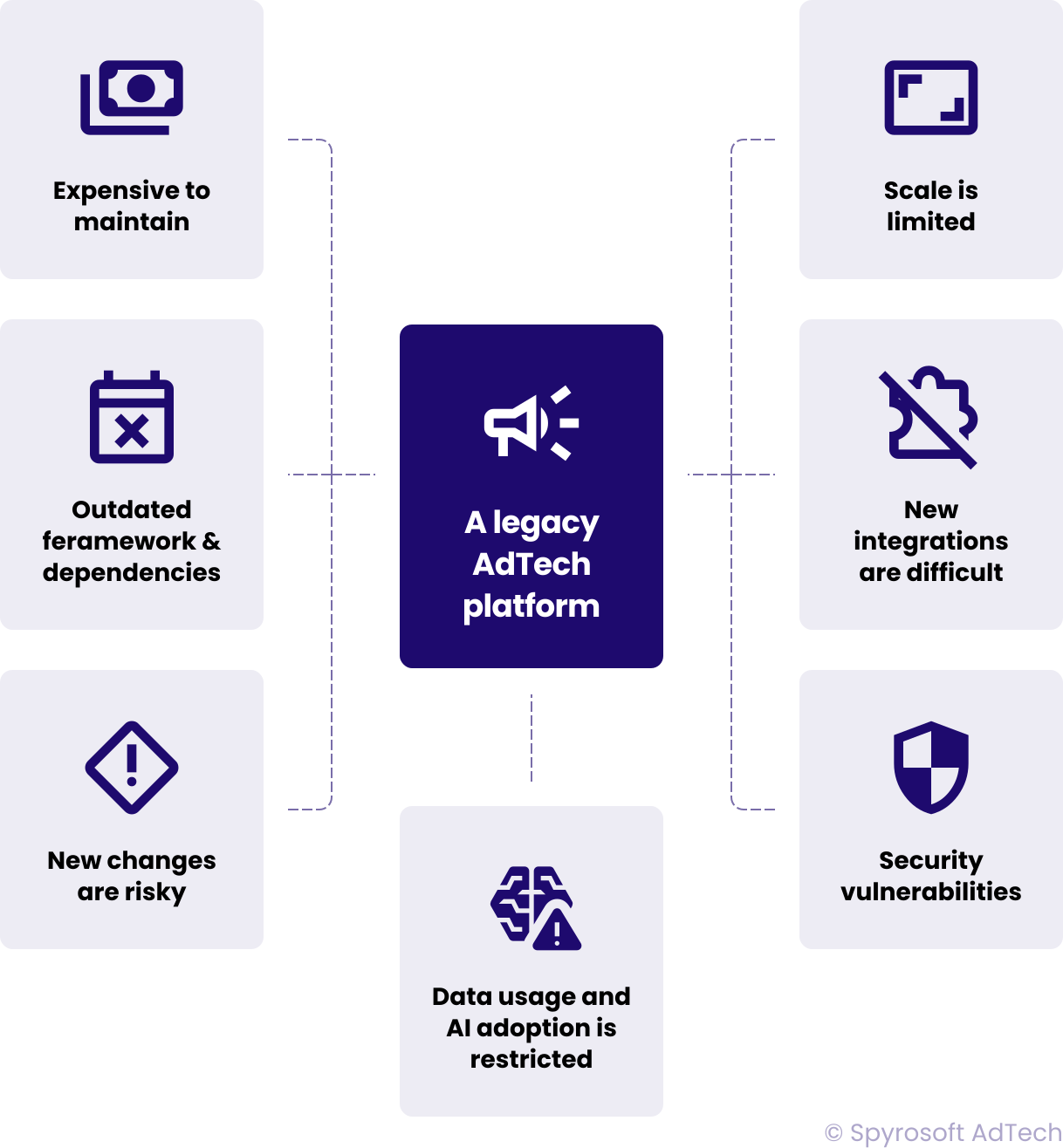
Technology doesn’t become outdated simply because it’s old. It becomes a problem when its architecture, infrastructure, dependencies, or technical debt start limiting what your business can do.
In advertising technology, that might mean platforms that are:
- Difficult and expensive to maintain
- Slow or risky to change
- Built on outdated frameworks and dependencies
- Difficult to integrate with modern tools and APIs
- Unable to scale efficiently with growing workloads
- Missing modern security and observability capabilities
- Difficult to connect to modern data and AI technologies
At this point, maintaining the existing technology can require more effort while delivering less flexibility for future development.
arrow_circle_right SYMPTOMS
How do you know if your technology needs modernising?
If your technology has become outdated or accumulated too much technical debt, then you’ll likely be experiencing one or more of the following:
New features take too long to build
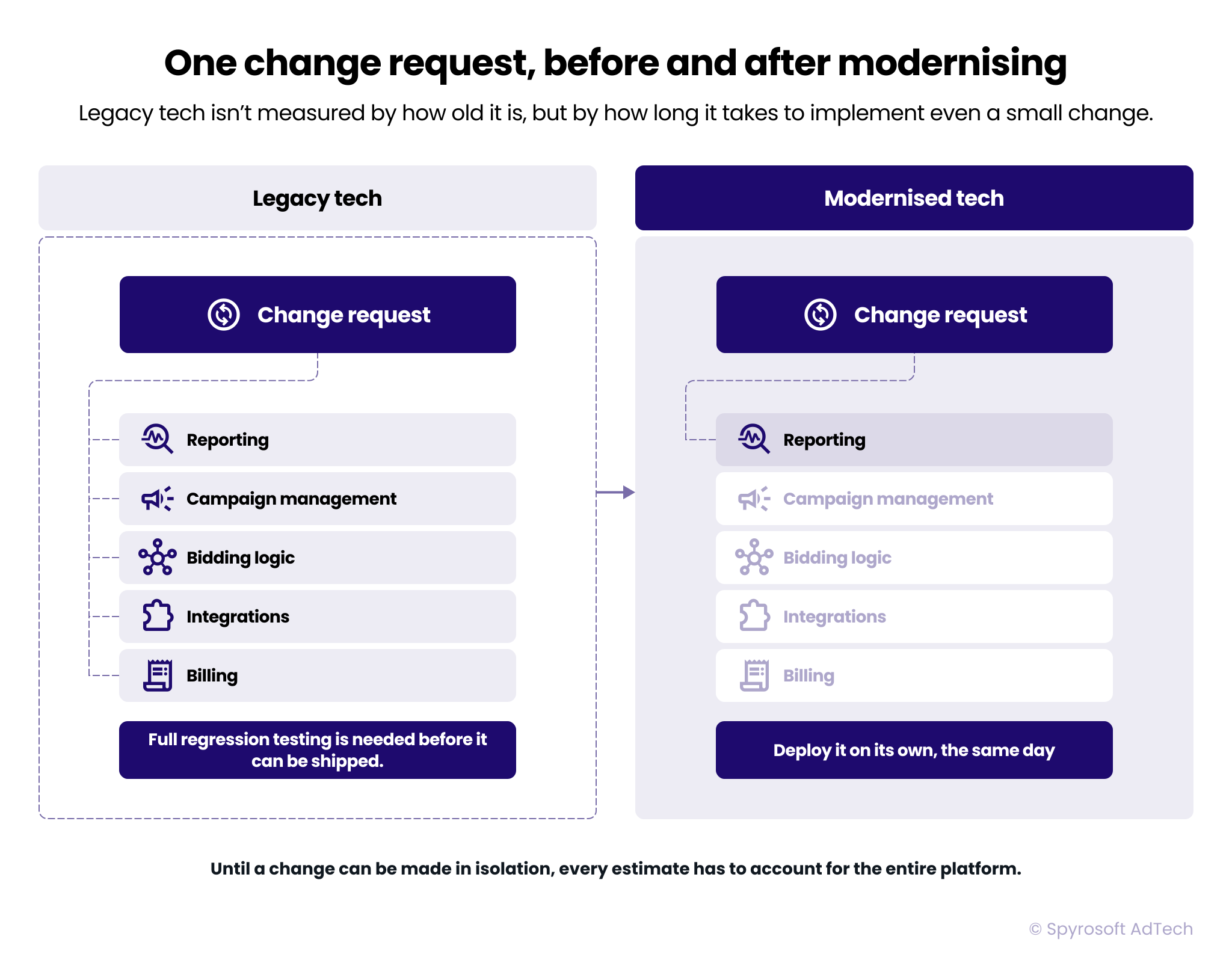
Changes that should be straightforward require engineers to understand dependencies, work around legacy code, and make modifications across multiple parts of the platform.
Integrations are increasingly difficult
Connecting modern platforms, APIs, data sources, and tools requires custom workarounds because your existing architecture wasn’t designed to support them.
Maintenance consumes too much engineering capacity
Your developers spend increasing amounts of time fixing bugs, maintaining legacy components, and resolving technical debt instead of developing new capabilities.
Changes create unexpected problems
Tightly coupled components, limited automated testing, and accumulated technical debt mean updates in one area can cause failures elsewhere in the platform.
Your technology is becoming harder to scale
Legacy architecture and infrastructure make it difficult or expensive to support increasing traffic, data volumes, transactions, or advertising workloads.
Implementing AI is proving difficult
Your existing architecture, data access, integrations, and infrastructure make it difficult to connect AI models and agents or introduce AI-powered capabilities.
Experiencing any of the problems above?
Get in contact with our team and find out how we can help you with your legacy and outdated tech problems.
arrow_circle_right THE CAUSES
How does advertising technology become outdated?
Legacy technology and technical debt rarely result from one bad technology decision.
They usually accumulate gradually as platforms evolve, requirements change, new features and integrations are added, and short-term development priorities take precedence over modernisation.
Years of continuous development
Platforms accumulate features, dependencies, integrations, and workarounds over time, making the original architecture increasingly complex and difficult to change.
Short-term fixes accumulate
Pressure to deliver features quickly can lead teams to implement temporary solutions that remain in the platform and gradually increase technical debt.
Technology and dependencies become outdated
Frameworks, libraries, databases, infrastructure, and other dependencies age, lose support, or become incompatible with modern technologies.
Business requirements outgrow the original architecture
Platforms designed for a particular product, scale, or use case can struggle when required to support new channels, customers, workflows, data volumes, or business models.
Modernisation keeps getting postponed
Product development and customer requirements take priority over technical improvements, allowing maintenance work and technical debt to accumulate over time.
arrow_circle_right THE BUSINESS IMPACT
How legacy technology impacts your business
Legacy technology and accumulated technical debt can increase development costs, slow innovation, reduce scalability, and make it harder for your business to respond to changing customer and technology requirements.
Slower product development
Engineers spend more time understanding legacy code, managing dependencies, and working around technical limitations, increasing the time required to launch new features and products.
Higher maintenance costs
More engineering capacity is needed to fix bugs, maintain outdated components, manage infrastructure, and keep existing technology operational.
Reduced ability to innovate
Technical limitations make it harder to experiment with new ideas, introduce new capabilities, and respond quickly to changing customer and market requirements.
Higher reliability and security risk
Outdated dependencies, fragile components, limited testing, and unsupported technologies can increase the likelihood of failures and security vulnerabilities.
Scalability becomes more expensive
Legacy architecture can require additional infrastructure and engineering effort to support increasing traffic, data volumes, transactions, and advertising workloads.
AI adoption becomes harder
Outdated architecture, fragmented data access, and limited integration capabilities make it more difficult and expensive to introduce AI models, agents, and AI-powered features.
arrow_circle_right SOLUTIONS TO THE PROBLEM
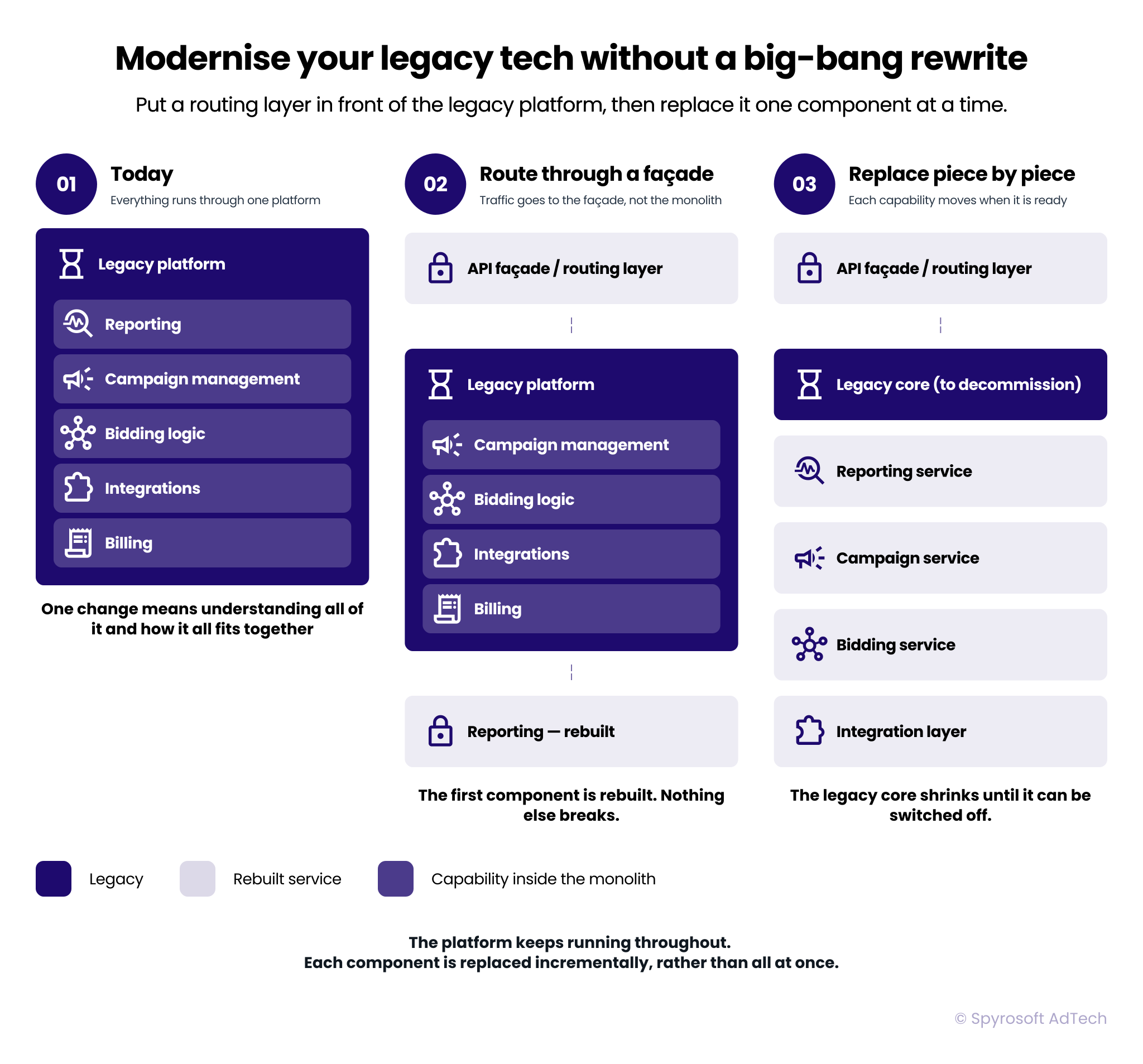
How we can help you modernise your advertising technology
01. Audit
Understand your existing technology, identify technical debt, and determine what needs to change.
We can assess your:
- Architecture and codebase
- Infrastructure and scalability
- Frameworks and dependencies
- Integrations and APIs
- Data architecture
- Security and reliability
AI readiness
Output: A current-state assessment and prioritised modernisation roadmap.

02. Modernise
Improve the parts of your existing technology that are limiting development and growth.
We can:
- Refactor legacy code
- Upgrade frameworks and dependencies
- Modernise architecture
- Improve APIs and integrations
- Migrate infrastructure and workloads
- Reduce technical debt
- Replace outdated components
Output: A modernised technology foundation that is easier to maintain and evolve.

03. Rebuild and migrate
Replace technology that can no longer be effectively modernised.
Where necessary, we can:
- Redesign platform architecture
- Rebuild legacy components and platforms
- Migrate data and workloads
- Recreate critical functionality
- Integrate existing and new systems
- Plan phased migrations
- Decommission legacy technology
Output: Modern technology that replaces the parts of your legacy platform that are no longer fit for purpose.

04. Optimise and evolve
Continuously improve your technology as your business and technical requirements change.
We can help you:
- Improve performance and scalability
- Strengthen reliability and security
- Add new features and integrations
- Improve monitoring and observability
- Optimise infrastructure costs
- Introduce new data and AI capabilities
- Prevent technical debt from accumulating again
Output: A scalable, maintainable technology platform that can evolve with your business.

arrow_circle_right EXPECTED OUTCOMES
What outcomes can you expect from modernising your advertising technology?
Modernising your technology can reduce technical debt, improve development efficiency, and create a more flexible foundation for new features, integrations, growth, and AI adoption.
Business outcomes
Faster product development
Lower maintenance costs
Faster time to market
Greater ability to innovate
More engineering capacity
Reduced operational risk
Faster AI adoption
Technical outcomes
Reduced technical debt
Modern architecture
Improved scalability
Greater reliability
Improved security
Easier integrations
AI-ready technology
arrow_circle_right CASE STUDIES
Examples of projects we’ve worked on



arrow_circle_rightContact us
Need help with your legacy and outdated tech?
Get in contact with our team and find out how we can help you.

Radosław Kostecki
Business Unit Director