Fragmented Data
Is your data fragmented, unorganised, scattered across different systems, and not ready to use for AI?
We can help.
Is your fragmented data limiting your advertising business’s growth?
Defragment your data to improve its quality, accessibility, and governance.
Organised and well-structured data makes it easier to report, automate workflows, make better decisions, and safely implement AI.
arrow_circle_right DATA FRAGMENTATION EXPLAINED
What is data fragmentation?
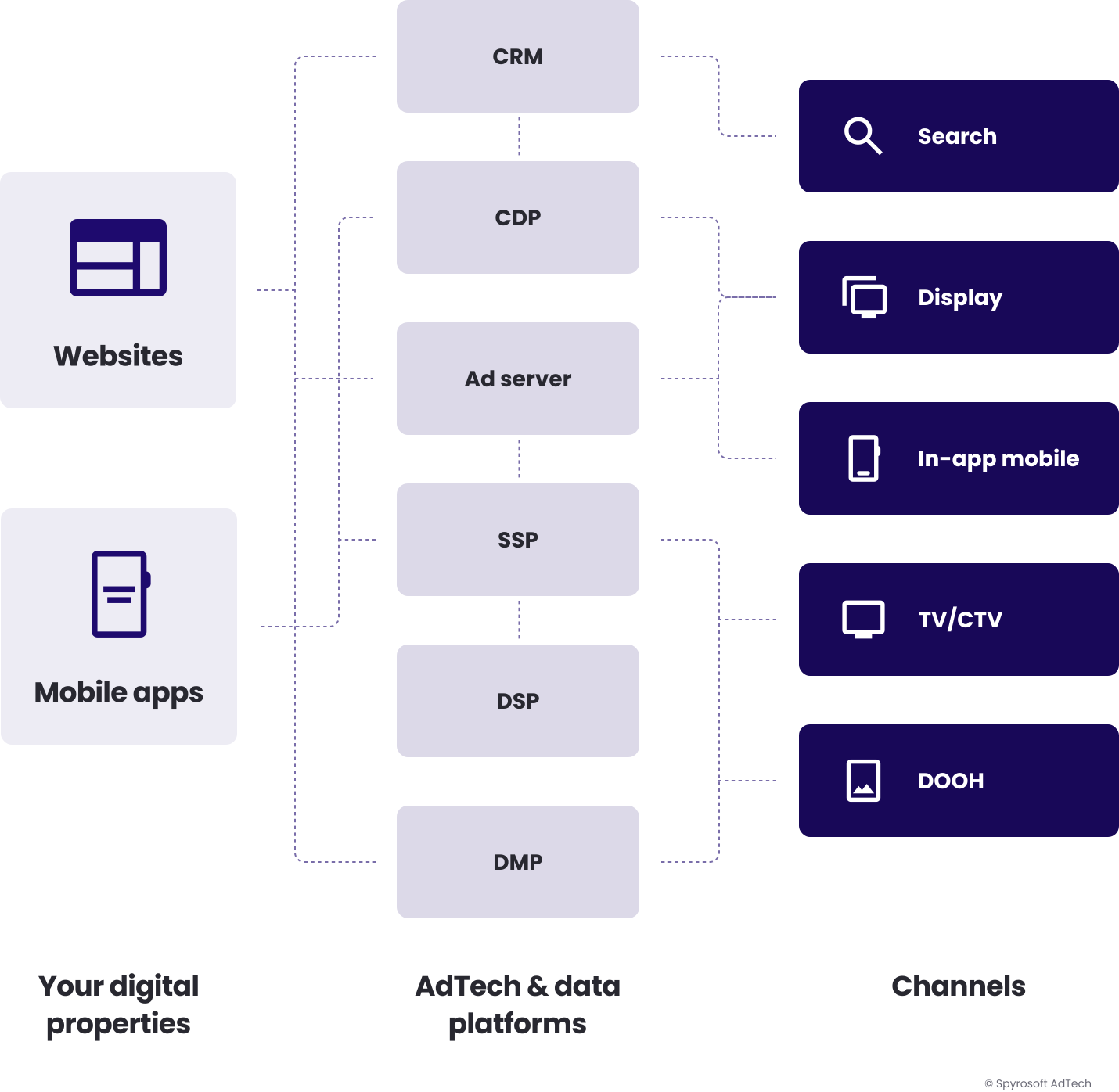
Data fragmentation occurs when a company‘s data is distributed across multiple systems that aren’t connected together.
In the programmatic advertising and digital marketing world, that might include data spread out across:
- Programmatic advertising tools like ad servers, DSPs, SSPs, and ad exchanges
- Data platforms like CRMs, CDPs, DMPs, data warehouses, and data lakes
- Analytics and reporting platforms
- Identity, measurement, and attribution platforms
- Spreadsheets and manually maintained datasets
arrow_circle_right SYMPTOMS
How do you know if your data is fragmented?
If you have fragmented data problem, then you’ll be experiencing one of more of the following:
Different systems contain different versions of your data
Your teams constantly export, transform, and move data between systems to keep information consistent.
Reporting requires too much manual work
Every report becomes a spreadsheet project involving exports, lookups, reconciliation, and manual QA.
Platforms show discrepancies on the same reported data
Teams spend more time debating which numbers are correct than understanding what the data actually means.
Every new platform creates another data silo
Adding new data sources and platforms grows your business but contributes to your fragmented data issue.
Valuable data is difficult to activate
Your first-party data sits unused because it can’t easily be accessed or activated across your technology.
Your data isn’t ready for the AI era
You have plenty of data, but you don’t trust its quality, consistency, or governance enough to give AI agents access to it.
Experiencing any of the problems above?
Get in contact with our team and find out how we can help you with your data fragmentation problems.
arrow_circle_right THE CAUSES
How does data become fragmented?
Data fragmentation rarely results from one bad technology decision.
It usually develops gradually as companies add platforms, vendors, integrations and data sources over many years.
Legacy architecture and technology
Older systems weren’t designed for modern APIs, real-time data exchange, cloud infrastructure, or AI workloads.
Acquisitions
Different business units bring different technology stacks, databases, taxonomies, and processes.
Multiple SaaS platforms
Each third-party tool you use has its own data structures, identities, APIs, and reporting methodologies, which makes creating a consistent data layer difficult.
Disconnected AdTech and data systems
Platforms like ad servers, DSPs, SSPs, CDPs, and DMPs store data that isn’t connected together.
Weak or no governance
There are no company-wide policies defining what data should be collected, where it should live, or what can be used for AI.
arrow_circle_right THE BUSINESS IMPACT
How fragmented data impacts your business
Fragmented data increases operational costs, slows decision-making and product development, impacts advertising performance, creates compliance risks, and makes AI harder to implement effectively.
Higher operational costs
Teams spend time exporting data, cleaning datasets, reconciling discrepancies, creating reports, and maintaining integrations.
Slower decision-making
If producing an answer requires several people and multiple systems, decisions take longer may be made using incomplete or inaccurate information.
Poorer ad performance
If data isn’t connected, it becomes harder to build audiences, personalise campaigns, optimise bidding, and measure performance.
Compliance and privacy risk
Having data fragmented across different systems and databases makes it hard to comply with privacy, security, and governance policies.
AI is harder to implement
If an AI agent or model is fed incomplete and unstructured data, it will lead to bad decisions and produce nonfunctional software.
Slower product development
Fragmented data means every new feature or upgrade requires engineers to understand and work around a complex network of legacy data integrations.
arrow_circle_right SOLUTIONS TO THE PROBLEM
How we can help you defragment and organise your data
01. Audit
Understand your existing environment, identify gaps, and create a roadmap.
We can conduct a data audit that analyses your:
- Data sources
- Architecture and integrations
- Duplication and data quality
- Governance and ownership
- Consent, privacy and security
- AI readiness
Output: A current-state assessment and prioritised roadmap.

02. Integrate and organise
Integrate your data together and organise it so it can be activated.
We can create reliable data flows between your different platforms and systems through:
- APIs
- ETL/ELT pipelines
- Event streaming
- Identity resolution
- Data transformation
- Data normalisation
Output: A centralised and connected data ecosystem.

03. Govern
Establish policies, ownership and controls governing how data is collected, managed and used.
We can work with you to define:
- Ownership
- Access
- Quality standards
- Taxonomies
- Retention
- Privacy
- Consent
- AI usage policies
- Data lineage
Output: Data governance framework.

04. Build
Develop the infrastructure that’s missing.
Where existing platforms can’t meet the requirement, we can design and build the platforms that connect it all together:
- CDPs
- DMPs
- Data lakes
- Data warehouses
- Clean rooms
- Identity platforms
- Reporting platforms
- Custom data pipelines
Output: A scalable data foundation appropriate to your company’s needs.

Need help defragmenting your data?
Get in contact with our team and find out how we can help you.
arrow_circle_right EXPECTED OUTCOMES
What outcomes can you expect from defragmenting your data?
Defragmenting and organising your data provides many positive business and technical outcomes.
Business outcomes
Faster reporting
Better decision-making
Lower operational costs
Faster product development
Better advertising performance
Reduced compliance risk
Faster AI adoption
Technical outcomes
Unified data
Improved data quality
Single source of truth
Automated data flows
Clear governance
Scalable architecture
AI-ready data
arrow_circle_right CASE STUDIES
Examples of projects we’ve worked on



arrow_circle_rightContact us
Need help with your data fragmentation problems?
Get in contact with our team and find out how we can help you.

Radosław Kostecki
Business Unit Director