The Top 30 AI Media-Planning Tools and Solutions

Back in the early days of online advertising, programmatic advertising emerged to automate key processes like ad serving. Then, in the late 2000s, real-time bidding (RTB) was introduced to automate auctions. Now, AI is ushering in the next wave of automation, and it’s being applied to many areas of programmatic advertising and digital media.
One key area is media planning.
But ask a media planner how a campaign comes together and you’ll often hear a different story.
Briefs buried in email threads, data scattered across platforms, spreadsheets passed back and forth, and the same targeting settings typed into one tool after another.
In a 2024 survey of 250 client and agency executives, 85% of those who manage media planning said they still relied on Excel or Google Sheets.
AI adoption remains uneven across the workflow, too.
Basis’s 2026 agency research found that while more than 99% of agencies use AI in some form, only 29.1% use it for media planning.
There are signs that’s changing.
The IAB’s 2026 Outlook Study found that 84% of the brand and agency buyers it surveyed are using, or are likely to use, agentic AI for media planning and buying recommendations.
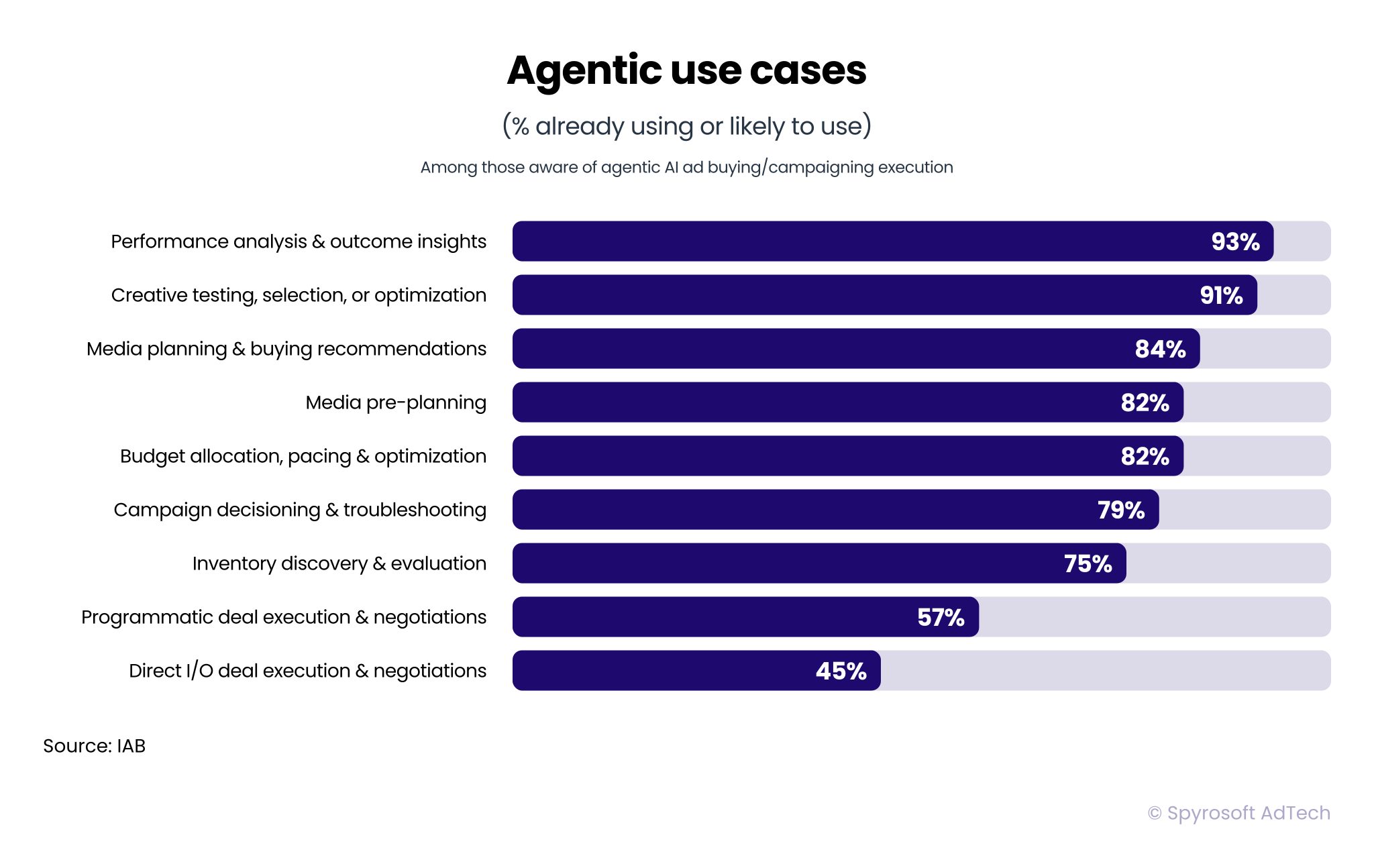
Source: 2026 Outlook Study: A Snapshot into U.S. Ad Spend, Opportunities, and Strategies for Growth, IAB
In a separate IAB report on digital video, media planning and buying recommendations topped the list of planned uses for agentic AI, cited by 51% of buyers.
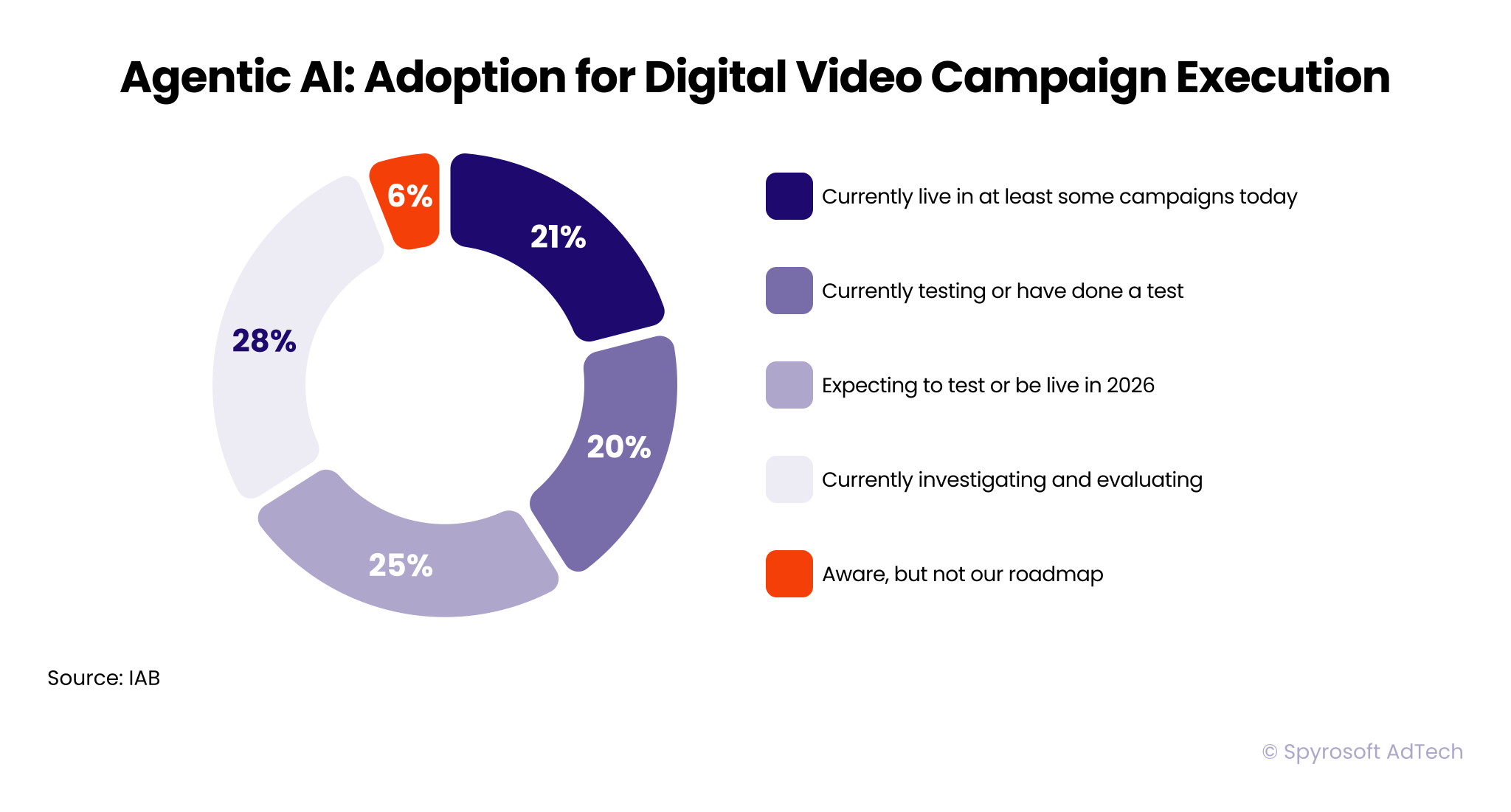
Source: 2026 Digital Video Ad Spend & Strategy Report, IAB
Media planning is a natural target for adoption of AI.
It’s repetitive, data-heavy, and full of decisions that depend on patterns in past campaigns, which is the kind of work AI models tend to handle well.
And AdTech vendors and ad agencies have identified the opportunity.
Most of the tools below launched in 2025 or 2026.
The result is a fast-moving market where the label “AI media planner” covers very different products.
This guide covers 30 of them.
They’re grouped by function rather than ranked, and the list deliberately includes tools that influence planning (audience insight, forecasting, execution, and operations) alongside those that generate plans.
Every description is based on public information, linked to its source, and accurate as of October 2026.
One disclosure: Spyrosoft AdTech’s own AI Media Planner is included, and it’s described with the same factual approach as every other entry.
Here’s a list of the tools and solutions mentioned in this article:
- Spyrosoft AdTech’s AI Media Planner
- SONA by Ogury
- EPAM’s Media Planner Assistant
- NanoQ’s Agentic Media Planner
- Compass by Basis
- Media Planning Agent by Equativ
- AgenticOS by PubMatic
- Open Pro by WPP
- Sigma Planning Agent by MiQ
- MediaPlan by Atlas
- AdCellerant’s AI Media Planner
- Q AI Suite by Quantcast
- NeuroX by Seedtag
- Azerion’s Intelligence
- ad:personam’s AI Media Planner
- Blis AI
- Agent Spark by GWI
- attentionPLAN by Amplified
- Lyzio by Medialyzer
- Media Planning Agent by Akkio
- Concord
- Medialive
- Fluency
- Gigi
- Madgicx
- Adsmith
- Camphouse
- Capably
- Gradial
- Abe by Tack Tech
Scroll down to read the detailed list of AI media-planning tools.
What is an AI media planner?
An AI media planner is software that uses machine learning (ML), large language models (LLMs) or AI agents to automate one or more stages of media planning, from interpreting a campaign brief to allocating budget and setting up campaigns in ad platforms.
The important words there are “one or more”.
Some tools stop at a written plan, others push line items straight into a demand-side platform (DSP), and a few never produce a plan at all but feed audience, attention, or performance data into one.
Across the lifecycle, that can mean brief interpretation, research and strategy, audience discovery, channel and inventory selection, budget allocation and forecasting, plan creation, campaign setup, and optimisation and reporting.
Most tools in the list below cover two to four of those stages.
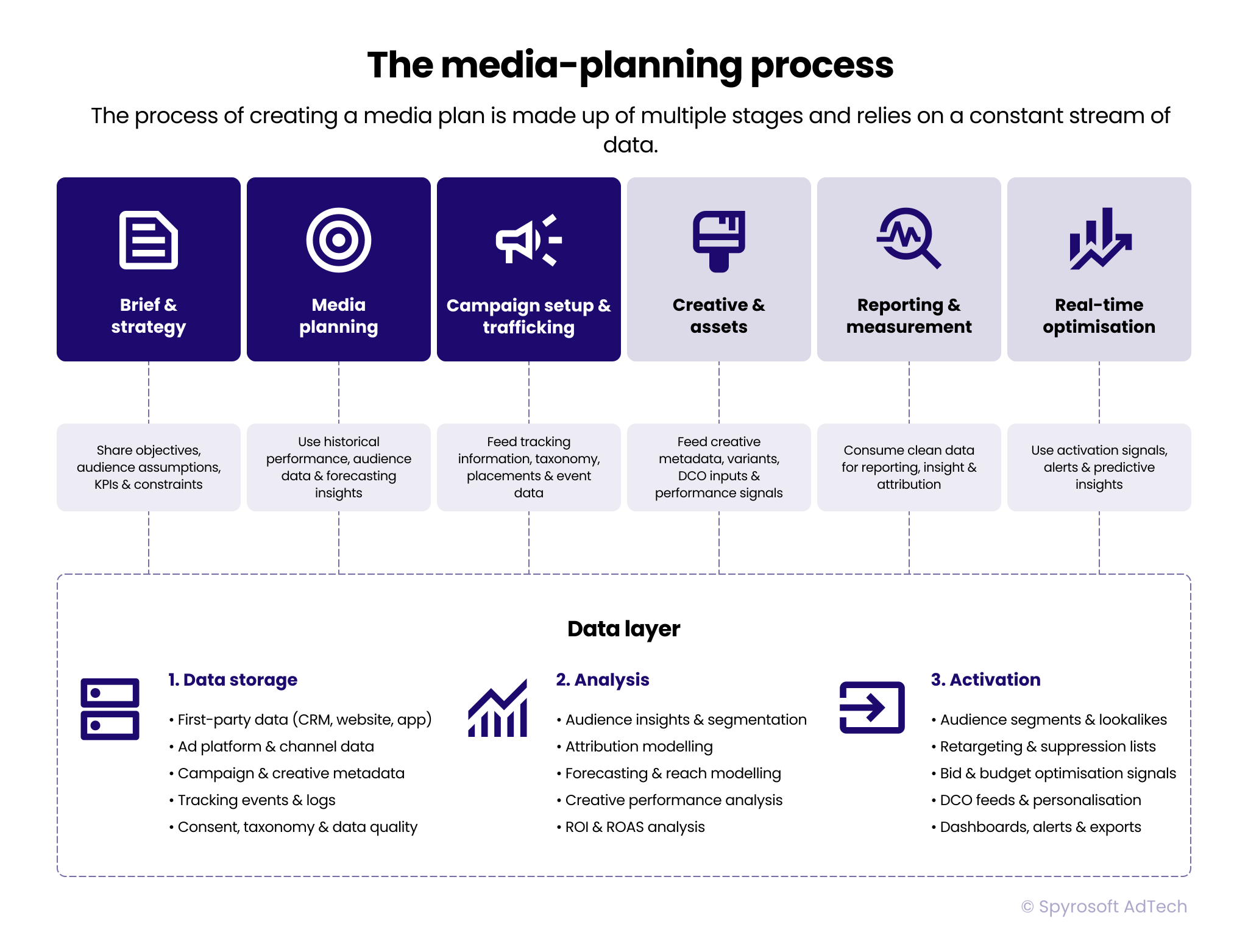
The second difference is how much a tool does on its own.
Assistive tools analyse data and make recommendations, while a person makes the decisions and does the work.
Agentic tools go further by breaking a goal into steps, calling other tools or platforms, and carrying out tasks, sometimes coordinating with other agents.
As our AdTech and programmatic advertising book explains, agentic systems are generally described as pursuing defined goals and acting on a user’s behalf, with varying degrees of autonomy.
In practice, most of the agentic planners below ask a person to approve a plan before money is spent.
The 30 AI media planning tools
01. Spyrosoft AdTech’s AI Media Planner
A fully customisable, agentic media-planning solution designed to automate multiple stages of the workflow, from interpreting briefs and developing strategy to audience selection, budget allocation, media-plan creation and campaign setup.
Launched in June 2026 as an agentic-based solution, it can connect with an organisation’s existing data and AdTech stack and be deployed standalone or integrated into proprietary platforms such as ad servers and DSPs.
Spyrosoft’s planner is a framework for building a custom solution around a company’s own workflows and objectives, and the client owns the resulting code and IP.
Media plans are generated for human review before activation across search, social, display, connected TV (CTV), over-the-top (OTT) and digital out-of-home (DOOH).
02. SONA by Ogury
Launched in June 2026, Ogury’s SONA turns a brief into a persona-based audience strategy, recommends publisher environments and formats, and projects reach before activating the campaign directly across CTV, desktop and mobile.
SONA is also available through MCP inside Gemini, Claude and ChatGPT, as well as through a chat interface in Ogury’s own platform, Ogury One.
Its personas are built from Ogury’s data model, which combines observed behaviour, declared data and purchase signals from real transactions.
Each recommendation shows the behaviours, preferences and geographic insights behind it, and the personas can be combined and scaled.
03. EPAM’s Media Planner Assistant
An AI and ML-powered planning assistant focused on data-driven, predictive media planning.
According to its AWS Marketplace listing, it combines campaign objectives and audience information with internal, external and historical campaign data to recommend budget distribution, channels, publishers and placements.
Planners can test scenarios through a chat interface and see forecast reach and performance before committing.
EPAM delivers it as a professional-services engagement built on Amazon Bedrock and SageMaker. Amazon Ads data is integrated through templates, with Google, Meta and TikTok available on request.
04. NanoQ’s Agentic Media Planner
An agentic media-planning tool with a strong focus on audience discovery and targeting, launched by Nano Interactive in March 2026.
It turns natural-language briefs into audience strategies using Nano’s proprietary, ID-free intent data. Separate agents study the campaign objectives, brand values, landing-page intent and sector trends.
A coordinating agent then picks the targeting tactics (Nano calls them Intent Topics), and a planner approves them before segments go live.
NanoQ lets planners define an audience once and activate it in 100 languages, without repeating the process for each market.
05. Compass by Basis
Announced in April 2026, Compass sits inside the Basis platform and turns briefs, emails, research and performance data into a media strategy, an omnichannel plan and campaigns ready to activate across programmatic, publisher-direct, paid search and paid social advertising.
Its LLM agents follow workflows defined by Basis’s in-house media experts, and an evaluation suite checks recommendations for bias.
Each recommendation comes with its rationale, and planners can refine outputs through prompts, extra uploads or structured inputs.
Because strategy and activation share one data environment, Basis describes the setup as a “closed data loop”.
06. Media Planning Agent by Equativ
Equativ launched its Media Planning Agent as an “AI co-planner” inside Maestro, its curation platform for buyers.
The agent turns media briefs into deal strategies, analyses more than 400,000 sites and apps, and, once a buyer approves, generates and activates private marketplace (PMP) deals.
It can also automatically bundle several deals into a single PMP through Maestro’s Advanced Meta Deals feature, and it prioritises premium supply, first-party data, and relevant audience segments for each campaign.
The planning agent was the first in a suite that now also covers optimisation, reporting and troubleshooting, and a separate MCP server, available by waitlist, lets a buyer’s own AI agents, in Claude for example, check live inventory availability and draft multi-channel strategies.
Equativ describes its longer-term aim as an open platform where customers and partners can plug in their own agents through protocols such as AdCP and the IAB Tech Lab’s Agentic Real-Time Bidding Framework (ARTF).
07. AgenticOS by PubMatic
PubMatic introduced AgenticOS as an operating system for agent-to-agent advertising.
Its agents automate planning, forecasting, pacing and troubleshooting for Programmatic Guaranteed (PG) and PMP deals and read buyer intent through AdCP and MCP.
It’s built in three layers. The infrastructure layer runs on NVIDIA-accelerated computing inside PubMatic’s own transaction systems, built for fast decisions at auction scale.
On top of it, the application layer holds agents that read buyer intent expressed through AdCP and MCP, and that automate and coordinate planning, forecasting, pacing, yield management, troubleshooting and measurement within limits set by the buyer.
The transaction layer then runs those decisions through PubMatic’s Activate buying platform as programmatic guaranteed (PG) and PMP deals, so agent-led buying works with existing buying models.
08. Open Pro by WPP
Unveiled in October 2025, WPP Open Pro is a self-serve version of WPP’s AI marketing platform that lets brands “plan, create and publish” campaigns.
Planning runs on expert agents trained on WPP’s proprietary frameworks and global media intelligence, covering campaign strategy and audience understanding, and finished work can be published directly to major ad platforms.
Alongside planning, it generates on-brand, channel-specific ads and content from brand templates, with digital asset management integration and review and approval workflows.
WPP Media clients can also hand campaigns off to WPP’s Open Media Studio, and the platform integrates with Google, Adobe, AWS, TikTok, Meta and Stability AI.
09. Sigma Planning Agent by MiQ
MiQ added a Planning Agent to its Sigma platform in June 2026.
A single conversational prompt produces a media plan with audience, channel and tactic recommendations, while a separate Trading Agent makes in-flight decisions once the campaign is running.
MiQ says the agent is designed to cut the time planners spend assembling inputs. It draws on a data spine of more than 600 feeds processing 2.5 petabytes a day, with partners including Circana for purchase data, TitanOS for smart TV viewing and Evertune for brand visibility in AI search.
Sigma activates across 16 open web and walled garden environments, including Google and YouTube, and the same update added Total Measurement, which shows how channels work together across the consumer journey.
10. MediaPlan by Atlas
Montreal-based MediaPlan describes itself as “the agentic media-planning workspace”.
Its agent, Atlas, drafts channel plans from a brief, moves budget around through chat, checks each line against cost-per-thousand, cost-per-click and return-on-ad-spend benchmarks, and builds vendor requests for proposals (RFPs) and presentation decks. Forecasts are “computed in code”, so impressions, clicks and conversions reconcile with the budget.
Atlas can also match vendors from a curated library of media owners across North America and Europe, and turn a finished plan into a deck with speaker notes, exported as a real PowerPoint file.
Audience profiles draw on US Census and Statistics Canada data, and Local Mode runs on the user’s own Anthropic API key, editing their Excel files in place.
11. AdCellerant’s AI Media Planner
Launched in January 2026, AdCellerant’s planner lives inside its white-label marketing platform.
Sellers enter goals, budget, audience details and timing, then receive an editable proposal with audience insights and channel-mix recommendations, ready to export to PowerPoint, PDF or CSV.
Recommendations come from AdCellerant’s proprietary knowledge graph, built on industry documentation and historical performance data from millions of ad campaigns, and sellers can add their own owned-and-operated products to the plan.
Proposals are white-labelled, so partners present them under their own brand, and the planner covers display, paid search, social, organic SEO and streaming TV.
12. Q AI Suite by Quantcast
Quantcast’s Q AI Suite builds AI modules into its DSP.
The flagship, Q+, asks only for a location, schedule, goal (cost per acquisition, return on ad spend or site engagement) and creatives.
It then runs display, video, CTV and native in one campaign, and allocates budget across formats, selects audiences and inventory, and optimises in flight. That removes the need to split budgets by media type.
Quantcast says Analysis by Q explains the AI’s decisions, so the optimisation isn’t a “black box”. Q+ doesn’t include audio.
13. NeuroX by Seedtag
NeuroX is an exchange that applies Seedtag’s neuro-contextual AI to every impression before it’s traded, across web and CTV.
Agencies can use it through managed service, curated supply or open marketplace activation in existing DSPs, and add their own data.
It’s built on Liz, the proprietary AI Seedtag has developed over more than a decade, which reads interest, emotion and intent signals across a network of more than 30,000 premium publishers and broadcasters and can link content environments that share the same emotional tone even when they look different on the surface.
At launch in April 2026, Seedtag also announced a self-serve curation platform for June 2026, so agencies can build and activate their own curated supply paths on top of NeuroX.
14. Azerion’s Intelligence
Azerion positioned Azerion Intelligence as “AI for everyone” in September 2025.
The platform combines multi-cloud AI hosting, access to several LLMs and a marketplace of AI apps and agents for marketers and publishers.
Channel-mix modelling and campaign setup are among the use cases Azerion lists.
It’s offered on a pay-per-use basis, and agencies can integrate it with their own internal platforms as well as using it for client campaigns.
Azerion says it combined its media and AI expertise with its own data to build the platform, with its systems handling roughly half a million ad transactions a second, and its product page now presents it to a much wider range of business sectors beyond media and marketing.
15. ad:personam’s AI Media Planner
Hamburg-based ad:personam offers a free AI planner that turns goals, audience, budget range and preferred channels into a multi-channel strategy covering programmatic, Google Ads and LinkedIn, complete with budget allocation and channel mix.
Plans can be exported or launched on the company’s self-serve DSP, which runs on Adform, and a forecasting tool simulates reach and cost.
The planner uses OpenAI as its AI engine and works without a DSP account, so anyone can use it independently.
Advertisers who move on to buying get access, through the self-serve DSP, to more than 330 inventory sources across display, video, CTV, audio and native, with no minimum spend and an Insight Agent that turns campaign data into recommendations.
16. Blis AI
Blis AI translates a simple campaign brief, written in natural language, into up to three audience recommendations, each with a rationale, inside Blis’s Audience Explorer.
It draws on Blis’s location, lifestyle, purchase and behavioural data without relying on identifiers, and its recommendations are ready for omnichannel activation.
Each recommendation is assembled from a range of audience inputs, which Blis says helps planners find audience combinations that traditional workflows often miss.
Launched in June 2025, it was Blis’s most significant product release since its acquisition by T-Mobile Advertising Solutions, which also owns the programmatic out-of-home platform Vistar Media, and it launched first for clients in the US and UK.
17. Agent Spark by GWI
GWI launched Agent Spark as an insights analyst that answers plain-language questions about consumers.
On its product page, GWI says the answers are drawn from its own survey data (more than 1.4 million surveys a year, across 53 markets) rather than from scraped web content.
You can use it inside the GWI platform or in the AI tools you already work in, including ChatGPT, Claude and Microsoft Copilot, through an MCP connector.
That also lets other AI workflows draw on the same data. GWI positions it for researchers, who can hand off ad-hoc data requests, and for sales and marketing teams who want audience facts in pitches and budget discussions.
18. attentionPLAN by Amplified
Amplified (formerly Amplified Intelligence) built attentionPLAN to forecast how much human attention a media plan will generate by channel and format, releasing a new version in 2023.
You upload a plan, compare scenarios with different channel mixes and, since a later 2023 update, apply attention-adjusted reach curves. Amplified’s site now lists coverage across TV and CTV, social, display, outdoor, audio and cinema.
The forecasts start from a dataset of human attention, which the algorithm uses to classify impressions as actively attentive, passively attentive or non-attentive. The tool can be used on the web or connected to existing planning tools through an API, and the current version includes attention benchmarks, audience analysis, and creative recommendations.
19. Lyzio by Medialyzer
Istanbul-based Medialyzer describes Lyzio as an “AI TV media planning agent”.
It uses results from previous TV campaigns to draft the next flight’s plan within your budget, dates and daypart limits, then lets you refine it by chat and test what-if scenarios.
Those results come from Medialyzer’s own TV attribution product, which links TV spots to digital events such as app installs and site sessions, although Lyzio doesn’t require online campaign objectives to be useful.
Each recommendation comes with its reasoning, and plans can be exported as editable XLSX files or visuals and shared with colleagues for comments.
20. Media Planning Agent by Akkio
Planners enter a budget and a goal, and the agent pulls from their own reach-curve data to produce a baseline channel mix.
They can then adjust it inline, for example by locking in a guaranteed CTV buy or shifting Meta down to 30% of spend, and the agent recalculates straight away.
Planners can create “what-if” scenarios, compare them side by side on spend, reach and efficiency, and pass the chosen plan into activation with its context intact.
21. Concord
Concord’s agent turns a media plan, an email or a brief into live campaigns across DV360, Meta, TikTok, YouTube, Amazon DSP, Google Ads and Snapchat, then handles QA, pacing, optimisation and reporting.
A “Skills” feature added in May 2026 lets the agent learn an advertiser’s preferences from repeated decisions, and nothing launches without approval.
Its workflow runs from the brief through the advertiser’s own rules, then build and pre-launch checks and approval, before the campaign goes live and is tracked.
22. Medialive
Medialive is an agent-powered workspace where buyers and sellers collaborate around each campaign brief.
Its Buyer Agent extracts budgets, flights and targeting from media plans and prepares campaigns, insertion orders (IOs) and line items, while a Deal Finder matches briefs to available deals.
Human traders approve each action before it goes live. Co-founder and CEO Joe Prusz, formerly chief revenue officer at Magnite, describes it as “Slack or WhatsApp for media buying”, with the AI also flagging brief errors such as mislabeled geography or imprecise targeting.
On the sell side, a Seller Agent and a deal-monitoring tool called DealOS support publishers, and Medialive lists integrations with DSPs including DV360, The Trade Desk, Amazon Ads and Yahoo DSP, as well as SSPs such as Magnite, Index Exchange and Google AdX.
23. Fluency
Fluency is an ad-ops operating system for high-volume, multichannel advertising across search, social and programmatic.
It creates budget proposals with performance forecasts and turns media plans into campaigns with the right naming, targeting and creative.
Its design offers a useful governance model as live budget actions are restricted to deterministic agents that follow the advertiser’s own rules, while AI makes recommendations that are checked against those rules first, so LLMs don’t control budgets directly.
An embedded AI layer called Muse supports the campaign lifecycle from planning and launch to daily optimisation and reporting, and operates entirely within Fluency’s own platform.
According to the company, Fluency powers nearly $3 billion in annual media spend and has established relationships with walled gardens and major DSPs, including Amazon, The Trade Desk, and Basis.
24. Gigi
Gigi is an “AI media manager” for Amazon DSP, built for agencies.
It brings Amazon DSP and Amazon Marketing Cloud (AMC) into one workflow, handling full-funnel campaign building, performance optimisation and custom AMC queries for audience insight.
Gigi first launched to buy and measure Streaming TV ads and has said it aims to support all the ad formats Amazon DSP offers.
Gigi says agencies can train the agent on their own standard operating procedures, much as they would train a new employee, so each agency ends up with a version shaped around its own approach.
Its Gigi 1P Platform also offers a private way to combine first-party data with Amazon Ads.
25. Madgicx
Madgicx’s AI Marketer audits Meta ad accounts 24/7 and gives data-driven optimisation recommendations, preparing the ads and audiences so you only need to click “Launch”.
Its MCP server gives AI assistants such as Claude and ChatGPT read and write access to campaigns, ad sets and ads, including budgets, bids and spending limits, and a companion server covers Google Ads.
Beyond optimisation, the wider platform generates ad creatives with AI, deploys them through an automated ad launch tool and tracks which ones perform.
Its One-Click Report builds shareable dashboards that can combine several ad channels and accounts.
26. Adsmith
Adsmith describes itself as doing “the work of an ad agency” in a fully self-serve product that goes from brief to launch in minutes.
It automates creative decisions, launches campaigns, cuts underperforming ads, boosts the winners and rebalances budget automatically, currently across Google Performance Max and Meta Advantage+ campaigns.
Its terms set a fee of 10% of ad spend, and customers who want an agency-style experience can add a white-glove managed service, which the company priced at $1,000 a month in March 2026.
27. Camphouse
Formerly Mediatool, Stockholm-based Camphouse acts as a “planning system of record” for plans, budgets, approvals, naming taxonomy and planned-versus-actual reconciliation.
AI forecasting and an AI agent are available on its Enterprise tier, with REST API and MCP access for connecting data sources. L’Oréal has chosen it as its global media planning system of record.
Advertisers and agencies work in one shared space, exchanging plans and versions, and the platform connects to Google Ads, Meta, LinkedIn, TikTok and Amazon Ads as well as tools such as Salesforce, HubSpot and Slack.
Camphouse doesn’t charge per-seat fees. Instead, it charges a single annual fee based on media spend for brands, or on the number and size of markets for agencies, and the company says most teams are up and running in eight to 12 weeks, depending on their data and markets.
28. Capably
London-based Capably is a no-code agentic automation platform used for sales, HR and finance as well as media.
Its prebuilt media-planning workflow ingests briefs through document processing, pauses for human approval, builds a plan with media types, placements, budgets and targeting, and reports through a custom dashboard.
It connects to a team’s existing media planning software and spreadsheets, and teams can build their own workflows by describing how they work, using what Capably calls a “Describe–Criticise–Automate” approach.
Capably also works alongside clients on roll-out: on its media and advertising page, it says a dedicated team of AI evangelists and engineers joins the client in the first week, with its platform deployed by week four.
29. Gradial
Seattle-based Gradial is an agentic marketing operations platform.
Its agents carry out work across briefs, assets, web pages, email and campaigns inside existing enterprise systems such as Adobe Experience Manager, Contentful, Workfront and Marketo, and it can connect to other agents through MCP.
The company raised a $65M Series C in June 2026 and counts AWS, T-Mobile and Vanguard among its customers. Connected systems feed a shared knowledge graph of organisational context that the agents reference as they work, and the platform handles asset QA, runs accessibility audits alongside production and applies brand governance rules automatically.
Gradial also says that when data shows a competitor outranking a brand in AI-generated answers, or key content missing or underperforming, it ships the fix directly rather than handing back a recommendation.
30. Abe by Tack Tech
London-based Tack Tech describes Abe as “your AI media team, on one canvas”.
Specialised agents handle strategy, audience insight, planning, activation and optimisation, and since a modular release in 2025 they can be used separately or together.
Abe connects to data partners through MCP and runs in the client’s own infrastructure, which the company frames as the tool being “owned by its users”.
A later update, Abe 2.0, reworked the agents so they reason in steps, from choosing channels to running reach, marketing mix modelling and scenario planning in real tools, and learn by comparing predicted outcomes with actual results.
Final thougths
AI media planning is still young.
Most of these tools are less than 18 months old, several are in beta, and independent benchmarks don’t exist yet.
Even so, the direction looks fairly clear.
Work that used to live in spreadsheets and email threads is moving to agents that can read a brief, propose a plan and, with approval, set it up.
For now, the most useful question is less “which tool is best?” and more “which part of planning slows us down, and where does the tool need to run?”
A team buying mostly on one platform may get the most from that platform’s own agent.
An agency juggling many clients might value a standalone planner.
A DSP, retailer or large agency with its own stack and proprietary data may find that a custom build fits better.
If you’d like to see how an agentic planner handles your own briefs and can connect to the rest of your AdTech stack, you can send a brief to the Spyrosoft AdTech team or read our AI in Media Planning 2026 report for a wider view of the market.
FAQ
AI media planning is the use of machine learning, large language models and AI agents to automate parts of the media-planning process, such as interpreting briefs, selecting audiences and channels, allocating budgets, forecasting results and setting up campaigns. Most tools automate a few of these stages rather than the whole workflow.
Agentic media planning uses AI agents that break a goal into steps and carry them out, for example reading a brief, building a plan and configuring campaigns in a DSP. AI-assisted tools make recommendations and leave the work to people. In practice, most agentic planners still require a human to approve a plan before it goes live.
Most vendors position their tools as support for planners. Basis, Medialive and GWI have all said their products aren’t designed to replace people. The planner’s role is more likely to shift towards strategy, oversight and judgement, with less time spent moving data between spreadsheets and platforms.
Typically, a campaign brief, historical campaign performance, first-party audience data, and inventory or benchmark data. Output quality depends heavily on these inputs. Tools without access to your performance history, such as Skeleton Key, rely on research and benchmarks instead, which limits how tailored a plan can be.
MCP is an open protocol that lets AI models connect to external tools and data sources. AdCP, launched in October 2025, builds on MCP to standardise how advertising agents activate audiences, curate inventory and buy media. Together, they could let a planning agent work with other vendors’ agents. Our guides to MCP in AdTech and AdCP and ARTF go into more detail.
Off-the-shelf tools are usually quicker to start with and work well for standard workflows. A custom or customised build tends to make more sense when your workflows are proprietary, you want tighter control over where first-party data is processed, or you need deep integration with your own ad server or DSP. Many organisations will end up combining both.