The Reasons Commerce Media is Ready for Agentic AI

Commerce media is one of the few environments where agentic AI already makes practical sense. The reason isn’t novelty. It’s structure. The data is machine-readable. The outcomes are clear. The volume of decisions is high enough to justify automation. At the same time, three shifts in the broader market have made the timing right.
This article covers both why now and why here. If you’re new to the topic, make sure you understand how agentic AI applies to commerce media.
What has changed in commerce media to make agentic AI viable now?
Three shifts explain the timing.
1. The retail and commerce media landscape has fragmented
Amazon and Walmart built the largest retail media networks, but thousands of smaller retailers have followed. From Kroger and Target in grocery to B&Q and Screwfix in home improvement, the ecosystem has expanded quickly.
Add payment platforms like PayPal, travel companies like Expedia, and delivery services like Instacart, and the commerce media landscape becomes even more complex. Each commerce media network runs its own auction, uses its own data format, and produces its own reporting.

The retail media landscape.
Source: Third-Party Providers Want In On The Retail Media Boom, Forrester
For brands and agencies, coordination across these environments has become difficult to manage manually. What used to be a limited set of partners is now a fragmented system of advertising platforms that requires automation to operate effectively.
2. Agentic AI is already being used to buy things
Consumers are beginning to delegate shopping tasks to AI agents. Not just product discovery, but price comparison, review summarisation, cart management, and in some cases, purchase completion.
Perplexity’s shopping features, ChatGPT’s product integrations, and Walmart’s Sparky assistant show how this behaviour is moving from experimentation into real usage. The adoption curve is still early, but the direction is clear. A growing share of purchase journeys will begin with an AI agent rather than a search interface.
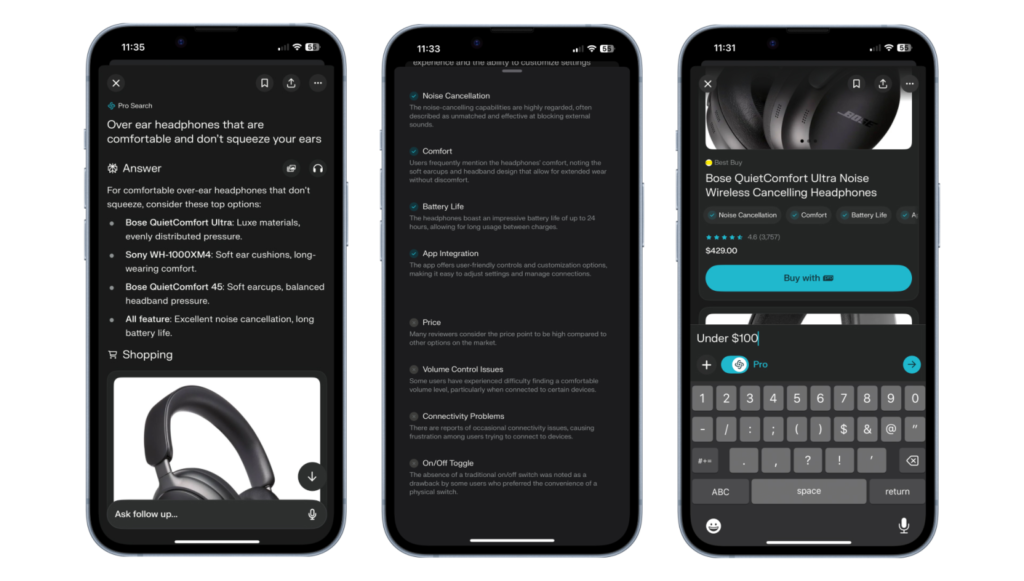
Source: Perplexity
Commerce media sits directly in that path. When an agent recommends a product, it interacts with the same retailer ecosystem that commerce media relies on. Over time, this creates a link between agent-driven shopping and agent-driven advertising.
3. Agentic AI is already changing programmatic advertising
Commerce media is, at its core, a digital advertising channel.
It relies on auctions, bidding, targeting, creative delivery, and attribution – the same mechanics that underpin programmatic advertising.
Agentic AI is already being applied to these systems.
The Trade Desk’s Kokai platform automates planning and optimisation, while Google’s Performance Max reduces manual campaign management across multiple channels.

How agentic AI works in programmatic advertising.
Source: Spyrosoft AdTech
Commerce media doesn’t require a new model. It’s the next logical environment for capabilities that are already proving effective elsewhere.
Why does commerce media work so well for agentic AI?
1. Structured data makes commerce media suited to agentic AI
Commerce media utilises a company’s rich product and service data, e.g. SKU IDs, pricing, inventory levels, margin data, and category structures. As this data is often already structured and machine-readable, AI agents can interpret and act on it directly.
AI agents can detect when inventory changes, when margins shift, or when demand patterns emerge, without requiring manual interpretation or input.
Compare this with brand advertising.
Optimising for sentiment or recall requires judgement. Optimising bids for products that just came back into stock does not. The decision is explicit and is based on real-time data.
According to Mirakl’s 2026 retail media report, AI systems rely on structured, comprehensive and accurate product attributes to surface relevant recommendations – meaning retailers with clean catalogues are already better positioned than those without.
One caveat: structured data is only useful if it’s accurate.
Stale inventory feeds, missing margin data, and inconsistent category taxonomy undermine everything downstream.
2. Commerce media has clearer outcomes than other channels
Most advertising relies on proxy metrics such as impressions, clicks, or video completions. These indicate attention, not outcomes.
Commerce media measures the outcome directly – i.e. whether a purchase occurred.
In agentic AI, agents optimise towards the signal they receive. If the signal is clicks, they will generate clicks. If the signal is purchases, they optimise for revenue.
In commerce media, the signal is already aligned with the business goal. That makes optimisation more meaningful.
Platforms like Amazon Ads and Walmart Connect treat purchase-based attribution as a standard feature rather than an add-on.
3. Agentic AI turns closed-loop measurement into continuous optimisation
Closed-loop measurement is not new. Retailers have long been able to connect ad exposure to purchases using first-party data.
What changes with agentic AI is how that feedback is used to optimise campaigns.
In most channels, impressions and purchases happen in different systems. The connection is inferred or determined using probabilistic data.
In commerce media, the retailer owns both the ad environment and the point-of-sale environment. This means it’s much easier to determine whether an ad impression led to a sale as the entire customer journey happens in the same system – hence the name “closed-loop”.
Agentic AI turns closed-loop attribution into real-time campaign optimisation by identifying performance patterns across SKUs, audiences and ad placements without manual reporting or intervention.
More importantly, the system acts on those signals in the same cycle. It automatically adjusts bids, sifts budgets, and pauses underperforming creatives.

The advantage isn’t the closed loop itself. It’s the ability to act on new data continuously at scale.
3. Commerce media is built on high-volume and repeatable decisions
Running commerce media campaigns involves constant decision-making: bids, budgets, targeting, creative selection, and campaign scheduling across thousands of SKUs and multiple channels.
Campaign setup alone can take weeks in large retail environments, which is incompatible with real-time pricing, demand shifts, or stock changes.
Agentic AI becomes more valuable as decision volume increases. The more moving parts there are, the stronger the case for automation.
For mid-sized retailers managing tens of thousands of SKUs, the impact can be even greater than for large organisations with dedicated teams.
What are the practical benefits of agentic AI in commerce media?
Each structural property translates into a practical benefit:
- Faster campaign execution: Campaigns move from weeks to hours because planning, creative generation, and setup follow repeatable patterns. Early deployments report an 80% reduction in creative production time.
- More precise targeting: Because optimisation is based on real purchase data rather than proxy metrics, agents identify and prioritise high-intent audiences more reliably than in most other channels. As more shopping journeys involve AI, audience discovery becomes more complex than manual workflows can handle.
- Real-time budget and bid optimisation: Because performance data is continuous and tied directly to outcomes, agents can reallocate spend mid-campaign in response to stock changes, demand shifts, or competitor activity.
- Personalisation at scale: Structured product data enables agents to match creatives, messaging, and bids to individual SKUs across large catalogues – something manual teams cannot sustain.
These benefits are real, but they depend on data quality, governance, and operational readiness.
For a deeper look, explore the limitations and challenges of agentic AI in commerce media.
FAQ
Commerce media has four structural properties that make it a strong fit for agentic AI:
1. Structured, machine-readable product data
2. Outcomes measured as actual sales rather than proxies
3. Closed-loop measurement and attribution that translates into real-time optimisation
4. High volumes of repeatable decisions at the SKU level that scale beyond what human teams can manage manually.
Closed-loop measurement and attribution means a retailer can connect an ad impression directly to a purchase using their own first-party data, within their own ecosystem.
Because the retailer owns both the advertising environment and the point of sale environment, the connection is directly rather than inferred via probabilistic data.
The main practical benefits are faster campaign launches, more precise audience targeting, real-time budget and bid optimisation, and personalisation at scale across large product catalogues.
Each benefit is directly enabled by a structural property of commerce media: structured data, purchase-based outcomes, closed-loop measurement and attribution, and high-volume, repeatable workflows.
Yes. The four structural properties apply regardless of retailer size.
The main readiness requirement is clean, consistently structured first-party data. The constraint isn’t size; it’s whether your data and operations are ready to support autonomous decision-making.
Mid-sized retailers with large product catalogues often have a stronger case for automation than large ones, because they have fewer people to absorb the manual work.
About the author
Get more articles like this sent to your inbox
If you want to learn more about the world of AdTech and AI, then fill in the form and we’ll send you our latest articles, videos, and industry reports.