AI in Media Planning [2026]
Artificial intelligence is transforming the advertising industry, with media planning emerging as one of the functions poised to benefit the most.
From audience research and media-plan creation to campaign setup, reporting, and optimisation, AI is creating new opportunities to automate manual tasks, improve decision-making, and enhance campaign performance.
This report explores the role AI is playing in media planning today, the technologies and tools shaping the market, the challenges and opportunities facing advertisers and agencies, and what the future of media planning may look like in an increasingly AI-powered world.
What is media planning?
Media planning is the process of determining how, when, and where advertising budgets should be spent to reach a target audience and achieve specific business objectives.
The media-planning process

BRIEF & STRATEGY
The process typically begins with a campaign brief and strategy.
The brief and strategy outline the advertiser’s:
- Goals
- Target audience and market segments
- Budget and bidding strategy (e.g. CPM or CPC)
- Flight dates and pacing
- KPIs
MEDIA PLANNING
Then, a media plan is created.
The media plan recommends the following:
- How the advertising budget should be allocated across different channels, e.g. display, search, social, CTV, DOOH, etc.
- The targeting strategies, e.g. audience, geographic, contextual, etc.
- The campaign’s projected reach and frequency.
- The expected performance outcomes.

CAMPAIGN SETUP & TRAFFICKING
Once the media plan is approved, the next step is to set up and execute the campaigns in the various advertising technology platforms.
This phase involves:
- Selecting the audiences to target
- Setting the budget and bidding strategies
- Configuring the targeting criteria
CREATIVE & ASSETS
Once the media plan has been approved, the next stage is to create and prepare the assets that will be used throughout the campaign.
Depending on the channels selected in the media plan, this may involve:
- Designing and creating the ads for the specific channels – e.g. display banners for websites, image ads for social media, video ads for TV, and static and digital ads for out-of-home (OOH).
- Developing and publishing landing pages and supporting marketing materials.
- Undergoing a review process to ensure the ads meet brand, legal, regulatory, and platform-specific requirements.
Once the creative assets have been created, it’s then time to launch the campaigns.

REPORTING & MEASUREMENT
The reporting and measurement phase focuses on collecting and analysing the campaign performance data to determine whether it is delivering the desired outcomes and objectives.
This process typically involves:
- Gathering data from multiple advertising platforms, analytics tools, ad servers, and measurement providers.
- Organising and presenting the data in an easy-to-understand report.
- Analysing the key metrics, such as impressions, reach, clicks, conversions, engagement, return on ad spend (ROAS), cost per acquisition (CPA), and other performance indicators relevant to the campaign’s objectives.

REAL-TIME OPTIMISATION
Once the campaign has been launched and the performance data has been analysed, it’s then time to make changes to optimise the performance and get closer to achieving the campaigns’ goals and objectives.
Today, most advertising platforms provide real-time optimisation, allowing companies to automate this process.
The real-time optimisation phase involves:
- Analysing campaign performance data across different platforms and channels.
- Making changes to budgets, bids, audiences, targeting criteria, creative assets, and channel allocations based on how the campaigns are performing.
- Identifying opportunities to improve performance while reducing wasted ad spend and ensuring campaign objectives are achieved.
The data layer: The role of data in AI-powered media planning
While AI is often the focus of discussions about the future of media planning, data remains the foundation upon which every AI system is built.

Regardless of how advanced an AI model may be, its effectiveness is ultimately determined by the quality, completeness, and accessibility of the data it can access.
Throughout the media-planning lifecycle, companies generate and collect vast amounts of information from a variety of sources.
This includes:
- First-party customer data
- Campaign performance data
- Audience insights
- Website and app analytics
- Creative metadata
- Tracking events
- Measurement data
- Information from advertising platforms
Together, these various pieces of data form the data layer that supports planning, activation, measurement, and optimisation activities.
The data layer typically consists of three core functions:
- Storage
- Analysis
- Activation
For AI-powered media planning solutions, the data layer acts as both a source of knowledge and a feedback mechanism.
Historical campaign data can help AI systems identify patterns and generate insights and trends, while real-time performance data enables them to continuously learn and adapt.

As campaigns run, new data is collected and fed back into the system, creating a cycle of ongoing improvement and optimisation.
The use cases of AI in media planning
Although the digital and programmatic advertising industries have become increasingly data-driven over the past two decades, many parts of the process still rely on spreadsheets, emails, manual data entry, and disconnected systems.
This results in media planners spending a significant amount of time gathering information and data from different sources, building reports, entering campaign details in different platforms, and coordinating with internal teams and external partners.
It’s these challenges, combined with the rise and evolution of AI, that have seen a sharp increase in the interest in AI-powered media planning tools and solutions.

Results from Google Trends highlights the recent interest in AI media planning.
The power of AI in media planning is evident in the following processes:
| Process | AI type |
| Understanding and making sense of information from various sources | GenAI |
| Converting disparate pieces of information and data into structured media plans | GenAI |
| Extracting insights and identifying trends in large data sets collected from different sources | GenAI |
| Executing campaigns in different advertising platforms | Agentic AI |
| Collecting and reporting on the performance of campaigns from multiple systems | Agentic AI |
| Optimising the performance of campaigns with limited human involvement | Agentic AI |
Key results of AI in media planning
AI has the ability to improve every stage of the media-planning process, from audience research and budget allocation to campaign setup and performance analysis.
Even though the technology and its applications are still evolving, companies that successfully identify the areas of their business that can be improved via AI can expect to see improvements in:
- Productivity – doing more with the same or less amount of resources.
- Efficiency – getting the most bang for your advertising dollars.
- Decision-making – making faster and more informed decisions.
- Campaign performance – improving campaign outcomes that better achieve goals and objectives.
During internal testing of our AI Media Planner solution, Spyrosoft AdTech noticed a significant and tangible improvement across many areas of the media-planning process:

The landscape of AI media-planning tools
Over the past few months, many AdTech companies and advertising agencies have released their own AI media-planning tools.

Some focus on specific advertising channels such as search, social media, or programmatic advertising, while others provide broader functionality across multiple channels.
Although the market is evolving rapidly, the vast majority of these solutions are designed as out-of-the-box products intended to meet the needs of a broad customer base.
While this approach allows organisations to deploy AI capabilities quickly, it also means these tools provide:
- Ridged workflows
- Predefined features
- Fixed integrations
For companies, such as AdTech companies and agencies, with highly specialised workflows, proprietary planning methodologies, unique data assets, or complex integration requirements, an off-the-shelf solution doesn’t provide the level of flexibility or customisation required to meet their needs and goals.
As AI becomes more deeply embedded within media-planning operations, companies are increasingly faced with an important strategic decision:
Should we adopt an existing AI media-planning platform, or invest in building a solution tailored to our own business?
Should companies rent or build an AI media-planning tool?
The decision to rent (i.e. use an existing solution) or build (i.e. develop a custom solution) an AI media-planning tool, or any piece of software for that matter, is one that a lot of companies face.
The answer ultimately depends on a company’s objectives, resources, and long-term strategy.
Typically, out-of-the-box solutions are used by the end users of the software, such as brands and advertisers.
For companies whose business is developing technology for others to use, such as AdTech companies, data providers, and agencies, a custom solution often delivers greater value.
Building a custom AI media-planning solution can provide these companies with the flexibility, control, and ownership needed to create a product that supports both their business objectives and those of their customers.
Pros of renting an AI media-planning solution
- Instant, or near-instant, access to a ready-to-use tool.
- No need to maintain the technology.
Best suited for
- The end users of the software – e.g. brands and advertisers that just require access to the tool to create and activate media plans.
Pros of building an AI media-planning solution
- Full control over the solution’s features, integrations, models, and algorithms.
- Ownership of intellectual property (IP).
- Protection of business-sensitive data, workflows, etc.
- Better integration into existing systems and tools.
- The ability to license the software to clients.
Best suited for:
- Advertising technology and data companies.
- Advertising agencies.
Challenges & opportunities facing AI media-planning tools
Although much progress and advancements have been made, AI in media planning is still in its infancy.
Main challenges
Accuracy and hallucinations
Large-language models (LLMs) can occasionally produce incorrect, misleading, or entirely fabricated information.
Integration issues
To orchestrate agentic media planning and buying, AI tools need to connect with multiple systems. Setting up and maintaining these connections can be complex.
A lack of transparency
Ready-to-use tools provide little to no transparency into how their models or tech work, leading many companies to question the accuracy of the recommendations and insights, as well as the validity of the reported performance and efficiency results.
Data security
Using an existing AI-powered media planning tool means handing over your valuable customer and business data to an AI model that you have no control over.
These models can learn from your data and weaken your competitive advantage and expose your business to compliance risks. This can be mitigated by building your own LLMs, which will limit exposure to external systems.
Main opportunities
Automating repetitive tasks
One of the biggest opportunities is reducing the amount of time spent on manual and repetitive work.
AI can automate various processes like extracting information from campaign briefs, configuring campaigns, and creating reports. This results in improved productivity, efficiency, and quality of outcomes.
Faster campaign creation
Many companies still rely on spreadsheets, emails, and manual data entry when creating campaigns.
AI-powered planning tools can help users move from a campaign brief to an approved media plan and campaign configuration much faster, allowing them to reduce the time between campaign ideation and activation.
Better use of historical campaign data
Most advertisers and agencies possess years of campaign data that remains difficult to access and analyse. AI can identify patterns across historical campaigns and uncover insights that haven’t been seen before.
Improved media plan recommendations
AI can analyse multiple variables simultaneously, e.g. campaign objectives, budget constraints, and channel performance, and create better performing media plans.
More accurate forecasting
Forecasting the performance of a is often based on historical benchmarks. AI models can incorporate significantly more data points and variables than traditional forecasting approaches, leading to better forecasting of key metrics.
What’s next for AI in media planning?
The use of AI in media planning is very much in its infancy.
However, the foundations are set and we are already witnessing the capabilities from generative AI and agentic workflows.
But in addition to the technological advancements, the future of AI also requires making strategic business decisions, such as how to properly utilise AI for growth while maintaining control and ownership of proprietary tech and data.
An increased use of conversational AI in media planning
One of the most significant changes likely to occur in media planning is the shift towards conversational interfaces powered by artificial intelligence.

For example, media planners may be able to type prompts and ask questions such as:
- “Create a media plan for a $500,000 native ad campaign targeting people interested in travelling.”
- “Which audiences delivered the highest return on ad spend last quarter?”
- “Show me the best-performing video creatives from the past six months”.
AI systems will then analyse the available data and create media plans, provide recommendations, forecast and predict outcomes, and offer actionable insights in real time.
Better agentic workflows and more autonomous decision-making
Despite all the advancements in agentic AI workflows, we’re not living in a fully agentic world just yet.
Challenges, obstacles, and limitations still exist, including:
- Fragmented data
- The reliability of AI models
- Governance
- Technical standards.
But the potential is there. And with time, these issues will be resolved.
Although human oversight will remain essential, particularly for strategy, governance, and budget approvals, AI agents are expected to take on a growing share of operational responsibilities.
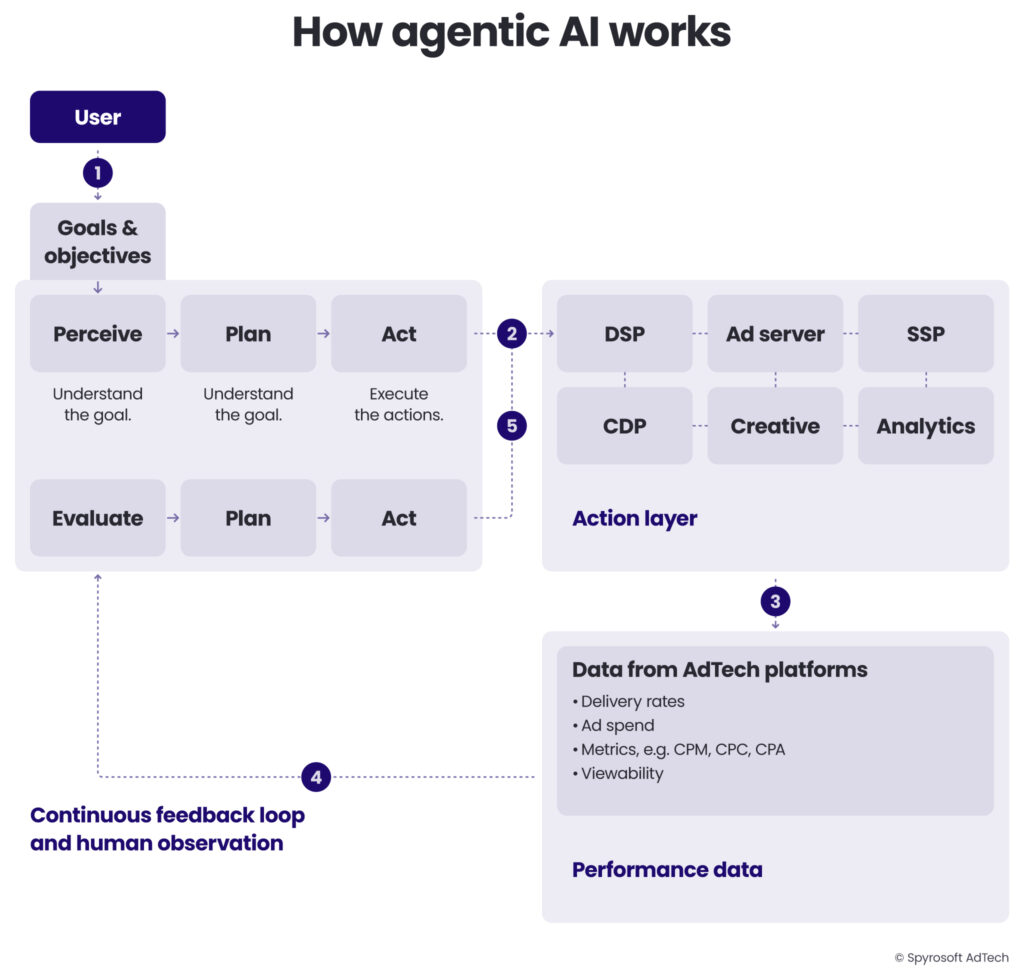
This will enable media planners to spend less time managing processes and more time focusing on business objectives, audience analysis, insights, and campaign strategy.
Media plans will become living documents
Historically, media plans have been static documents created before a new campaign launches.
As AI gains access to real-time performance data, media plans will likely become dynamic and continuously updated based on changing market conditions, audience behaviour, insights, and campaign performance.
This will not only reduce the need to create a new media plan for each campaign, but it’ll also result in better performing campaigns.
Proprietary data will become a competitive advantage
As AI capabilities become widely available, competitive differentiation will increasingly come from the quality of the data used to train and inform AI systems.
Companies with strong first-party data assets, historical campaign data, and robust measurement frameworks will gain an advantage over those relying solely on generic AI tools.
This will also lead companies to adopt proprietary tools and software to ensure their data isn’t used to train publicly available AI models, which would therefore heavily reduce the competitiveness of their data.
AI MEDIA PLANNER
Looking to add AI capabilities to your media-planning processes?
Our AI Media Planner is an agentic AI solution that helps you plan, execute and improve ad campaigns through a simple conversational interface, while automating repetitive tasks.
It is a customisable and extensible platform that can incorporate your own workflows and proprietary data, while also integrating into your existing technology.