Agentic AI in Commerce Media: What’s Happening?

Overnight, an AI agent detected that a competitor’s bestselling product was out of stock. Within minutes, it increased bids on your equivalent SKU, shifted ad budget, and updated the ad copy to highlight availability. By the time your team arrives to work in the morning, the campaign has already been selling the product for hours.
This scenario isn’t science fiction.
And depending on which retailer you ask, it’s either already running or a few months away.
That’s what agentic AI is starting to do in commerce media, but it’s worth understanding what it actually means before the claims outrun reality.
What is agentic AI?
Most AI tools people use every day respond to requests. You ask a tool like ChatGPT or Claude a question and it answers. A recommendation engine notices what you’ve browsed and suggests similar products. These are useful tools, but they’re also reactive – they wait for input before doing anything.
Agentic AI works differently.
At its core, agentic AI is designed to achieve goals and objectives and automate how decisions are made. Once a goal has been set, it plans a sequence of steps and acts across systems, adapting as it goes, without waiting for a human to direct each move.
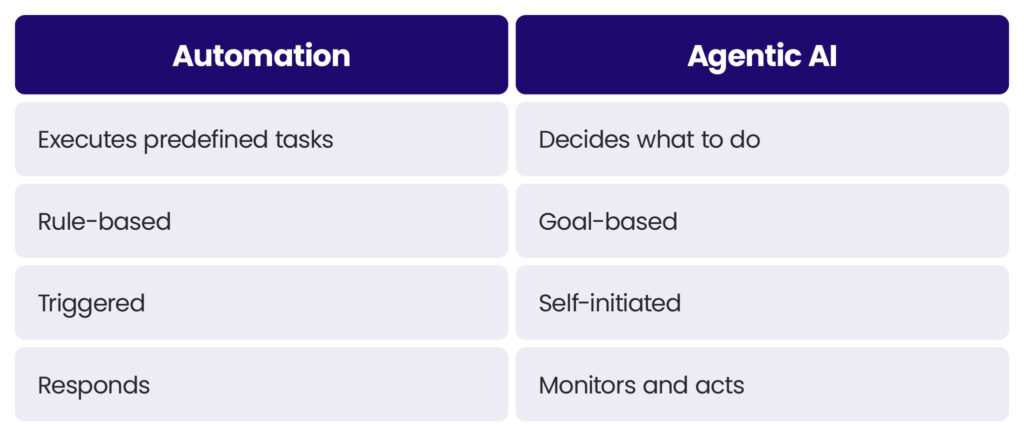
The shift is from automation – doing the same task faster – to autonomy – deciding what to do.
That’s not a subtle distinction.
Automation runs the same playbook every time. An autonomous system reads the situation and chooses a playbook.
In a commerce media context, this matters enormously.
An agent that detects a stock change, revises a bid strategy, and updates a creative in response is doing something different from a rule-based script.
These systems aren’t new in other industries. They’re already operating in logistics, financial trading, and scheduling. Commerce media is the next environment they’re entering.
For a fuller and a slightly more technical explanation, see our article on agentic AI in AdTech..
What is commerce media?
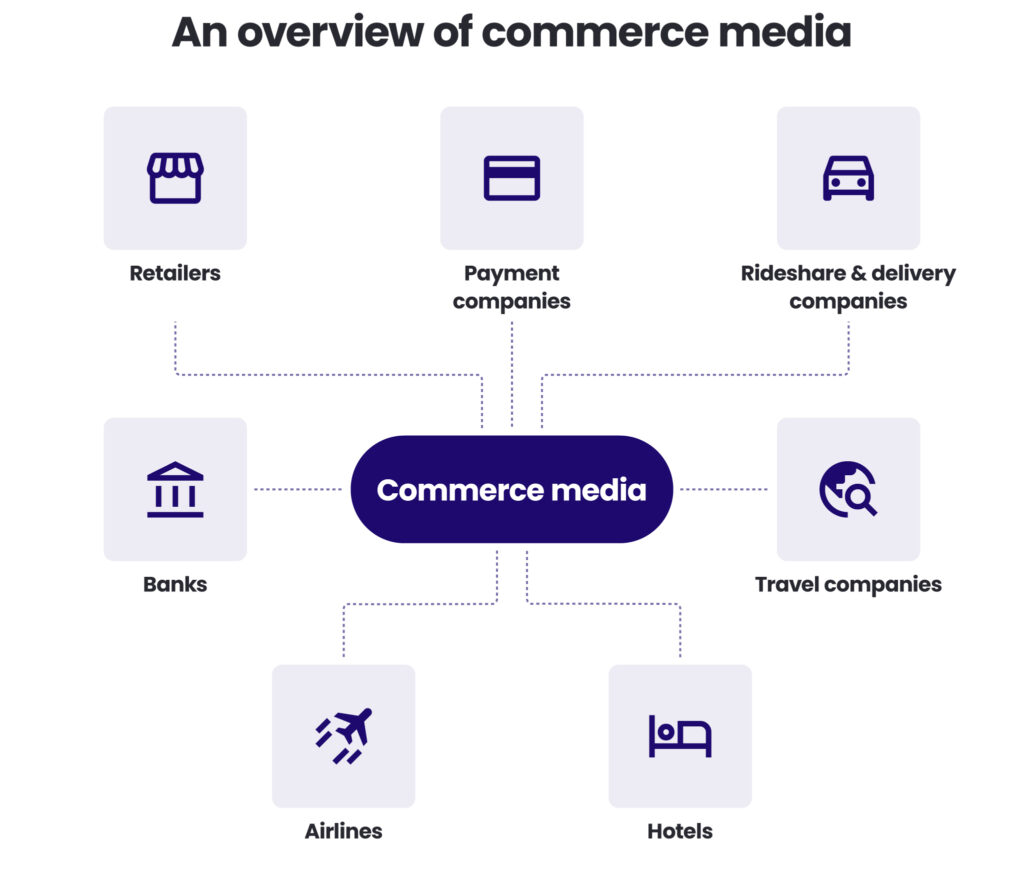
Commerce media refers to advertising powered by transactional and commerce data: real purchase signals, behavioural history, and first-party customer data generated when people buy things both online and offline.
It is an umbrella term for advertising carried out by retailers, rideshare and delivery apps, and even airlines, travel companies, and banks.
The most established form of commerce media is retail media.
This is advertising within a retailer’s own environment – website, app, and in-store screens.
However, it can also refer to advertising outside of a retailer’s own environment. This example is known as off-site advertising, and it uses a retailer’s first-party customer data to power ad targeting in other digital channels, such as DOOH and CTV.
Amazon, Walmart, Tesco, and Carrefour have built the largest retail media networks, while many smaller retailers are now developing their own. Retail media ad revenue alone is forecast to exceed $176 billion globally by 2028, according to Mirakl and Forrester.
Commerce media extends beyond retailers. Any business operating at the point of transaction and holding first-party purchase data can build a media offering:
- Payment companies: PayPal launched its ads platform in 2024, using data from millions of transactions.
- Travel and hospitality: United Airlines, Marriott, and Expedia operate commerce media networks, targeting travellers based on booking and spend behaviour.
- Delivery platforms: Uber and similar services sell advertising based on order and browsing data.
Commerce media platforms can also combine transactional data with signals from multiple sources, including retailers, publishers, and other transaction points, to build a more complete view of customer behaviour across the buying journey.
How is agentic AI coming to commerce?
Two shifts are happening in parallel, and it helps to separate them.
On the consumer side, AI agents are handling shopping tasks on behalf of buyers: comparing prices, checking availability, placing orders.
Walmart’s Sparky and ChatGPT‘s shopping features are live examples. This is commonly called agentic commerce.
On the advertising side – i.e. commerce media – AI agents are handling campaign tasks on behalf of brands and retailers: adjusting bids, shifting budgets, adapting creative to reflect real-time stock availability. That’s the focus of this series.
Replenishment purchases vs discretionary purchases
One nuance worth noting is that the consumer-side shift doesn’t apply equally across all categories.
For replenishment purchases, detergent, pet food, batteries, removing friction is genuinely useful. People treat these as errands.
For discretionary categories, clothing, furniture, gifts, the browsing and choosing is often part of the experience itself.
Delegating that to an agent removes value rather than friction. This distinction shapes where agentic AI in advertising performs best, and you will see it in our next article about use cases.
The two tracks are connected, though.
When AI agents begin mediating consumer purchase decisions, the rules for reaching those customers change on the advertising side too.
Walmart Connect’s Marty already hints at the scale of complexity. According to Walmart Connect, 97% of queries submitted to Marty are unique. There’s no standard playbook for that range of decisions. That’s exactly where agents start to make sense.
Frequently asked questions
What is the difference between agentic AI and regular AI?
Regular AI responds to prompts or executes predefined rules. Agentic AI sets goals, plans a sequence of actions, and executes them on its own, adapting as it goes, without waiting for a human to direct each step.
What is commerce media?
Commerce media refers to advertising powered by transactional and commerce data: real purchase signals, behavioural history, and first-party customer data generated when people buy things both online and offline. It is an umbrella term for advertising carried out by retailers, rideshare and delivery apps, and even airlines, travel companies, and banks.
What is agentic commerce?
Agentic commerce refers to AI agents that handle shopping tasks on behalf of consumers: comparing prices, checking stock, placing orders. It’s related to agentic AI in commerce media, but the focus is different. Agentic commerce is about the consumer shopping journey; agentic AI in commerce media is about advertising automation.
Is agentic AI in commerce media happening now?
Yes, partially. Tools like Walmart Connect’s Marty and Amazon’s automated campaign tools are live. Fully autonomous campaign management, where agents operate without human approval, is still emerging. Most current implementations involve human oversight.
About the author
Get more articles like this sent to your inbox
If you want to learn more about the world of AdTech and AI, then fill in the form and we’ll send you our latest articles, videos, and industry reports.