Chapter 10: How to Create a Digital Advertising Campaign
There’s more to digital advertising campaigns than just displaying ads on a website, search engine or during TV shows. There are structured processes that connect business objectives with audiences, platforms, and measurable outcomes.
In this chapter we outline the key phases involved in planning, executing, and optimising campaigns across different advertising channels.
Phase 01: Media planning
Media planning is the foundation of any digital advertising campaign.
It translates business objectives into a structured plan that defines who you want to reach, where you will reach them, how much you will spend, and how success will be measured.
The process begins with goal and objective setting, where the campaign’s purpose is clearly defined.
Although similar, there is a slight difference between the goals and objectives of an advertising campaign.
Goals are connected to the overall strategic business outcomes, such as increasing revenue and building brand awareness. The objectives are more about the targets that will help a company achieve its goals. Examples include driving sales, generating leads, and increasing website traffic.

An example of campaign objective selection in an advertising platform.
Source: Google Ads.
From these objectives, you establish KPIs (e.g. CPA, ROAS, CTR, reach) and a measurement framework that determines how performance will be tracked and evaluated across platforms.
Next, the focus shifts to audience creation and segmentation.
This involves identifying the types of people or companies you want to target using first-party data, contextual signals, and behavioural insights, and grouping them into meaningful segments (e.g. prospecting vs retargeting). A well-defined audience strategy ensures that budget is directed toward users most likely to deliver the desired outcome.
With the audience defined, you then develop the media mix and channel strategy, which involves deciding how the budget will be allocated across channels such as search (e.g. Google Ads), social platforms like Facebook, and programmatic environments via DSPs. This includes selecting the most appropriate ad platforms based on campaign goals, audience availability, and inventory types (e.g. display, video, CTV).
Next, you determine budgeting and pricing models, aligning spend with expected outcomes. This may involve CPC (cost-per-click), CPM (cost-per-thousand impressions), CPA (cost-per-acquisition), or ROAS-driven approaches, depending on the channel and objective. Budget allocation should also reflect funnel stages, ensuring a balance between awareness, consideration, and conversion activity.

An example of setting the bidding strategy in an advertising platform.
Source: Google Ads.
Finally, the plan is formalised through flight dates and pacing, which define when the campaign will run and how the budget will be distributed over time. This ensures consistent delivery, avoids overspending early in the campaign, and aligns activity with key business moments (e.g. product launches and seasonal demand).
At the end of Phase 01, you have a clear, data-informed blueprint that guides campaign execution and provides a benchmark for performance evaluation.
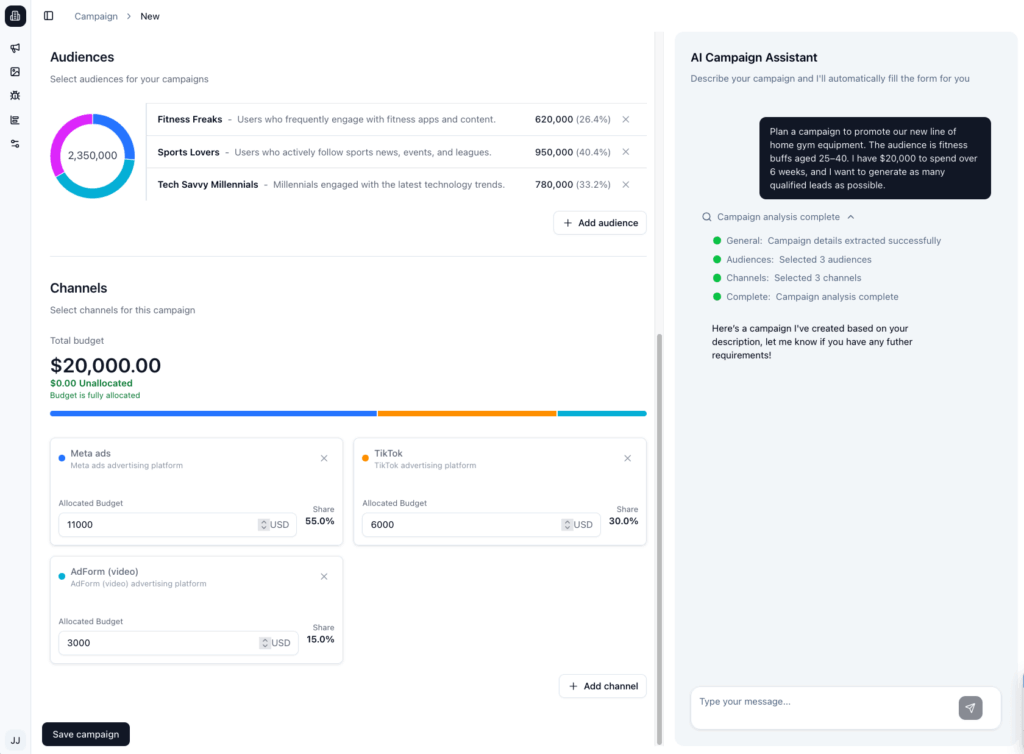
An example of how a media plan is created.
Source: The AI Media Planner by Spyrosoft AdTech
Phase 02: Creative asset production
Creative asset production is where the campaign strategy is translated into the actual ads that users will see. It connects the “who” and “where” defined in media planning with the “what” and “why” that drive engagement and action.
The first step is selecting the appropriate ad formats based on the chosen channels and campaign objectives.
Different environments require different formats. For example, text-based ads in search platforms like Google Ads capture user intent, while display banners are suited to awareness and retargeting across the open web, and video formats are commonly used in social feeds, online video, and connected TV (CTV).

An example of the different types of campaigns and their respective ad formats.
Source: Google Ads.
Each format comes with its own specifications, constraints, and user expectations, which must be considered upfront.
Once formats are defined, the focus shifts to developing the creative assets themselves.
This includes writing ad copy, designing visuals, and producing video content tailored to each platform and audience segment.
Effective creative aligns closely with the campaign objective and audience intent. For example, clear value propositions and strong calls-to-action for performance campaigns, or more narrative-driven messaging for awareness campaigns.
In most cases, multiple variations of each asset are created to support testing and optimisation.
This may involve different headlines, visuals, messaging angles, or calls-to-action, allowing advertisers to identify which combinations drive the best results once the campaign is live.
By the end of this phase, all creative assets are finalised, formatted to platform specifications, and ready to be deployed across the selected advertising channels.
Phase 03: Platform setup and campaign configuration
This phase translates the media plan into live campaign configurations within the selected advertising platforms and links up with the creative assets.
It involves taking the strategic decisions made during media planning, such as audience targeting, budget allocation, and channel mix, and implementing them directly in advertising tools like Google Ads and Facebook Ads, and programmatic advertising platforms like The Trade Desk and Google’s Display & Video 360 (DV360).
The process starts with inputting campaign details into each platform, including campaign objectives, audience targeting, geographic settings, creatives, and flight dates.
In programmatic environments, this also involves setting up insertion orders (IOs), which act as the primary budgeting and organisational layer, containing multiple line items that define specific targeting and buying strategies.
A key decision at this stage is how to buy the ad inventory.
Advertisers can choose between different buying methods depending on their goals and desired level of control.
These include:
- Direct buys, where inventory is purchased directly from publishers at fixed prices.
- Real-time bidding (RTB), where impressions are bought individually via open-market auctions.
- Private marketplace (PMP) deals, which is an invitation-only version of RTB, providing advertisers with access to premium inventory.
The next step is selecting the bidding and pricing strategy, which determines how the campaign competes in auctions.
This could include models such as max CPC (cost-per-click), CPM (cost-per-thousand impressions), or automated bidding strategies that optimise toward specific outcomes like conversions or return on ad spend. The chosen approach should align closely with the campaign’s KPIs and objective.
Finally, budget and pacing settings are configured to control how spend is distributed over time.
This includes setting overall campaign budgets, daily budgets, and pacing strategies such as even delivery or accelerated (“ASAP”) delivery. Proper pacing ensures that campaigns do not overspend too quickly or underdeliver against their targets.
By the end of this phase, all campaign elements are fully configured within the platforms, aligned with the media plan, and ready for activation.
Phase 04: Measurement, attribution, and optimisation
This phase ensures that campaign performance is accurately tracked, properly attributed, and continuously improved.
It closes the loop between execution and outcomes, enabling advertisers to understand what is working, what is not, and where to adjust.
The first step is setting up tracking and conversion pixels across websites, apps, or landing pages.
These pixels capture user actions like clicks, sign-ups, purchases, or other key events, and send that data back to the advertising platforms. Accurate tracking is essential, as it underpins both reporting and automated optimisation.
Next is setting up integrations with analytics tools, such as web analytics platforms, to provide a more complete view of user behaviour beyond ad interactions. This allows advertisers to analyse on-site activity (e.g. bounce rate, session duration, conversion paths) and connect media performance with broader business outcomes.
To support cross-channel visibility, UTM parameters are often added to campaign URLs. These tags enable consistent traffic attribution across platforms, ensuring that visits and conversions can be traced back to specific campaigns, channels, and creatives within analytics tools.
A critical decision in this phase is selecting the appropriate attribution model, which determines how credit for conversions is assigned across touchpoints. Common models include last-click, first-click, linear, and data-driven attribution. The chosen model influences how performance is interpreted and how budget and optimisation decisions are made.
With measurement in place, the focus shifts to ongoing performance analysis and optimisation.
Campaign reports are reviewed regularly to assess delivery, engagement, and conversion metrics against the defined KPIs.
Based on these insights, advertisers make adjustments such as:
- Refining bidding strategies (e.g. adjusting max CPC or shifting to automated bidding)
- Updating or rotating creatives to combat fatigue and improve engagement
- Narrowing or expanding audience segments
- Adjusting frequency capping to balance reach and repetition
- Reallocating budget across channels, campaigns, or platforms
In programmatic environments, this may also include optimising supply paths, prioritising higher-quality inventory, and filtering out low-performing placements.
By the end of this phase, campaigns are not only measured but actively improved, ensuring that performance increases over time and that insights feed into future media planning and execution.
Download the PDF & join our waiting list
Fill in the form to download the PDF version and get notified when the next chapters are released.