Agentic AI in AdTech: AdCP and the IAB’s Agentic RTB Framework (ARTF)

Agentic AI in AdTech is moving from concept to early implementation. As these systems develop, one key question arises: how can these different agentic systems actually buy and sell digital media?
The answer: via industry standards.
Two early frameworks are now emerging to fill that gap:
These agentic AI standards take different approaches to the same goal, and understanding both AdCP and the Agentic RTB Framework helps you see where the industry is heading.
Agentic AI in AdTech
Read the other articles in our series:
Agentic AI in AdTech: What Is It and How Does It Work?
Agentic AI in AdTech: What It Changes in Programmatic Advertising
Agentic AI in AdTech: 7 Use Cases
Agentic AI in AdTech: Understanding the Role of Model Context Protocol (MCP)
Agentic AI in AdTech: AdCP and the IAB’s Agentic RTB Framework (ARTF)
What is AdCP and how does it work?
AdCP is an open standard launched in October 2025 by a consortium including Scope3, Yahoo, Optable, PubMatic, and Triton Digital.
AdCP is designed to work alongside standards like Anthropic’s Model Context Protocol (MCP) and agent-to-agent (A2A) communication frameworks, giving agentic AI systems a common language for advertising transactions.
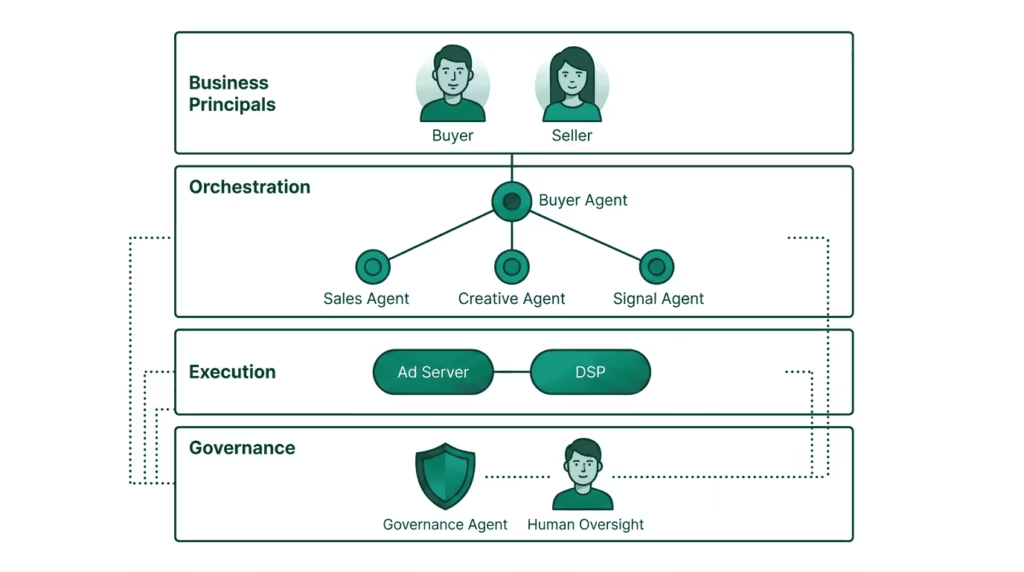
The AdCP ecosystem layers.
Source: adcontextprotocol.org
To power the buying and selling of digital media, AdCP contains various protocols, including:
- Media buy
- Creative
- Governance
- Sponsored intelligence
- Brand
- Signals
What makes AdCP distinctive is its asynchronous design.
Unlike real-time bidding (RTB) where decisions happen in milliseconds, AdCP supports workflows that do not need to happen in milliseconds, allowing for more complex negotiation and optional human approval. This accommodates human-in-the-loop approvals while agents negotiate complex deal terms.
In practice, an advertiser might prompt their agent with something like “find women interested in rock climbing in the UK.” That request travels to publisher and platform agents, which respond with inventory packages and audiences that fit.
The Ad Context Protocol is published by AgenticAdvertising.org (AAO) and released under an MIT licence.
What is the IAB’s Agentic RTB Framework and how does it work?
The IAB Tech Lab’s Agentic RTB Framework (ARTF) takes a different approach.
Released for public comment in late 2025, this agentic RTB standard enhances real-time bidding by moving execution into containerised environments.
Here’s the key innovation: instead of bid requests travelling between separate cloud services, ARTF deploys bidding logic inside portable software containers that run in the same data centre as the auction itself.
These containers communicate through gRPC protocols rather than traditional HTTP calls.
The performance gains are significant.
Transactions that typically take 400 to 600 milliseconds can shrink to fractions of that time.
This freed capacity allows for real-time enrichment and fraud analysis that wasn’t previously possible within auction windows.
ARTF also changes the economics of AdTech:
- Lower costs by avoiding cloud egress fees and reducing network connections
- Advertiser control through embedded bidding logic that executes exactly as specified
- Publisher enhancement by adding contextual data and fraud detection before bid requests leave their systems
- Security via cryptographic signing and container permissioning
The framework was developed collaboratively by Index Exchange, Amazon Ads, Yahoo DSP, Netflix, Paramount, WPP, and others.
How do AdCP and the IAB’s Agentic RTB framework differ from existing programmatic advertising processes?
Both standards complement rather than replace existing infrastructure. That’s worth emphasising, because the relationship between these frameworks often gets misunderstood.
Where OpenRTB handles sub-100-millisecond impression auctions, AdCP focuses on agent-to-agent negotiation at a higher level. It doesn’t dictate the buying method. You can use it with programmatic, direct, or IO-based transactions. Think of it as a negotiation layer that sits above the execution layer.
ARTF enhances RTB rather than replacing it. The containerised approach keeps the familiar auction mechanics but dramatically improves performance by co-locating the participants. It’s still real-time bidding, just executed more efficiently.
The practical distinction: AdCP handles the “what should we buy and why” conversations between agents, while ARTF optimises the “how do we execute this transaction quickly” mechanics.
Neither framework requires you to abandon your existing tech stack. Both are designed for gradual adoption alongside current systems. This represents the industry building exactly the kind of orchestration layers and shared protocols we described as essential for agentic systems at scale.
What do AdCP and the IAB’s ARTF mean for AdTech?
These frameworks address what’s been missing from the agentic AI conversation: standardisation.
Without shared protocols like AdCP and the IAB’s Agentic RTB framework, every integration becomes a custom project. With them, agents from different vendors can communicate and transact.
For advertisers, this means direct access to inventory and audiences without navigating complex intermediary layers.
For publishers, it means simplified campaign execution with transparent deal parameters. These capabilities unlock practical use cases for agentic AI in AdTech that weren’t previously possible.
The timeline for this new agentic world in AdTech and programmatic advertising is accelerating.
AdCP plans to expand its scope throughout 2026, adding protocols for creative generation and performance attribution. The ARTF specification was available for public comment until January 15, 2026, with work on version 2.0 already underway.
For most organisations, the challenge now is deciding where agent-driven negotiation or execution would add value first, without disrupting what already works.
About the author
Get more articles like this sent to your inbox
If you want to learn more about the world of AdTech and AI, then fill in the form and we’ll send you our latest articles, videos, and industry reports.