Agentic AI in AdTech: Understanding the Role of Model Context Protocol (MCP)

The rise of agentic AI has brought with it some new terms to learn. One new term that you’ll see is model context protocol (MCP).
In previous articles, we’ve explained what agentic AI is and how it works, what changes it introduces to programmatic advertising, and 7 main uses cases of it.
In this article, we’ll cover what MCP is, how it works, and why it’s so important in powering agentic AI solutions in programmatic advertising.
Agentic AI in AdTech
Read the other articles in our series:
Agentic AI in AdTech: What Is It and How Does It Work?
Agentic AI in AdTech: What It Changes in Programmatic Advertising
Agentic AI in AdTech: 7 Use Cases
Agentic AI in AdTech: Understanding the Role of Model Context Protocol (MCP)
Agentic AI in AdTech: AdCP and the IAB’s Agentic RTB Framework (ARTF)
What is the Model Context Protocol (MCP)?
The Model Context Protocol is an open-source standard developed by Anthropic and released in November 2024. It solves a problem that’s been limiting AI adoption in digital advertising: every connection between agentic AI systems and external platforms requires custom integrations.
MCP standardises those connections.
How does MCP enable AI agents to connect to advertising platforms?
In today’s AdTech environment, connecting an AI system to a DSP, analytics tool, or CRM usually requires separate, custom integrations for each platform. Each system has its own interface, data structure, and rules.
MCP provides a common language that allows these AI systems and platforms to communicate with each other.
Instead of building a different connection for every platform, each platform exposes an MCP server. This server makes the platform’s data and capabilities available in a standard format.
Build one MCP server for your advertising platform, and any MCP-compatible agent can access it.
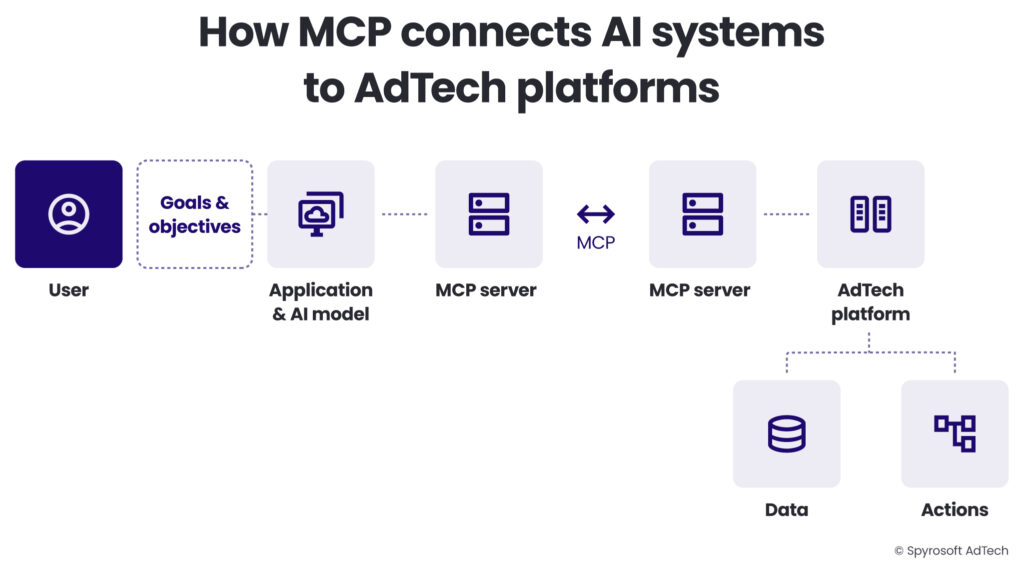
Here’s an overview of the process:
- The user, e.g. an advertiser, sets the campaign’s goals and objectives.
- The application, containing LLMs and agents, connects to an MCP server containing the campaign’s details, e.g. audience targeting, budget, flight dates, etc.
- The AdTech platform also connects to its MCP server and exposes its capabilities, e.g. what data and actions are available.
- The data and information between the MCP servers are transferred via the model context protocol and the actions.
Previously, connecting an AI agent to a DSP, a DMP, and an analytics platform meant building three separate integrations.
With MCP, you implement one server that exposes your platform’s capabilities. Any MCP-compatible agent can then access those capabilities through the standardised protocol.
The types of data, information, and capabilities that are typically exposed by the MCP servers include:
- Data: audience segments, campaign metrics, inventory availability
- Actions: create campaigns, adjust bids, generate creative variants
- Workflows: predefined sequences agents can execute autonomously
Is the programmatic advertising and AdTech industry adopting MCPs?
Adoption of MCPs has accelerated rapidly. Anthropic donated MCP to the Agentic AI Foundation (part of the Linux Foundation) in December 2025. Support came quickly from OpenAI, Google, Microsoft, and AWS.
By late 2025, the MCP SDK had reached 97 million monthly downloads, with over 10,000 active servers deployed.
For advertising specifically, early MCP-based integrations and experimental servers have begun to appear around major platforms such as Google Ads, Meta Ads, and LinkedIn.
However, it’s important to note that while these popular ad platforms haven’t released official MCP servers, many companies are building their own MCP and connecting to these ad platforms using their existing APIs.
Also, the IAB Tech Lab announced plans for a reference MCP server for advertising in 2026.
What is the role of MCP in agentic AI?
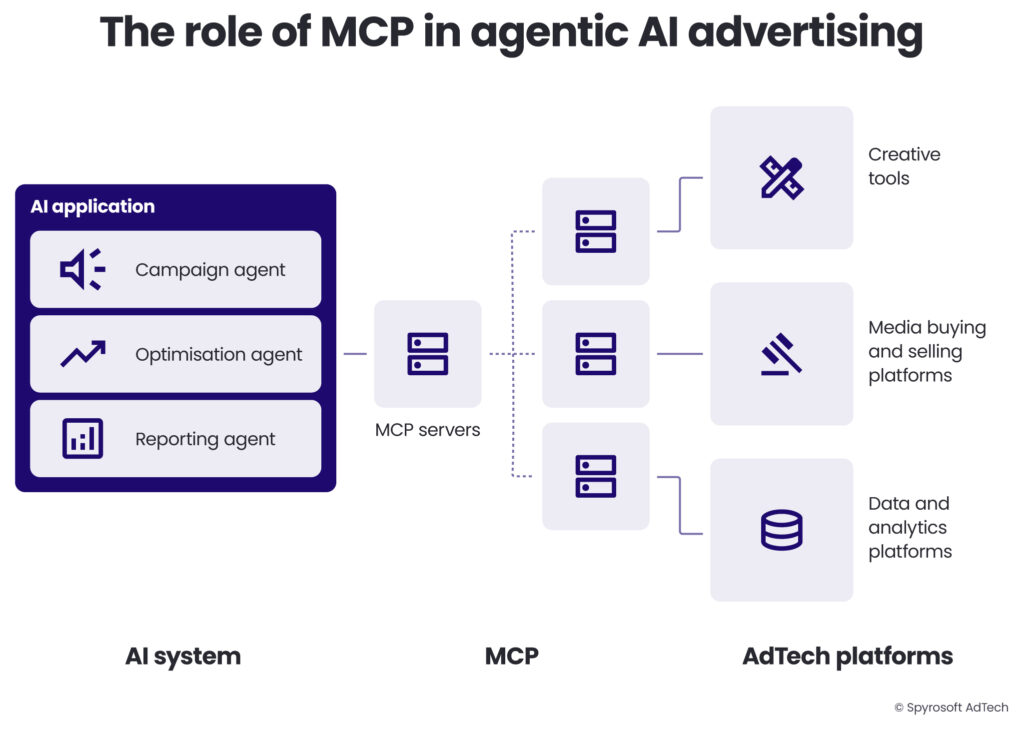
Beyond standardising connections, MCP defines what agents can actually do once they’re connected. It provides three essential capabilities.
01. Context access
Context access lets agents retrieve data from multiple sources simultaneously.
An agent optimising a campaign pulls audience insights from your CRM, performance data from analytics platforms, and inventory availability from ad exchanges, all through standardised MCP connections.
02. Tool execution
Tool execution enables agents to take actions, not just make recommendations.
Agents can launch campaigns, optimise bids, generate creative variants, and reallocate budgets by invoking tools exposed through MCP servers. The agent calls a tool through the protocol, then the server executes it.
03. Workflow orchestration
Workflow orchestration allows agents to combine multiple steps into autonomous processes.
An agent doesn’t just access data and trigger tools independently. It sequences operations, handles dependencies, manages multi-step workflows, all coordinated through MCP connections.
What are some workflow examples of MCP in programmatic advertising?
Let’s examine three workflows that demonstrate how MCP operates in practice.
Autonomous campaign creation
An agent receives a brief: “Launch an awareness campaign for a new product targeting tech professionals.”
Via MCP, the agent:
- Connects to an audience data server to identify relevant segments
- Accesses creative generation tools to produce ad variants
- Interfaces with media buying platforms to select inventory
- Orchestrates audience selection → creative generation → campaign setup → budget allocation
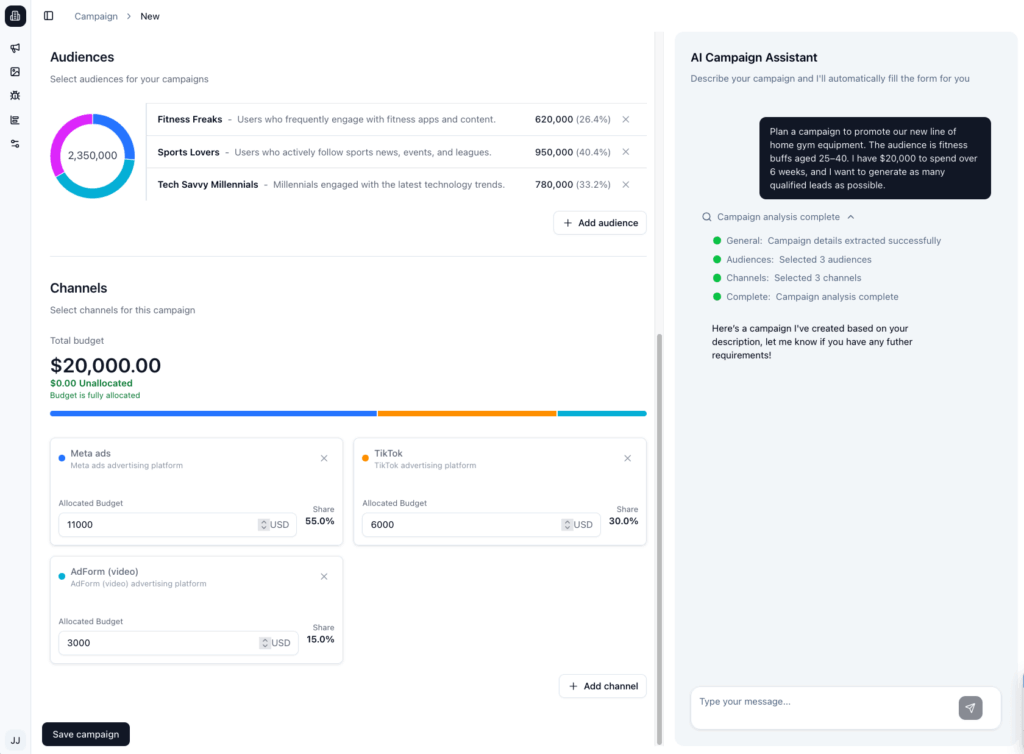
An example of how agentic AI is used in campaign creation.
Source: Spyrosoft AdTech’s AI Media Planner
Real-time optimisation
An agent monitors campaign performance via an MCP-connected analytics server. It identifies an underperforming creative variant.
The agent then:
- Accesses a creative generation tool through MCP to produce an alternative
- Configures an A/B test
- Reallocates budget toward better-performing variants
- Continues monitoring
The entire workflow executes through standardised protocol interactions. The agent focuses on advertising logic; MCP handles the connection mechanics.
Cross-platform coordination
This is where MCP’s relationship with other agentic frameworks, like the Ad Context Protocol (AdCP), becomes most apparent. An agent needs to coordinate a buy across multiple programmatic platforms.
Each platform exposes an MCP server providing access to its inventory, targeting capabilities, and bidding systems. The agent uses AdCP, which is built on MCP, to negotiate with each platform’s agent.
MCP provides the technical infrastructure for those conversations; AdCP provides the advertising-specific protocol for what gets discussed.
The pattern across these examples: MCP eliminates integration complexity by providing a common language for communication, allowing agents to focus on advertising decisions rather than connection mechanics.
The connection to AdCP and agentic RTB
Here’s where this becomes relevant to popular agentic advertising frameworks like AdCP and the IAB’s agentic real-time framework (ARTF), which we discuss in our next article.
MCP is the foundation upon which AdCP (Ad Context Protocol) is built.
AdCP defines the advertising-specific language: how agents negotiate media buys, exchange campaign parameters, and share performance data. But AdCP uses MCP as its underlying infrastructure.
The relationship works like this:
- MCP handles the mechanics of how agents connect and communicate
- AdCP defines what they’re communicating about (advertising-specific concepts)
- ARTF optimises how those communications execute in real-time auctions
What’s the difference between MCP and AdCP?
MCP and AdCP address different layers of the same problem, and they are designed to work together rather than compete.
MCP is a general-purpose infrastructure protocol. It defines how AI agents connect to external systems, retrieve context, invoke tools, and orchestrate workflows. It does not understand advertising concepts on its own, only how to expose data and actions in a standardised way.
AdCP is a protocol designed for advertising. It defines the concepts agents need to communicate about in an advertising context, such as campaigns, inventory, bids, audiences, and performance data.
In practice, the relationship works as follows:
- MCP handles how agents connect, exchange context, and execute actions
- AdCP defines what agents are communicating about in advertising workflows
- AdCP is implemented on top of MCP, using MCP’s connectivity and execution model as its foundation
Without MCP, AdCP would require bespoke integrations for every platform. Without AdCP, MCP-enabled agents would lack a shared advertising language.
Together, they enable agent-to-agent communication that is both technically interoperable and advertising-aware.
What does agentic AI mean for AdTech?
Implementing an MCP server makes your platform instantly accessible to the growing ecosystem of AI agents.
With a growing catalogue of MCP-compatible tools and new servers appearing regularly, early adopters gain competitive advantage. An MCP server turns your advertising platform into an agent-native service.
MCP-enabled agents can work across your entire AdTech and MarTech stack without custom integrations for each tool. This reduces implementation costs and accelerates autonomous advertising workflows.
The capabilities these agents unlock, such as autonomous campaign creation and real-time cross-platform optimisation, were previously difficult to implement at scale before MCP standardised AI-to-system communication.
MCP accelerates the shift to agentic advertising by solving the integration problem that previously limited agent deployment.
Every new MCP server adds capabilities to every compatible agent. That creates network effects benefiting the entire ecosystem.
About the author
Get more articles like this sent to your inbox
If you want to learn more about the world of AdTech and AI, then fill in the form and we’ll send you our latest articles, videos, and industry reports.