Chapter 06: The Main Channels and Mediums in Programmatic Advertising

Advertisers today have more choices than ever when it comes to where they display their ads. From websites and mobile apps to streaming services and digital billboards, the growing number of digital channels creates more opportunities to reach target audiences. And with a wide range of formats available — including native, video, and rich media — advertisers can engage their audiences in new and increasingly creative ways.
Key takeaways
- A medium describes the format of the ads, while a channel refers to where the ads appear.
- Examples of channels include search engines, social media platforms, websites, mobile apps, advanced TV (e.g. connected TV), retail media, and digital out-of-home (DOOH).
- Examples of mediums include text and image, video, native, audio, and rich media ads.
- Text and image ads remain the foundation of digital advertising, evolving from simple static banners to sophisticated HTML5 creatives that balance engagement with performance considerations.
- Native advertising has gained prominence by seamlessly integrating into content experiences, with formats spanning from in-feed placements to content recommendations and branded content.
- Video advertising has become increasingly sophisticated through technical standards like VAST (delivery) and VMAP (ad breaks), enabling television-like experiences across digital environments.
- Rich media ads push creative boundaries through interactive elements, expandable formats, and immersive experiences, delivering higher engagement but requiring careful implementation to balance impact with user experience.
- Traditionally, advertisers have allocated their budgets to channels such as the web (websites), in-app mobile (mobile apps), search engines, and social media platforms. However, with the rise of newer digital channels such as connected TV and retail media, advertisers are increasingly redistributing their budgets toward these emerging opportunities.
The difference between a medium and a digital channel
In programmatic advertising, understanding the distinction between mediums and channels is essential for developing effective campaign strategies and allocating budgets appropriately.
Though sometimes used interchangeably in casual conversation, these terms represent fundamentally different concepts in the digital advertising ecosystem.
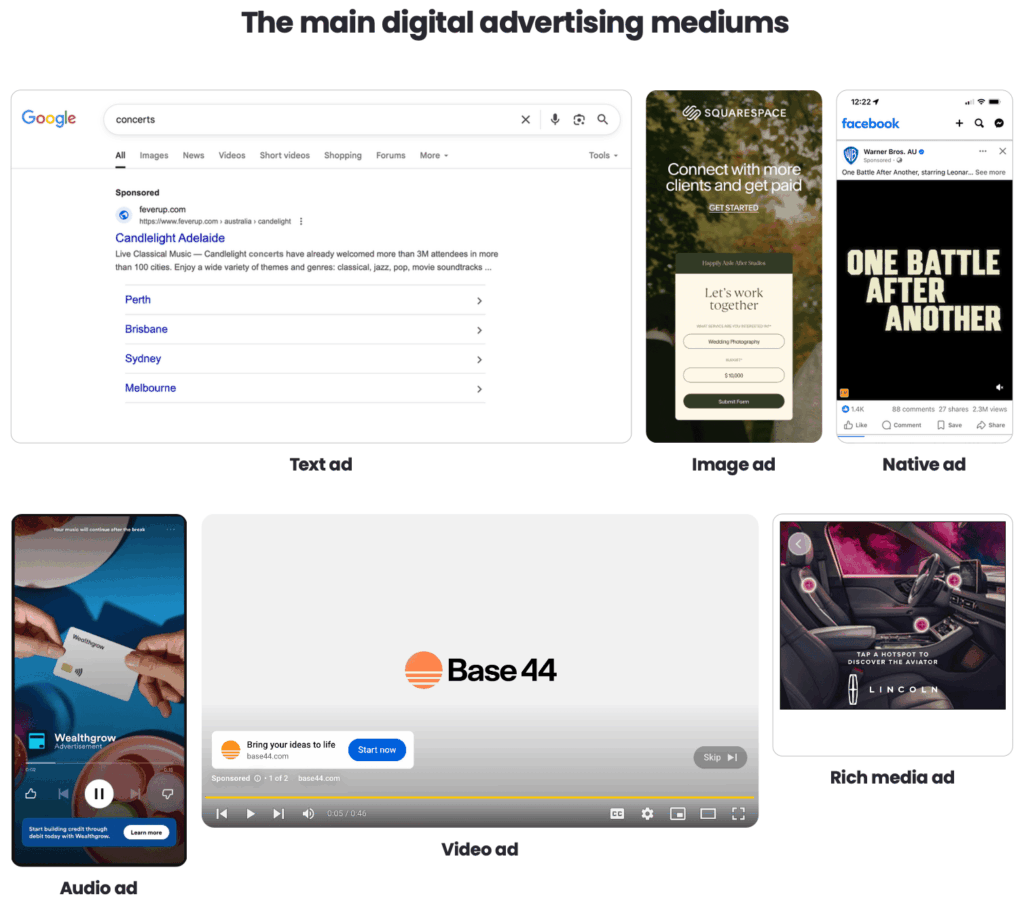
A medium describes the format or type of creative asset used to communicate with audiences – the “what” of digital advertising.
Mediums represent the various creative formats that advertisements can take, each with different capabilities for conveying messages and engaging users.
When advertisers discuss using “video,” “images,” or “interactive ads,” they’re referring to mediums.
The choice of medium significantly impacts creative strategy, production costs, and potential user engagement.
The key advertising mediums are:
- Text ads using headlines and descriptions without visual elements
- Static image ads presenting simple visual messages in standard dimensions
- Video ads combining sight, sound, and motion across various lengths
- Native ads blending in with surrounding content in non-disruptive formats
- Rich media incorporating interactive elements for deeper engagement
- Audio ads delivering messages through sound only
A digital channel refers to the environment or platform where advertisements appear – essentially, the “where” of digital advertising.
Channels are the distribution paths through which ads reach consumers, each with its own unique audience characteristics, targeting capabilities, and performance metrics.
For example, when a marketer discusses allocating budget to “search,” “social,” or “display,” they’re referring to channels.
Each channel has distinct audience behaviours, technical requirements, and strategic considerations that influence how advertisers approach them.
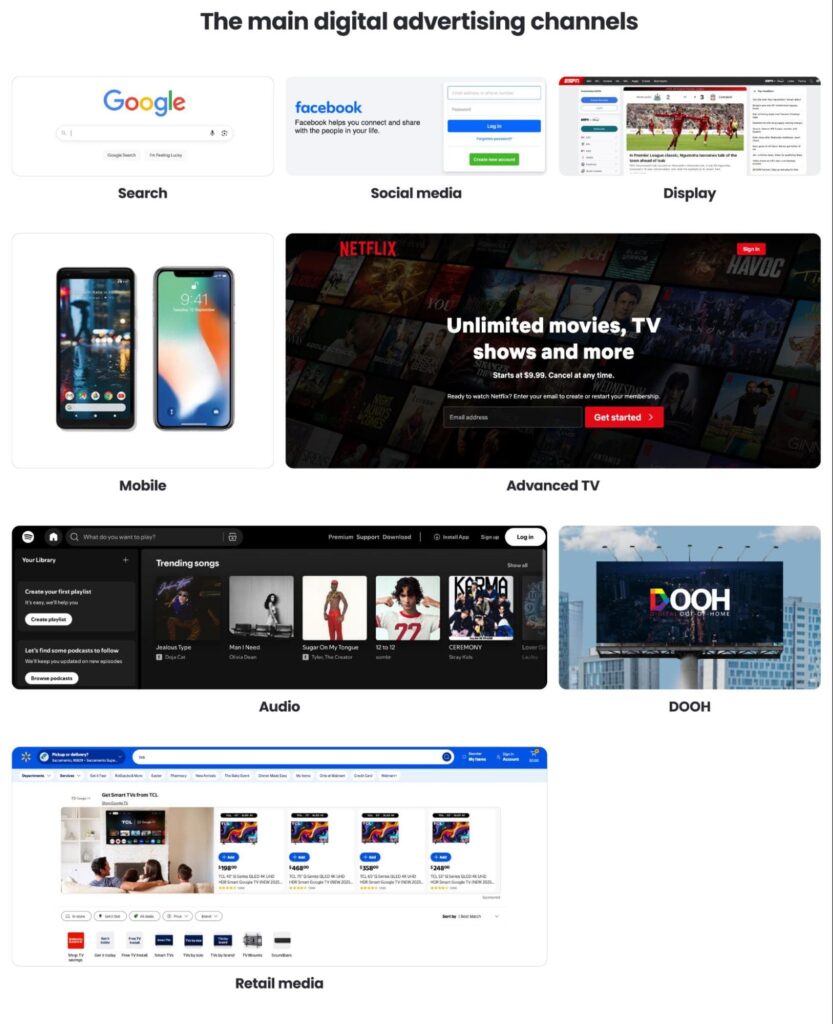
Common digital advertising channels include:
- Search: Ads displayed on search engines like Google and Bing.
- Social media: Ads displayed on social media platforms like Facebook, Instagram, LinkedIn, and TikTok.
- Display: Ads displayed on websites.
- Mobile: Ads displayed on both mobile web (websites) and mobile apps (in-app mobile advertising).
- Advanced TV: Ads displayed in digital TV environments like Netflix and Disney+. Advanced TV is an umbrella term for forms of television that go beyond traditional, linear TV. It includes connected TV (CTV) and over-the-top (OTT) streaming services.
- Retail media: Ads displayed on a retailer’s digital properties (e.g. website and mobile app) or across other channels using the retailer’s first-party customer data.
- Audio: Ads displayed on audio platforms like Spotify.
- Digital out-of-home(DOOH): Ads displayed on digital signage, such as billboards and digital displays.
The relationship between mediums and channels is complex, as not all mediums work effectively across all channels.
For example, a 30-second video ad might perform exceptionally well on connected TV but prove ineffective on a website, while a text ad might drive strong performance in search but get lost in a visually rich social feed.
Understanding which mediums work best in which channels – and how to adapt creative strategies accordingly – is a critical skill for digital advertisers and marketers.
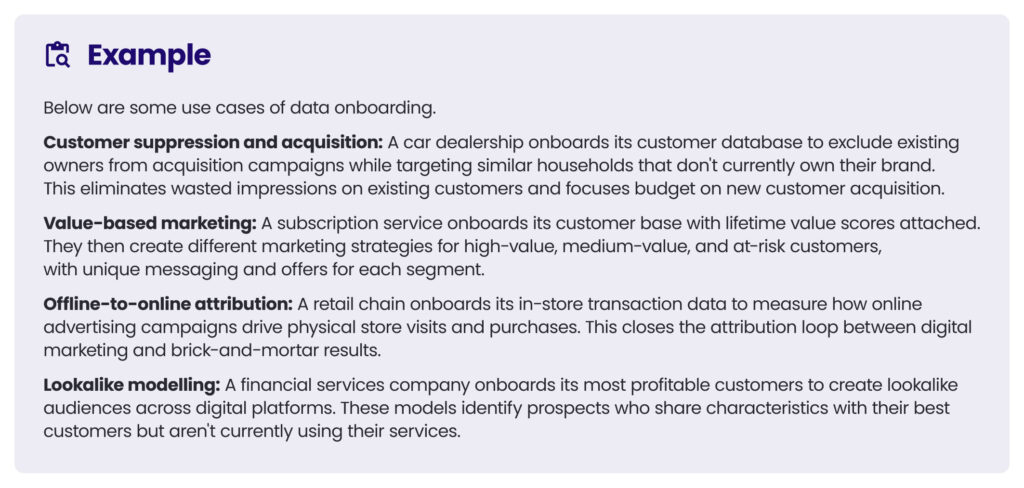
The effectiveness of each combination would vary based on audience, context, and campaign objectives.
By understanding both the unique characteristics of each channel and the creative possibilities of each medium, advertisers can develop more nuanced and effective campaign strategies.
As programmatic technology continues to evolve, the boundaries between traditional channels are increasingly blurring, while new mediums emerge to take advantage of technological advances.
Successful advertisers master both dimensions – understanding where their audiences can be reached most effectively (channels) and what creative formats will best communicate their message in those environments (mediums).
The main advertising mediums
The programmatic advertising ecosystem encompasses a diverse range of creative formats, each with unique capabilities, technical requirements, and user experience implications.
These advertising mediums have evolved significantly since the early days of digital marketing, growing increasingly sophisticated as technology advances and consumer expectations shift.
While new formats continually emerge, four core medium categories form the foundation of most programmatic advertising strategies:
- Text and image ads
- Native ads
- Video ads
- Rich media ads
Each category represents a different approach to capturing attention and delivering messages, with distinct strengths, limitations, and ideal use cases.
Understanding the characteristics and applications of these primary mediums is essential for developing effective creative strategies that align with campaign objectives and audience preferences.
Text and image ads
Text and image ads represent the foundation of digital advertising, evolving substantially since the early days of the internet while remaining central to most programmatic campaigns.
Though sometimes overlooked in conversations about cutting-edge formats, these ads still account for the majority of programmatic inventory and continue to drive significant performance for advertisers across objectives.
The evolution of text ads
Text ads emerged as the first true digital advertising format, pioneered by early search engines and directory services.
Google revolutionised the format with AdWords (now Google Ads) in 2000, establishing the text ad as the primary format for search advertising.
Though seemingly simple, modern text ads have evolved into sophisticated messages that balance brevity with persuasiveness.
Contemporary text ads typically include several key components:
- Headlines capturing attention and communicating key value propositions
- Descriptions elaborating on benefits, features, or offers in more detail
- Display URLs showing a user-friendly version of where users will land
- Extensions providing additional information like location, pricing, or callouts

An example of text ads on Google Ads.
While text ads remain primarily associated with search advertising, variations appear across other channels, including:
- Text-based sponsored content in email newsletters
- Text listings in classified-style marketplaces
- Simple text promotions within messaging platforms
- Text components within larger display ad formats
The enduring effectiveness of text ads demonstrates that compelling messaging can drive action even without visual elements, particularly when reaching users with high intent.
A well-crafted text ad speaking directly to a user’s search intent often outperforms more elaborate formats by delivering precisely what the user is seeking.
Image ads: From simple banners to dynamic creatives
Image ads have undergone perhaps the most dramatic evolution in digital advertising, transforming from simple static GIFs to sophisticated HTML5 creatives that rival the quality of rich media while maintaining broader compatibility.
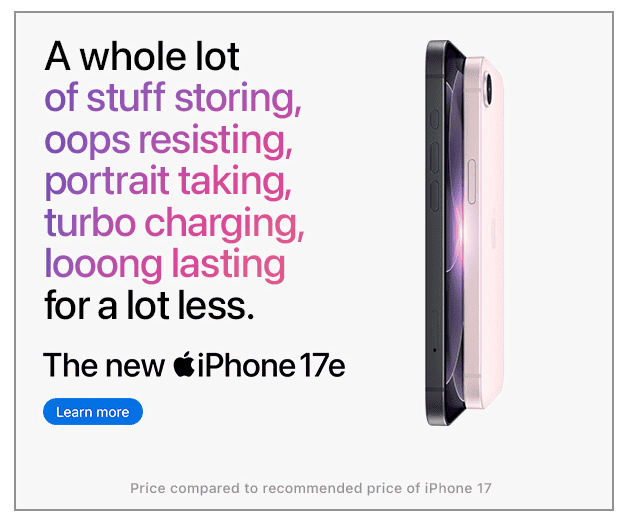
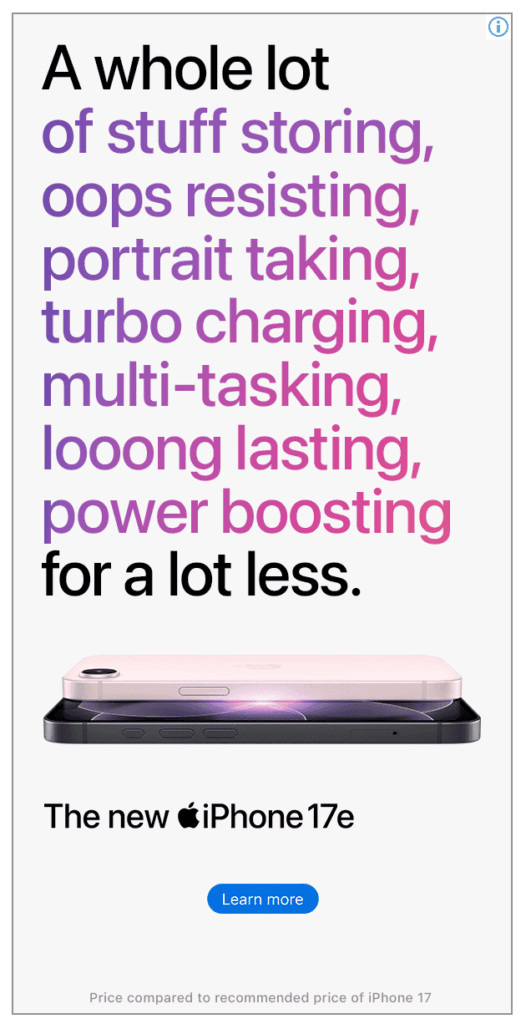
An example of an image ad in two different sizes.
As discussed in an earlier chapter, the first image banner ad appeared on HotWired.com (now Wired.com) on October 27, 1994, when AT&T purchased a simple banner asking “Have you ever clicked your mouse right HERE?” with an arrow pointing to a button reading “YOU WILL.”
This pioneering ad achieved a reported 44% click-through rate – an unimaginable performance by today’s standards. This simple banner established what would become the dominant digital advertising format for the next decade.
The evolution of image ads includes several key phases:
- Static GIF banners (1994-2000): Simple images with limited colours and no animation
- Animated GIFs (1995-2005): Basic movement through frame sequences, often with flashy, attention-grabbing animations
- Flash banners (2000-2015): Interactive capabilities and sophisticated animations, but with plugin requirements and security issues
- HTML5 creatives (2010-present): Modern standards-based formats combining rich capabilities with cross-device compatibility
Today’s image ads balance creative impact with technical performance considerations.
Modern HTML5 display ads typically feature:
- Responsive design adapting to different placements and screen sizes
- Optimised file sizes to ensure quick loading and rendering
- Brand-compliant visual elements establishing immediate recognition
- Clear calls-to-action guiding user response
- Dynamic elements personalised to user characteristics or behaviour
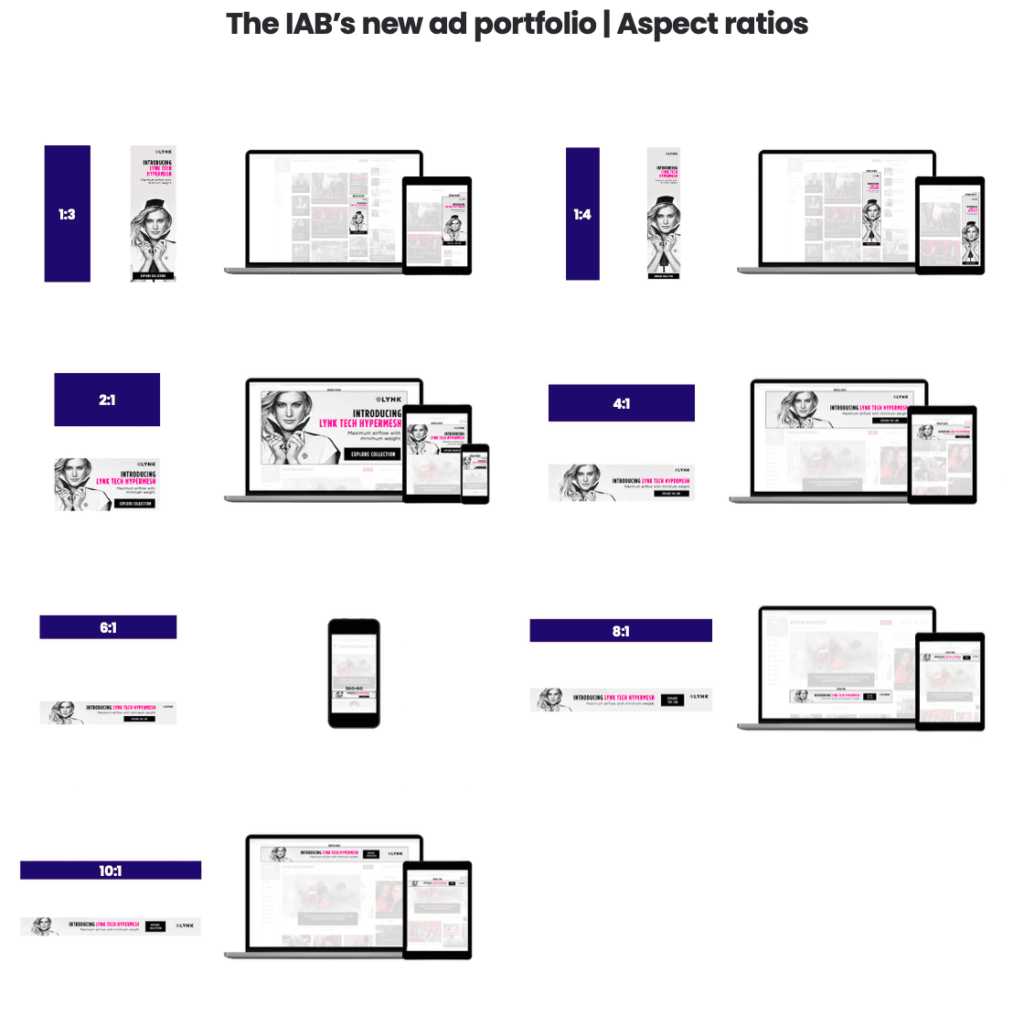
Standard ad sizes established by the Interactive Advertising Bureau (IAB) remain the foundation of image advertising. The latest creative guidelines focus on using aspect ratios instead of fixed sizes in pixels.
Despite being the oldest digital ad formats, text and image ads continue to evolve and remain relevant through technological advances, standardisation, and creative innovation.
Their efficiency, scalability, and performance ensure they remain central to programmatic advertising strategies even as newer formats emerge.
Native ads
Native advertising represents an evolution from traditional display advertising, prioritising integration with surrounding content rather than disruption.
This medium emerged as users became increasingly blind to conventional banner ads, with advertisers seeking formats that could overcome attention barriers while respecting the user experience.
By adopting the look, feel, and function of the environments in which they appear, native ads deliver commercial messages in contexts where users are actively engaged with content.
The concept of native advertising isn’t entirely new – advertorials in print publications and sponsored segments in broadcast have existed for decades. However, digital technology has enabled native formats to achieve unprecedented scale and sophistication through programmatic delivery.
The IAB defines native advertising as “paid ads that are so cohesive with the page content, assimilated into the design, and consistent with the platform behaviour that the viewer simply feels that they belong.”
Native ad formats
The native advertising landscape encompasses several distinct formats, each with unique characteristics and applications:
- In-feed ads appear within content streams alongside non-sponsored content, maintaining the same format and interaction model as organic posts.
These ads are particularly prevalent on social media platforms and content sites with feed-based layouts.
Facebook’s Sponsored Posts, Twitter’s Promoted Tweets, and Instagram’s Sponsored Stories exemplify this format, appearing within users’ normal content consumption flow with minimal disruption. - Content recommendation widgets present sponsored content under headings like “You might also like” or “Recommended for you,” typically appearing at the bottom of articles or in sidebars.
Companies like Outbrain and Taboola pioneered this format, which now accounts for significant revenue for many publishers. - Branded content represents the most integrated form of native advertising, where advertisers work directly with publishers to create bespoke content that aligns with the publisher’s style and audience expectations.
The New York Times’ T Brand Studio and BuzzFeed’s Partner showcase how high-quality branded content can engage audiences while clearly indicating its sponsored nature.
Programmatic native advertising
The integration of native advertising with programmatic technology has enabled these formats to achieve significant scale while maintaining their contextual relevance.
Programmatic native combines the targeting precision and efficiency of automated buying with the engagement benefits of context-appropriate formats.
Several key technologies have enabled the programmatic delivery of native advertising:
- Native supply-side platforms (SSPs) like TripleLift and Nativo provide standardised infrastructure for publishers to offer native inventory programmatically.
- Native ad exchanges facilitate real-time buying of native placements across multiple publishers through standardised formats and bidding mechanisms.
- Dynamic creative optimisation (DCO) enables advertisers to automatically adapt creative elements to match the visual style of each placement.
- Native demand-side platforms (DSPs) offer specialised capabilities for buying and optimising native campaigns at scale.
The IAB’s OpenRTB Dynamic Native Ads specification has been particularly important in standardising native formats for programmatic trading.
This framework defines how native ad components (headline, body, image, etc.) can be transmitted through programmatic channels while allowing for customisation to match each publisher’s environment.
Effectiveness and disclosure considerations
Native advertising typically outperforms traditional display formats across key metrics:
- Click-through rates average 4x higher than conventional banner ads: Native ads achieve 0.2% CTR compared to 0.05% for display ads (Sharethrough/IPG Media Labs study).
- Visual engagement shows increased attention: Nielsen eye-tracking study found participants looked at native ads 53% more frequently than display ads, with 25% more consumers measured to look at native placements.
- Brand recall improves in context-appropriate environments: Sharethrough study documented native ads driving higher brand lift across all campaigns.
- Purchase intent shows significant lifts: Sharethrough research found 18% higher lift in purchase intent for native vs banner ads, with 9% lift for brand affinity responses.
However, these performance benefits come with important ethical and regulatory considerations around proper disclosure.
The Federal Trade Commission (FTC) and similar regulatory bodies worldwide have established guidelines requiring clear disclosure of native ads as paid content.
Terms like “Sponsored,” “Promoted,” or “Advertisement” must be prominently displayed to ensure users understand the commercial nature of the content.
Effective native advertising balances seamless integration with transparent disclosure – engaging users through relevance while maintaining trust through honesty.
When executed properly, native ads represent a win for all parties: users receive content that respects their experience, publishers monetise in ways that complement rather than detract from their environments, and advertisers achieve meaningful engagement with receptive audiences.
Video ads
Video advertising has emerged as one of the most powerful mediums in the programmatic ecosystem, combining sight, sound, and motion to deliver emotionally resonant messages that drive brand awareness and consideration.
The evolution of video advertising parallels broader changes in video consumption, as audiences have shifted from traditional broadcast television to a fragmented landscape of streaming platforms, social media, and publisher sites.
This transition has transformed video advertising from a linear, TV-centric model to a diverse ecosystem spanning multiple channels, devices, and formats.
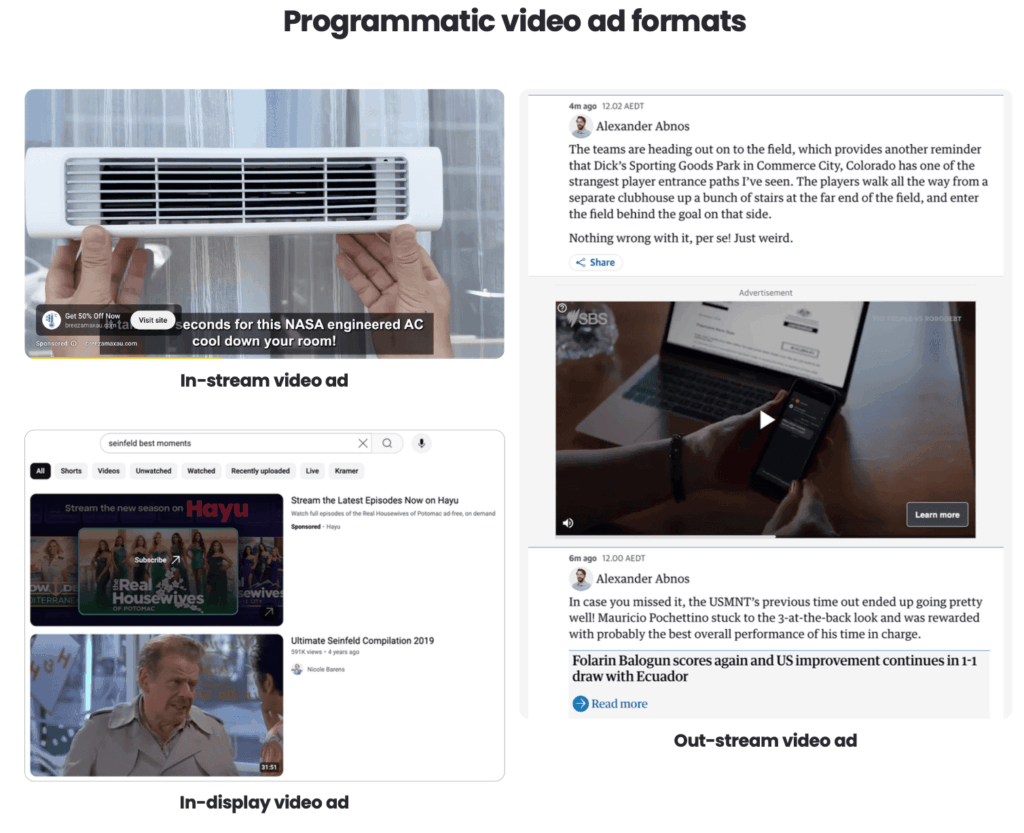
The programmatic video ads encompass several distinct types:
- In-stream video appears before (pre-roll), during (mid-roll), or after (post-roll) video content the user has chosen to watch. This format most closely resembles traditional TV commercials and typically runs 15-30 seconds on premium content sites and streaming platforms.
- Out-stream video appears within non-video content, such as between paragraphs of text, in social feeds, or in banner placements. These formats typically play automatically (often muted) when scrolled into view, creating video opportunities on sites without video content.
- In-display video appears as a thumbnail that users must click to initiate playback, often in recommendation units or search results. Unlike in-stream or out-stream formats, these videos require user initiation.
The effectiveness of video advertising stems from its unique ability to communicate through multiple sensory channels simultaneously.
However, the technical complexity of delivering video advertising programmatically exceeds that of simpler formats. Video requires specialised infrastructure for storage, streaming, player compatibility, and measurement.
This complexity has driven the development of several technical standards that enable the programmatic video ecosystem to function efficiently.
VAST (Video Ad Serving Template)
The Video Ad Serving Template (VAST) is the fundamental technical standard enabling video ad delivery across different players and platforms.
Developed by the IAB Tech Lab, VAST defines a common XML-based protocol for communication between video players and ad servers, allowing video ads to render consistently regardless of the player or device being used.
VAST serves several critical functions in the video advertising ecosystem:
- Standardised delivery: VAST provides a common language for ad servers to communicate with video players, ensuring consistent ad experiences across different technologies.
- Cross-platform compatibility: By establishing standard protocols, VAST enables video ads to function across desktop, mobile, connected TV, and other video-enabled devices.
- Creative flexibility: The specification supports various creative types, including linear video, companion banners, and interactive elements.
- Measurement framework: VAST includes standardised tracking events – impression, start, first quartile, midpoint, third quartile, complete, etc. – for consistent measurement across platforms.
The VAST specification has evolved through several versions to address emerging needs in video advertising:
- VAST 1.0 (2008): Established basic video ad delivery framework
- VAST 2.0 (2010): Added support for multiple ad formats and expanded tracking capabilities
- VAST 3.0 (2012): Introduced support for skippable ads and additional metrics
- VAST 4.0 (2016): Added server-side ad insertion support and improved viewability measurement
- VAST 4.1 (2018): Enhanced support for interactive elements and measurement
- VAST 4.2 (2019): Improved support for OTT (over-the-top) environments
- VAST 4.3 (2022): Includes enhancements to support modern video advertising needs, such as in connected TV advertising
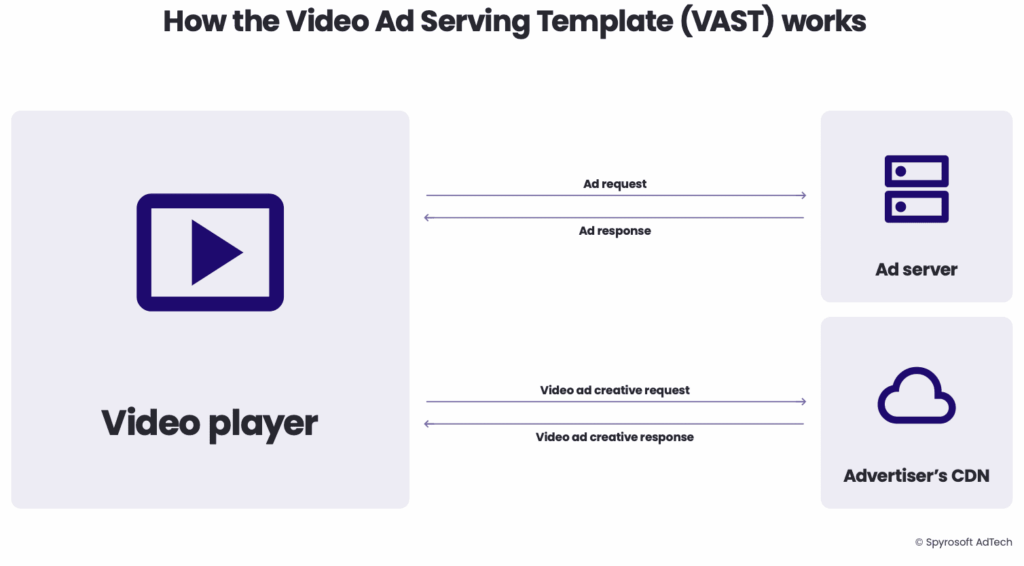
A basic VAST implementation follows this flow:
- The video player requests an ad from an ad server.
- The ad server responds with a VAST XML document.
- The player parses this document to determine what creative to play and what events to track.
- The player requests the video ad creative from the advertiser’s content distribution network (CDN), renders the creative, and fires tracking pixels at appropriate moments
VPAID, OMID and SIMID
VPAID (Video Player Ad Interface Definition) was the standard for enabling rich interactivity in in‑stream video ads.
VPAID was officially deprecated around 2019 due to performance, compatibility, and security concerns – especially in mobile and CTV environments. VAST 4.x removed support for VPAID and introduced two modern, more focused standards: OMID and SIMID.
OMID (Open Measurement Interface Definition)
OMID replaces VPAID’s measurement and verification capabilities. It offers a standardised API (via the OMSDK) for viewability and verification without requiring executable ad code inside the video player, improving security and simplifying integrations.
SIMID (Secure Interactive Media Interface Definition)
SIMID replaces VPAID’s interactive layer. It separates the interactive components from the media file, sandboxing creative code within secure iframes and communicating via postMessage.
This enhances security, reduces latency, allows pre‑caching, and supports environments like mobile, server-side ad insertion (SSAI), and OTT.
VMAP (Video Multiple Ad Playlist)
The Video Multiple Ad Playlist (VMAP) standard addresses a different aspect of video advertising: the scheduling of multiple ad breaks within a single video content.
While VAST handles individual ad delivery, VMAP provides a framework for defining where and when ad breaks should occur within longer content.
VMAP is particularly important for monetising long-form video content, such as TV episodes, movies, or extended clips that may contain multiple ad opportunities.
The specification allows content providers to:
- Define precise timings for ad breaks within content
- Specify different ad break types (pre-roll, mid-roll, post-roll)
- Set parameters like maximum break duration or number of ads per break
- Maintain consistent ad break timing across different platforms
A typical VMAP implementation for a 30-minute television episode might include:
- A pre-roll break before content begins (typically 60-90 seconds)
- Several mid-roll breaks at natural content transitions (typically 60-120 seconds each)
- A post-roll break after content concludes (often shorter duration)
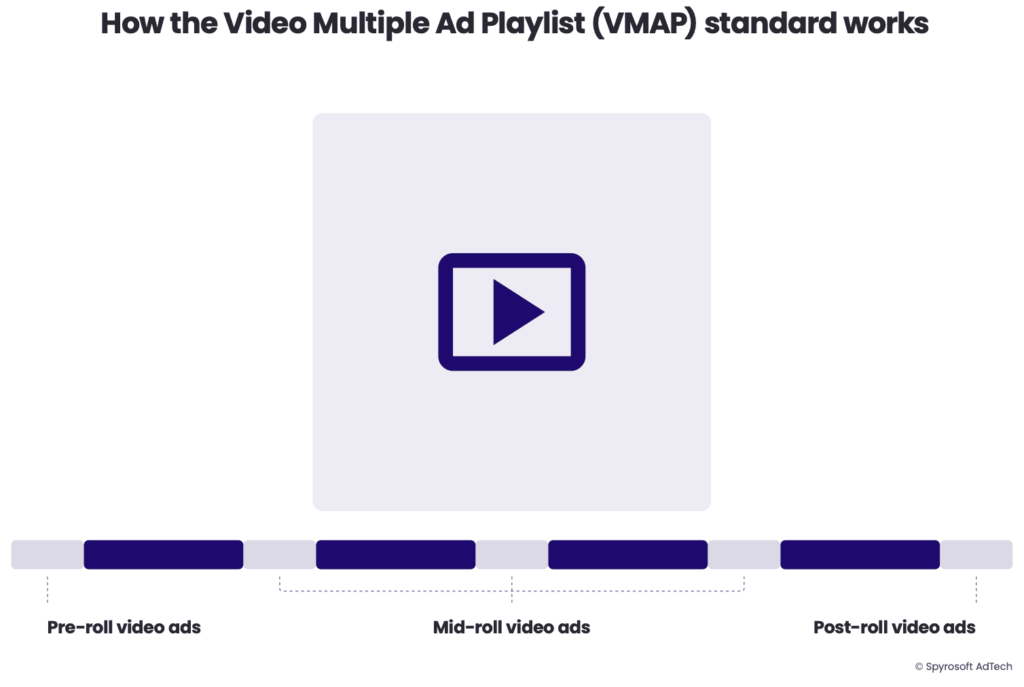
VMAP ensures this structure remains consistent regardless of which platform delivers the content or which ad server fulfills the inventory, creating a television-like experience in digital environments.
The combination of these technical standards – VAST for basic delivery, VMAP for scheduling, SIMID for interactivity, and OMID for measurement – creates the infrastructure necessary for programmatic video advertising to function at scale across diverse environments.
As video consumption continues to fragment across devices and platforms, these standards (and their evolving successors) will remain essential to maintaining a consistent, measurable ecosystem for video advertising.
Audio ads
Audio advertising has experienced a renaissance in the programmatic ecosystem, driven by the explosive growth of streaming music services, podcasts, and smart speakers.
This medium offers unique advantages for reaching audiences during moments when visual advertising isn’t possible – while commuting, exercising, working, or engaging in other screen-free activities.
The resurgence of audio as a premium advertising channel reflects broader shifts in media consumption.
With over 800 million people subscribed to a paid music-streaming service globally, audio advertising provides access to engaged audiences in intimate, distraction-free environments.
Types of audio ads
The audio advertising landscape encompasses several distinct formats, each suited to different listening contexts and campaign objectives:
- Baked-in or burned-in ads: When podcasters monetise their content by using their voice to record ads directly into the audio file for a specific podcast episode.
- Companion ads: Just like the banner ads on web pages and mobile apps, companion ads (also known as or banner ads) can appear on the screen when the user is listening to an audio track (e.g. in a podcast or music app), while audio playback is not interrupted.
- Audio spots: Traditional audio commercials, typically 15-30 seconds long, that play during ad breaks (in ad pods) during music streaming or between podcast segments. These closely resemble radio commercials but benefit from digital targeting and measurement capabilities.
- Podcast ads: Implemented by music and podcast platforms like Spotify, podcast advertising includes both programmatic insertions and host-read sponsorships. Dynamic ad insertion (DAI) technology enables programmatic placement of ads within podcast content, while maintaining the intimate feel of the medium.
- Voice-activated ads These are emerging formats for smart speakers and voice assistants that enable interactive audio experiences. Users can respond to prompts, request more information, or even make purchases through voice commands.
- Branded audio content Similar to native advertising in other mediums, branded podcasts, playlists, and audio experiences integrate brand messages into content formats that provide value to listeners.
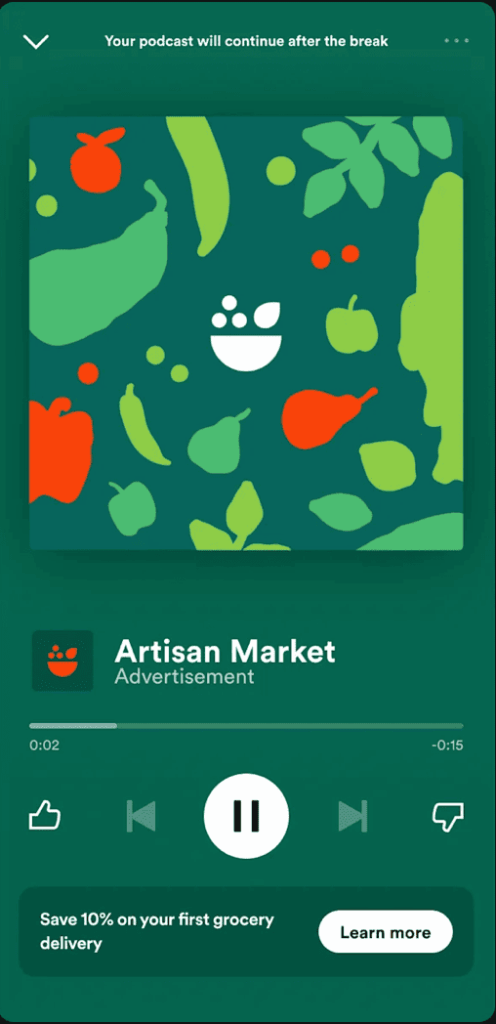
An example of a Spotify Podcast Ad.
Technical standards for audio advertising
The programmatic audio ecosystem relies on adapted versions of display and video standards:
- VAST for audio: While originally designed for video, VAST has been adapted to handle audio-only creatives, providing standardised delivery and measurement.
- DAAST (Digital Audio Ad Serving Template): A specialised standard for audio that addresses unique requirements like seamless insertion and audio-specific metrics.
- Podcast measurement guidelines: The IAB has established specific standards for podcast advertising measurement, addressing challenges like download vs. listen metrics.
Unique characteristics of audio advertising
Audio advertising presents distinct opportunities and challenges:
Advantages:
- Attention without distraction: Audio reaches users when they can’t look at screens
- Emotional connection: The human voice creates intimacy and trust
- Contextual relevance: Ads can match mood, genre, or content themes
- Sequential messaging: Audio’s linear nature suits storytelling formats
Challenges:
- Attribution complexity: Connecting audio exposure to digital actions requires sophisticated measurement
- Creative constraints: Messages must work without visual support
- Frequency management: Repetition can quickly become annoying in audio formats
- Skip resistance: Many platforms allow limited or no skipping of audio ads
Audio advertising continues to evolve with new technologies like spatial audio, real-time personalisation, and voice-interactive formats promising even more engaging experiences for brands and listeners alike.
Rich media ads
Rich media represents the most technically sophisticated category of digital advertising, encompassing a diverse range of interactive and immersive formats that extend far beyond the capabilities of standard display or video ads.
These advanced creatives leverage technologies like HTML5, CSS animations, and JavaScript to create engaging user experiences directly within ad units, blurring the line between advertising and interactive content.
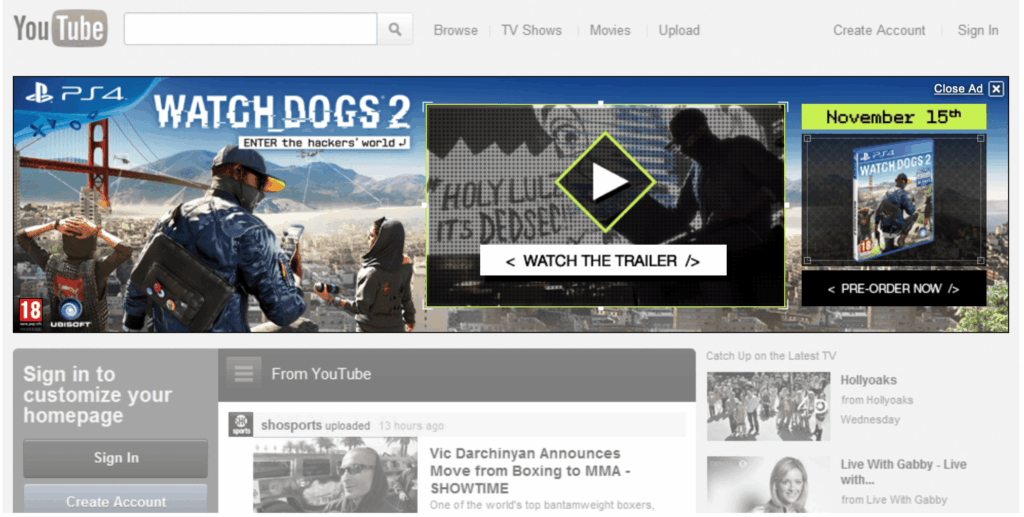
An example of a rich media ad. Users can watch the trailer by clicking on the video embedded in the ad. Source: Google Rich Media Gallery
While rich media demands more technical resources to develop and deploy, it typically delivers significantly higher engagement rates and brand impact than standard formats.
At its core, rich media advertising is defined by its interactive capabilities – these ads don’t simply present a message but invite active participation from users.
This interactivity can range from simple actions like expanding a banner to complex experiences like playing games, customising products, or exploring 3D environments.
The format emerged in the late 1990s with early technologies like Flash, but has evolved significantly with modern web standards to create more sophisticated, accessible experiences across devices.
Key rich media formats and capabilities
The rich media landscape encompasses several distinct format categories, each offering different creative possibilities and user experiences:
- Expandable ads begin as standard display units but expand to larger formats when users interact with them, typically through mouseover or click actions. This format allows advertisers to combine the broad reach of standard display with the engagement of larger canvas experiences. For example, a movie studio might use a standard 300×250 banner that expands to a full trailer when clicked.
- Interstitials appear between page loads or content transitions, temporarily taking over the full browser window with rich content. These high-impact formats deliver immersive experiences at natural transition points in user journeys. A travel brand might use an interstitial featuring an interactive 360° view of a destination resort that appears between articles on a travel site.
- Floating ads appear above page content, often with animation effects that draw attention without requiring full-screen takeovers. These formats create high visibility while allowing users to continue browsing underlying content. A common implementation might feature a product that animates across the screen before settling into a fixed position.
- Interactive video enhances standard video advertising with clickable elements, branching narratives, or user-controlled features. This format combines the emotional impact of video with the engagement of interactive elements. An automotive brand might create a video where users can change the car’s colour, explore different features, or choose different driving scenarios within the video player.
- Playable ads incorporate game-like elements that allow users to experience products or services through direct interaction. Particularly popular in mobile app advertising, these units let users trial experiences before downloading. A mobile game developer might create a mini-game version of their full app that gives users a taste of gameplay within the ad unit itself.
- 360° and immersive ads leverage technologies like virtual reality (VR), augmented reality (AR), or 3D rendering to create explorable environments within ad units. These formats create particularly memorable experiences through their novelty and depth.
A furniture retailer might develop an AR-enabled ad that allows users to visualise products in their own space through their device camera.
To view examples of rich media ads, visit Google’s Rich Media Gallery.
Key components of a rich media ad
Rich media creatives typically incorporate several technical components that enable their advanced functionality:
- HTML5 animation using CSS transitions and keyframes for smooth, efficient motion
- Document Object Model (DOM) manipulation allowing dynamic content changes based on user actions
- User interaction handlers capturing clicks, swipes, drags, and other input methods
- Video and audio elements embedded directly within the creative structure
- Data processing capabilities for dynamic content personalisation
- Device APIs accessing features like accelerometers, cameras, or geolocation (with permission)
- Cross-domain communication enabling secure interaction with external services
Implementation and technical considerations
While rich media offers compelling creative possibilities, it also introduces additional technical complexity compared to standard formats.
Several key considerations influence successful rich media implementation:
- File size and load performance: Rich media’s enhanced capabilities often come with larger file sizes that can impact page load performance. Best practices include asynchronous loading, resource optimisation, and progressive enhancement techniques to balance impact with performance.
- Cross-device compatibility: Rich experiences must adapt to diverse screen sizes, input methods, and technical capabilities across devices. This requires responsive design approaches and fallback options for less capable environments.
- Standardisation challenges: Unlike standard display, rich media often requires custom implementations or certified rich media vendors to ensure proper functionality across publishers and platforms.
- Measurement complexity: The interactive nature of rich media necessitates more sophisticated measurement approaches beyond simple impressions and clicks, including engagement metrics, interaction rates, and time-based measures.
Major rich media providers like Google Studio, Flashtalking, and Celtra offer platforms that address these challenges through templated creative tools, certification processes with major publishers, and specialised serving infrastructure.
These platforms have been essential to scaling rich media beyond custom one-off implementations to programmatically viable formats.
Effectiveness and use cases of rich media ads
Research demonstrates rich media’s performance advantages over standard formats:
- Interaction rates: Eskimi found parallax ads had CTRs 5x higher than banners, with Facebook interactive formats reaching CTRs of 1.25-1.33%.
- Dwell time: Eyeblaster’s 42 billion impression study shows video-rich media generated 71.5 seconds of dwell time vs. non-video at 37.7 seconds. Dwell time refers to the average time consumers intentionally spend with online ads.
- Brand recall: Nielsen studies show 70%+ brand recall for interactive formats, with GumGum documenting 41% spontaneous recall increases.
- Purchase intent: Publift research shows 1.16% direct increases in purchase intent, while a study conducted by FreakOut, Nielsen, and Hyundai found that rich media ads are nearly 50% more effective in generating purchase interest among users vs standard banners.
These performance benefits make rich media particularly valuable for certain advertising objectives:
- Brand storytelling: Complex narratives that require more engagement than standard formats allow
- Product demonstrations: Interactive showcases of features and benefits
- Consideration building: Detailed exploration of options and specifications
- Lead generation: Capturing user information through in-unit forms
- Driving app installs: Demonstrating app functionality before download
- Location-based marketing: Incorporating maps, directions, and local information
Despite its advantages, rich media isn’t appropriate for all campaign objectives.
The higher development costs and technical complexity make it less suitable for performance-focused campaigns with tight cost-per-acquisition targets or initiatives requiring maximum reach at minimal cost.
As with all media choices, marketers must align format selection with specific campaign goals, audience behaviours, and measurement frameworks.
The evolution of rich media continues as new technologies emerge, with recent innovations incorporating augmented reality, voice interaction, and AI-driven personalisation.
As browser capabilities advance and connectivity improves, the boundary between rich media advertising and immersive web applications continues to blur, creating increasingly sophisticated opportunities for brands to engage audiences through interactive experiences.
The main digital advertising channels
While mediums define the creative format of advertisements, channels represent the environments where these ads appear.
Each digital channel offers unique characteristics in terms of audience behaviour, targeting capabilities, technical requirements, and performance expectations.
Understanding these channels is essential for developing effective media strategies and optimising campaign performance across the digital ecosystem.
Web advertising
Web advertising – displaying ads on websites accessed through desktop and mobile browsers – remains the foundation of digital advertising despite the growth of app-based and walled garden environments.
This channel encompasses the vast expanse of the open web, from major publisher sites to long-tail blogs, offering unparalleled reach and diversity.
The web advertising ecosystem includes several key placement types:
- Display inventory spans traditional banner placements, in-article units, and sidebar positions across millions of websites. These placements support various creative formats from simple images to rich media experiences.
- Native placements integrate advertising into content streams, recommendation widgets, and in-feed positions, providing less disruptive advertising experiences that match the look and feel of surrounding content.
- Video placements include both in-stream opportunities within video content and out-stream formats that bring video advertising to traditionally text-based environments.

An example of native content-recommendation ads.
Web advertising offers unique advantages, most notably massive scale and access to billions of daily impressions across a wide range of content.
The channel enables contextual targeting to align messages with relevant content, while cross-site reach allows advertisers to follow users throughout their web journey. Its support for flexible formats – from simple text to complex rich media – enables creative strategies that adapt to any campaign objective.
However, the channel also faces challenges including ad blocking adoption, viewability concerns, and the impending deprecation of third-party cookies that will reshape targeting and measurement capabilities.
In-app mobile advertising
In-app mobile advertising targets users within mobile applications rather than mobile web browsers, representing a distinct channel with unique technical requirements and user behaviours.
With mobile users spending up to 90% of their time in apps rather than browsers, this channel has become essential for reaching mobile audiences effectively.
The in-app environment offers several placement opportunities:
- Banner ads appear within app interfaces, often at the top or bottom of screens, providing persistent brand presence without disrupting app functionality.
- Interstitial ads display full-screen messages at natural transition points, such as between game levels or content sections, commanding complete user attention.
- Native ads integrate seamlessly into app experiences, appearing in social feeds, content streams, or as sponsored listings that match the app’s design language.
- Rewarded video offers users in-app rewards (extra lives or credits in games, premium content, virtual currency) in exchange for watching video ads, creating a value exchange that benefits all parties.
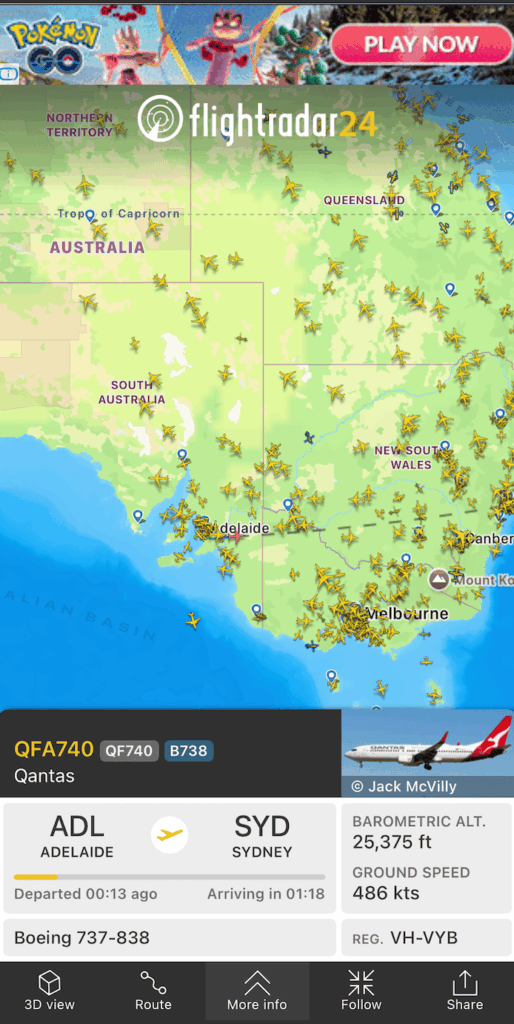
Banner ad.

Interstitial ad.
Advantages of in-app advertising
In-app advertising provides distinct advantages through device ID targeting, which offers more persistent user identification than cookie-based web targeting.
The channel enables targeting based on app-specific behaviours and usage patterns, creating highly relevant audience segments.
Ads in apps typically achieve better viewability than web environments due to controlled rendering, while interactive formats that leverage device capabilities like touch, tilt, and location create unique engagement opportunities.
The channel requires specialised technical considerations, including SDK integrations, app store policies, and different measurement approaches than web-based advertising.
Search advertising
Search advertising represents one of the most intent-driven channels in digital marketing, placing ads alongside search engine results when users actively seek information, products, or services.
This channel captures demand at the moment of highest purchase intent, making it invaluable for performance-focused campaigns.
Google text ads matching user queries, presented using the style of organic results.
Search advertising primarily encompasses:
- Text ads appear above or alongside organic search results, matching user queries with relevant commercial messages. These ads typically include headlines, descriptions, and various extensions that provide additional information.
- Shopping ads display product images, prices, and merchant information directly in search results, particularly effective for e-commerce advertisers.
- Local ads promote nearby businesses with location information, directions, and click-to-call functionality, bridging digital advertising with physical store visits.
The search channel offers unique benefits by reaching users with high intent who are actively seeking related products or services.
Keyword precision enables targeting of specific search terms that indicate purchase readiness, while the channel provides performance transparency with clear attribution between searches and conversions.
Sophisticated bidding algorithms enable scalable automation that optimises for specific goals, whether maximising conversions or achieving target return on ad spend.
While search remains highly effective, increasing competition and rising costs-per-click require sophisticated strategies to maintain profitability, particularly in competitive verticals.
Social media advertising
Social media advertising leverages the massive audiences and rich user data of platforms like Facebook, Instagram, LinkedIn, TikTok, and Twitter to deliver highly targeted messages within social environments.
This channel has grown to represent over 30% of global digital ad spend, driven by unparalleled targeting capabilities and engaged user bases.
Social platforms offer diverse ad formats:
- Feed ads appear within content streams, mimicking organic posts while being clearly labeled as sponsored content. These native placements achieve high engagement by fitting seamlessly into user behaviour patterns.
- Stories ads leverage the full-screen, ephemeral format popularised by Snapchat and Instagram, creating immersive brand experiences that capture complete attention.
- Video ads range from short-form TikTok creatives to longer Facebook Video content, capitalising on the shift toward video consumption in social environments.
- Messenger ads reach users within private messaging interfaces, enabling conversational commerce and personalised customer service at scale.
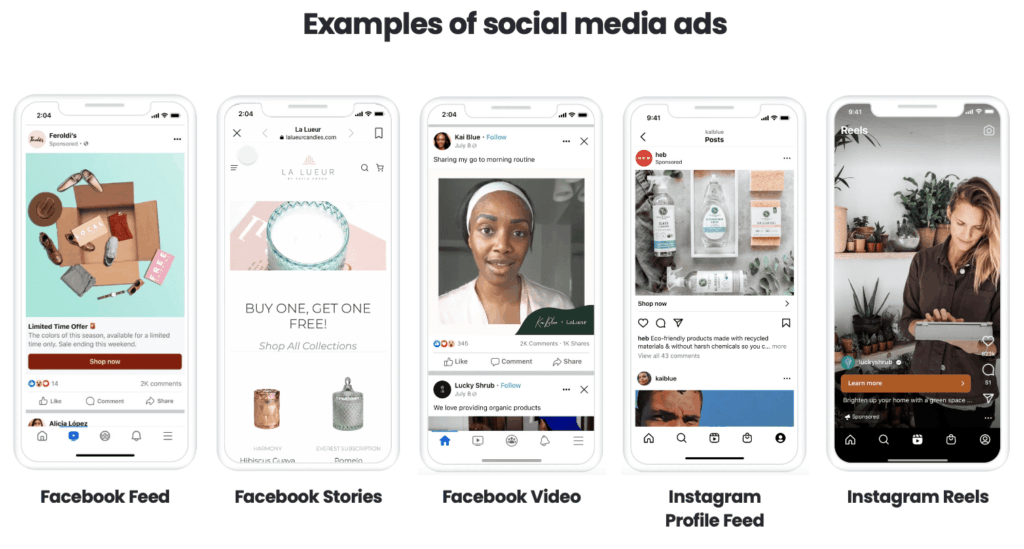
Social media advertising excels through granular targeting that leverages detailed user profiles, interests, and behaviours to achieve unmatched precision.
The channel benefits from social signals like shares, comments, and reactions that amplify reach beyond paid impressions.
Creative flexibility supports everything from simple images to AR experiences, while cross-device identity through logged-in users ensures consistent targeting across devices, solving many attribution challenges.
Advanced TV advertising (OTT, CTV, addressable)
Advanced TV advertising represents the convergence of traditional television with digital targeting and measurement capabilities, delivered through internet-connected devices.
This channel includes over-the-top (OTT) services, connected TV (CTV) platforms, and addressable TV systems that bring programmatic capabilities to the largest screen in the home.
How Advanced TV advertising can be delivered
- Connected TV (CTV): Video ads delivered through smart TVs and streaming devices like Roku, Apple TV, or Amazon Fire TV. These placements offer television-quality creative with digital precision.
- Over-the-top (OTT): A content delivery method whereby video content is displayed across all devices from mobile phones and tablets to TVs, providing reach beyond traditional broadcast or cable distribution.
- Addressable linear TV: A way to enable household-level targeting within traditional cable and satellite systems, allowing different homes watching the same program to see different ads.
Advanced TV provides unique advantages by placing ads alongside premium, professionally produced content while reaching cord-cutters and cord-nevers unreachable through traditional TV.
This channel delivers TV-scale impressions through large-format video that commands attention, combined with digital-style measurement offering impression-level data and attribution capabilities.
However, it faces complexities around fragmentation, measurement standardisation, and frequency management across numerous streaming services and devices.
Retail media
Retail media is a form of digital advertising where retailers sell ad space using their own shopping data and platforms.
There are three main forms of retail media:
- On-site: Ads displayed on a retailer’s website or mobile app. Common on-site ad formats include display ads and sponsored product listings.
- Off-site: Ads displayed on platforms and environments not owned by the retailer, but powered by the retailer’s data for targeting and measurement.
- In-store: Ads show on digital displays inside a retailer’s store.
Instead of relying on third-party audiences, brands can reach consumers based on real shopping behaviour, including browsing history, product searches, loyalty data, and past purchases.
This allows advertisers to target shoppers while they are actively researching or buying products, which makes retail media one of the most commercially relevant forms of digital advertising.
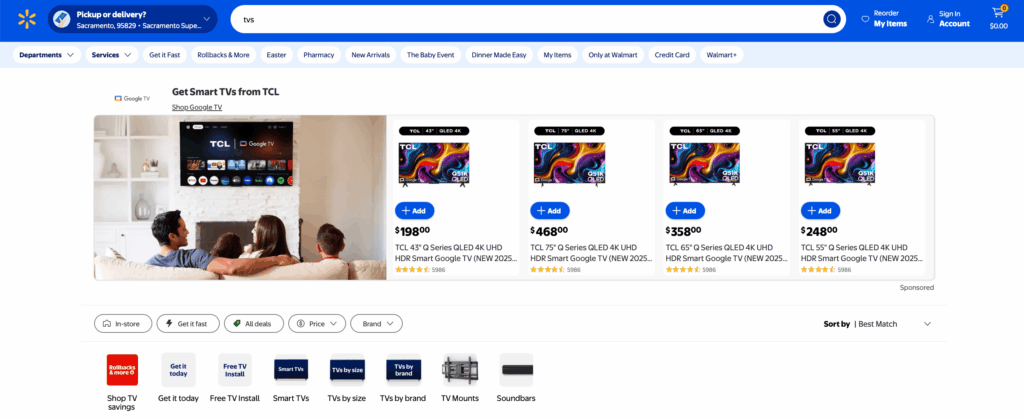
An example of a sponsored product listing for TCL Google TVs on Walmart’s website.
When a shopper searches for a product, brands can bid to appear in prominent placements within the results.
Because the ad exposure occurs close to the point of purchase, advertisers can measure outcomes much more precisely than in traditional media. Retailers are able to connect ad impressions and clicks directly to sales, creating what is often described as “closed-loop measurement”.
In recent years, many large retailers have built dedicated retail media networks that operate almost like full advertising platforms.
Companies such as Amazon, Walmart, and Tesco now offer advertisers a combination of on-site placements, off-site advertising powered by shopper data, and in-store digital media.
For retailers, this has become a highly attractive revenue stream, as advertising typically carries much higher margins than traditional retail operations. In fact, retail media was the fastest-growing digital channel in 2025.
The rapid growth of retail media is also closely tied to broader industry changes, particularly the decline of third-party cookies and increased privacy regulation.
As brands search for reliable ways to reach addressable audiences, retailers’ first-party data has become increasingly valuable.
Digital out-of-home (DOOH) advertising
Digital out-of-home advertising brings programmatic capabilities to the traditional out-of-home advertising world through connected digital screens in public spaces.
This channel transforms traditional billboards, transit advertising, and place-based media into dynamic, data-driven marketing opportunities that bridge digital and physical experiences.
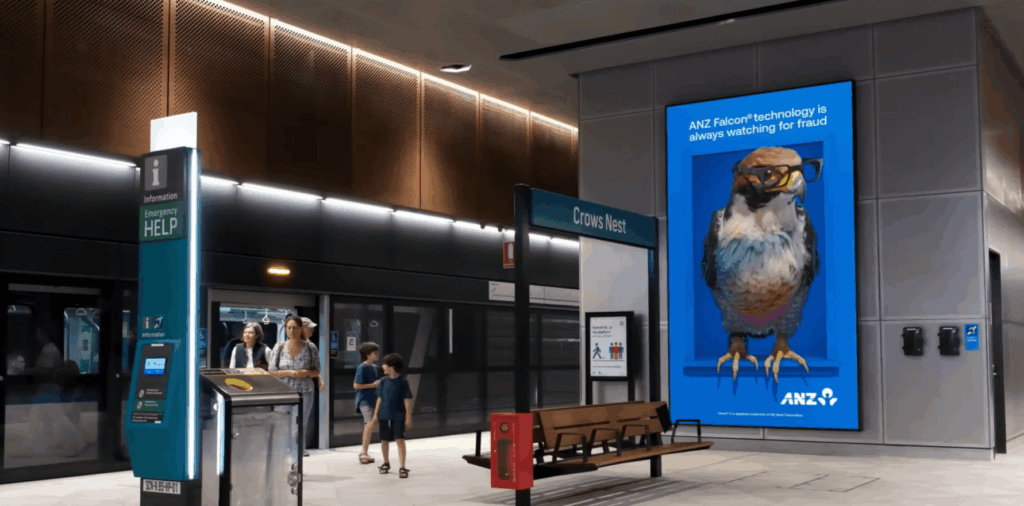
An example of a DOOH ad. Source: oOh! Media.
Examples of DOOH advertising
- Roadside digital billboards offer massive reach along highways and major arterials, with the ability to change creative based on time of day, weather, or traffic conditions.
- Transit screens in airports, train stations, and bus stops reach travelers during dwell time, with opportunities for sequential messaging throughout journey paths.
- Retail displays within malls, stores, and shopping districts influence purchase decisions at the point of sale with contextually relevant messages.
- Urban panels on sidewalks, in elevators, and throughout cities provide street-level engagement with pedestrian audiences.
DOOH offers distinctive benefits through real-time creative optimisation based on weather, events, or local conditions.
Additionally, large-format displays create high-impact brand exposure while reaching audiences during their daily journeys.
However, DOOH requires unique considerations around impression measurement, audience verification, and creative adaptation for public viewing environments with limited sound and interaction capabilities.
Digital audio
Digital audio refers to audio content that is delivered over the internet and consumed on connected devices such as smartphones, laptops, smart speakers, and connected cars.
This includes music streaming services, podcasts, internet radio, and other on-demand or live audio experiences.
Platforms like Spotify and Apple Music have made digital audio a major media channel, with millions of people listening throughout the day while commuting, working, exercising, or relaxing.
Because listening often happens during activities where screens are not the primary focus, digital audio offers advertisers a way to reach audiences in moments where traditional visual advertising cannot.

Video.
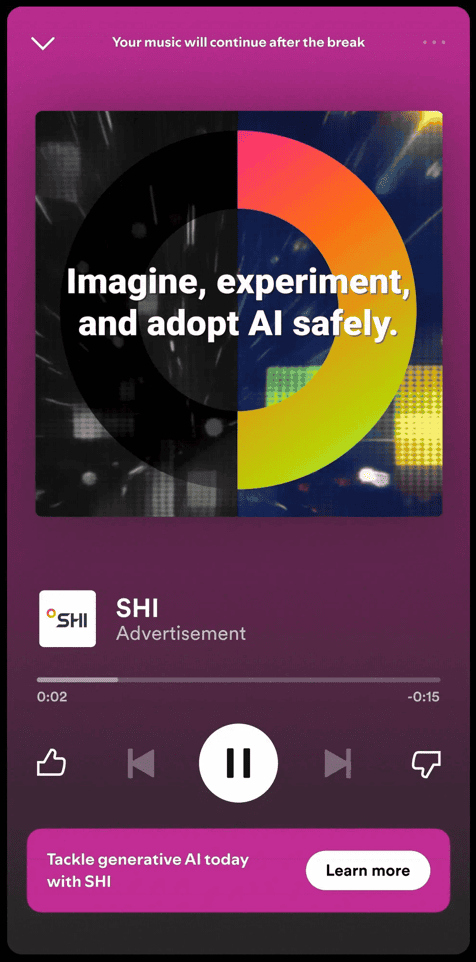
Text and audio.
As an advertising channel, digital audio allows brands to deliver targeted messages within streaming music, podcasts, and digital radio.
Unlike traditional broadcast radio, digital audio platforms can use data such as listener demographics, location, listening behaviour, and contextual signals to target specific audiences and measure campaign performance more precisely.
As consumption of streaming music and podcasts continues to grow, digital audio has become an important part of the modern media mix.
For advertisers, it offers a way to reach engaged audiences in a relatively uncluttered environment, often with high completion rates and strong recall.
For publishers and audio-streaming platforms, advertising provides a key revenue stream that supports free or lower-cost access to content for listeners.