Agentic AI in AdTech: What Is It and How Does It Work?
Agentic AI in AdTech represents a shift from task automation to decision automation. Instead of supporting isolated actions, these systems manage ongoing decisions across planning, optimisation and execution.
Leading cloud providers like AWS describe agentic AI as systems built from multiple models and tools that work together to act in dynamic environments rather than generating static responses to prompts.
In advertising, where campaigns run across multiple platforms simultaneously, that ability to coordinate across systems is what makes the difference.
In this article, we explain what agentic AI in AdTech is, how it works, its key components, the advantages it offers to advertisers and publishers, and the limitations you should be aware of.
What is agentic AI in AdTech and how does it work?
Agentic AI refers to a class of systems in which autonomous agents continually evaluate objectives, prioritise actions, and execute tasks in response to changing conditions.
Advertisers define goals and set objectives along with constraints including budget caps, maximum CPMs, and brand safety policies. The agentic AI system then launches the campaign and sets out to achieve the goals and objectives.
Agentic AI isn’t about replacing manual workflows with bots; it’s about automating how decisions get made.
For example, agentic advertising systems can:
- Monitor campaign performance and bids in real time
- Make decisions based on evolving context
- Act across systems, including reallocating budget, testing creatives and refining audience targeting
- Optimise continuously within a single decision loop
- Adjust future actions based on outcomes
To achieve this, the agentic AI system needs to connect to multiple other “agents” and systems to receive data and carry out decisions.
The diagram below illustrates how agentic AI translates business objectives into coordinated actions and continuous optimisation within the AdTech ecosystem.
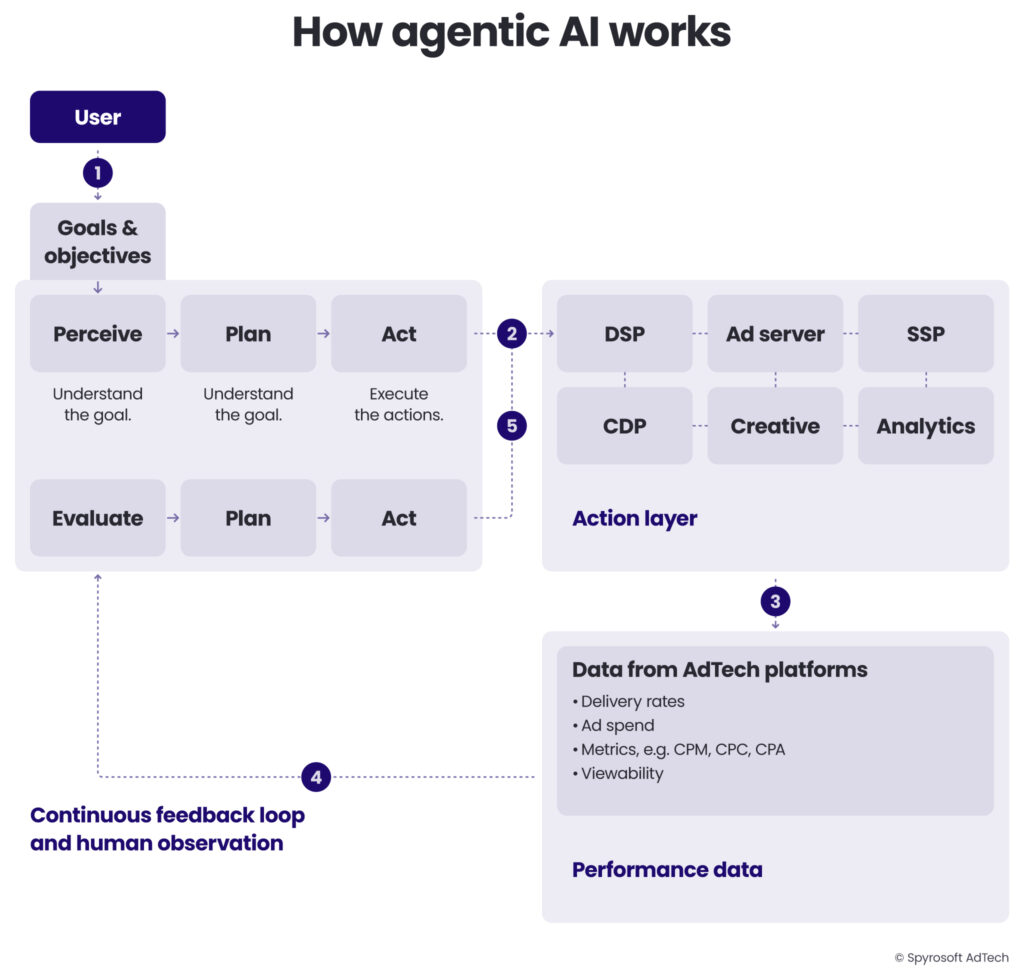
A step-by-step explanation of how agentic AI works:
- The user, e.g. an advertiser, sets goals and objectives using natural language. The goals and objectives could relate to setting up a new advertising campaign or something else, such as detecting and resolving campaign performance issues.
- The agentic AI system perceives the goal, plans the actions it’ll take, and then executes the actions.
- Data and information are collected from various systems, e.g. demand-side platforms (DSPs), ad servers, etc.
- The performance data is fed back into the agentic AI system. A human can also review the data at this stage to perform a “human-in-the-loop” role.
- The agentic AI system then evaluates the new data, plans a new set of actions, and executes them once again.
How does agentic AI compare to other AI models?
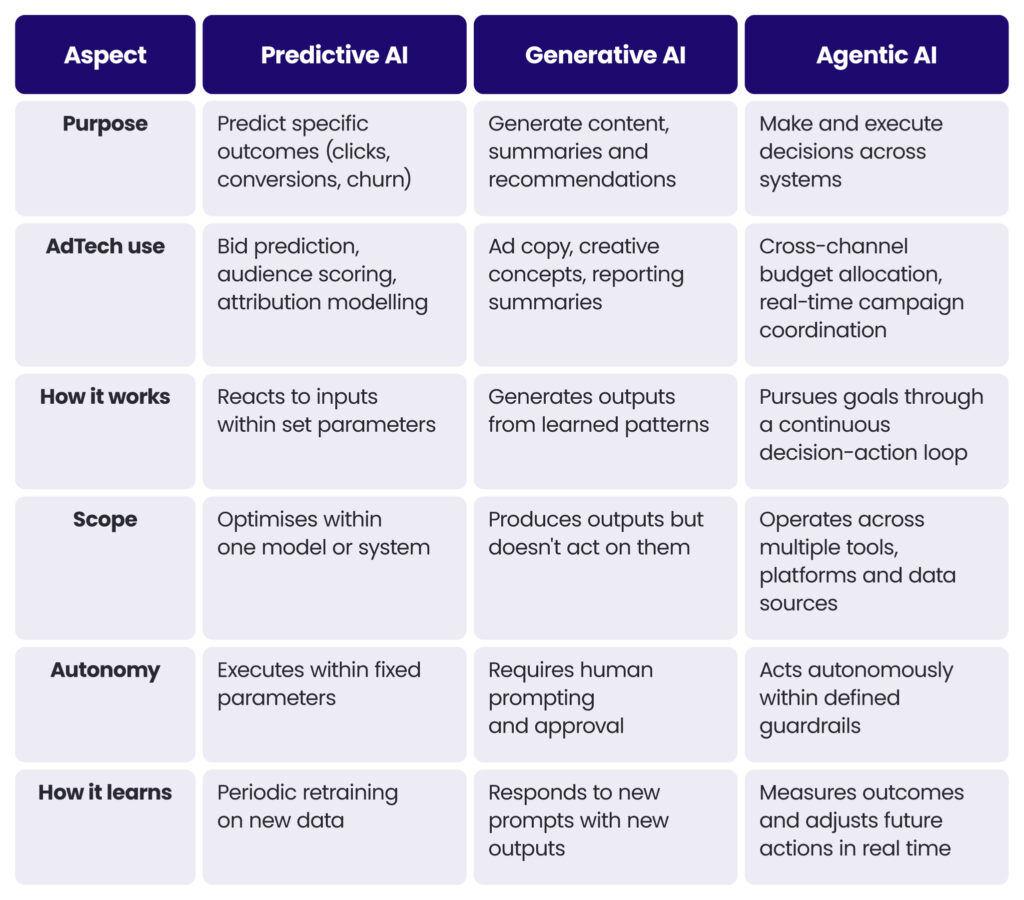
To understand agentic AI, it’s useful to see how it fits within the broader AI landscape used in advertising.
Traditional AI and machine learning
Traditional machine learning has been deployed in AdTech for years, used for things like CPM prediction, bid optimisation, audience scoring, and attribution.
They take inputs, find patterns, and forecast specific outcomes. They help advertisers answer questions like, “how likely is this user to click on an ad?”.
Generative AI
Generative AI (GenAI) is used for creating new content. It uses large-language models (LLMs) to produce text, images, audio, and video content based on patterns in data.
Generative AI alone does not act across systems. Instead, it produces outputs based on a user’s prompts.
What are AI agents in AdTech?
AI agents in AdTech are the operational entities within agentic AI systems.
Each agent performs a set of functions based on its design and communicates with other agents to carry out the goals and objects set by the user.
There are a few types of AI agents:
- Rule-based agents: Follow predefined logic to handle repetitive decisions. Predictable, consistent, no manual oversight needed.
- Reactive agents: Respond to real-time market signals. When auction dynamics or engagement patterns shift, these agents adjust immediately.
- Goal-based agents: Work toward a defined business objective and adapt their approach as conditions change.
- Utility-based agents: Weigh competing factors like reach, cost and quality to find the strongest overall outcome when trade-offs are unavoidable.
- Conversational agents: Provide answers and insights through natural language.
- Multi-agent systems: Several specialised agents coordinating across platforms. Bidding, targeting and budget allocation managed together rather than in silos.
These agents learn from outcomes and adjust future decisions accordingly.
When multiple agents run at the same time, orchestration keeps them aligned toward the same business goals rather than competing with each other.
What are the key components of agentic AI systems?
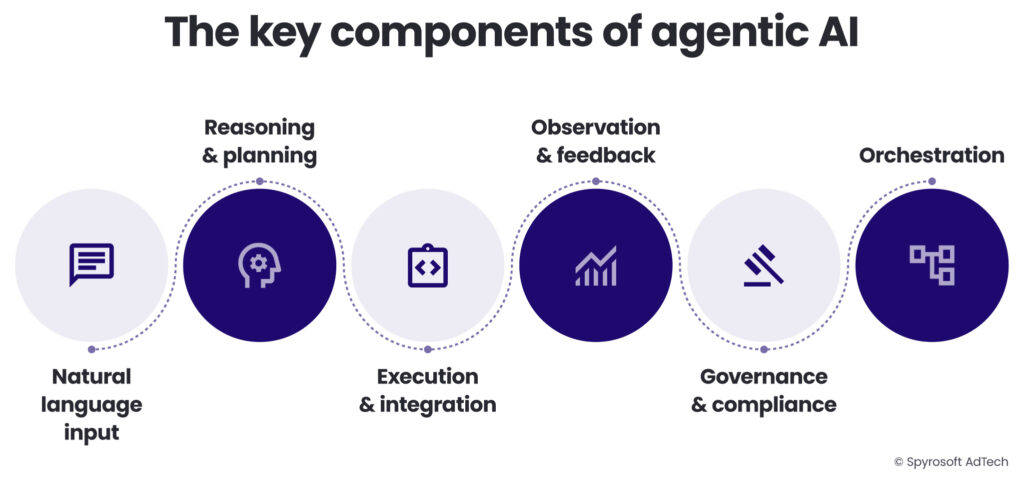
In practice, agentic AI systems in AdTech are built from a small number of interconnected layers that work together to support ongoing decision-making.
- Natural language input: Allows people to describe goals or instructions in everyday language, which the system interprets and converts into tasks the agents can act on.
- Reasoning and planning: Translates your business targets into a sequence of actions the agents carry out.
- Execution and integration: Connects to your existing ad platforms, analytics, creative tools, and other external agents to act on decisions directly.
- Observation and feedback: Monitors performance across all channels and feeds results back into the next decision.
- Governance and compliance: Every agent decision stays within your budget limits, brand policies and regulatory requirements.
- Orchestration: Coordinates the full cycle: observe, decide, act, measure, adapt.
For these elements to function effectively, the surrounding ecosystem must also support them. Clear standards and shared interfaces help different tools and platforms communicate smoothly, reducing friction across fragmented AdTech environments.
At the same time, high-quality, consistent and near real-time data is essential. Without reliable data, even well-designed agents will struggle to adapt accurately or stay aligned with the goals and objectives.
Frameworks like Model Context Protocol (MCP) further help align agentic behaviours with context-specific constraints and tools, essentially serving as a language that agents use to coordinate across an ecosystem of capabilities.
Benefits of agentic AI for advertisers and publishers
While the technology matters, the real question for leaders is simpler: what changes in practice?
Agentic AI in AdTech offers tangible advantages:
- Less manual work, more strategic focus: Campaign setup, A/B testing, and performance reporting are tasks agents can handle efficiently. Your team gains time to focus on strategy, creative direction, and higher-value decisions.
- Decisions grounded in data: Agents process volumes of data that would be impractical to analyse manually. They surface patterns, identify underperforming segments and suggest adjustments based on measurable signals.
- Campaigns that respond to user behaviour: Real-time signals influence which creative, message or format a user sees. Campaigns become more responsive to context rather than relying on static segmentation.
- Budget that follows performance: Spend can be reallocated dynamically across channels and formats based on current results, reducing lag between insight and action.
- Consistent cross-channel execution: Agents apply the same optimisation logic across platforms, helping maintain alignment without increasing coordination overhead.
- Scale without proportional team growth: As campaign complexity increases, agents help manage additional variants, audiences and markets without expanding operational workload at the same rate.
- Integrated fraud detection and brand safety controls: Automated monitoring can flag suspicious activity and prevent placements that conflict with brand guidelines.
- Continuous optimisation through feedback: When feedback loops are built into the system, historical performance informs future decisions, improving alignment with defined objectives over time.
Known limitations of agentic AI and key considerations
It’s important to remember that agentic systems operate within boundaries defined by people, data availability and technical constraints.
Their autonomy is conditional, shaped by objectives, rules and governance frameworks rather than independent intent.
With this in mind, advertisers and publishers should be aware of several considerations:
Hype vs reality
Industry sources have cautioned that not all solutions marketed as agentic deliver true autonomy.
Some are built on repackaged automation with limited multi-stage reasoning or coordination. Evaluating tools against clear criteria, including real continuous adaptation and multi-agent coordination, is essential.
Data dependency
As in all advanced AI systems, the quality and structure of data directly impact performance. Fragmented or inaccurate data undermines agent decisions.
Governance and oversight
While agents can operate autonomously to some degree, businesses must use governance frameworks to ensure alignment with strategy, accountability, and safety.
Organisational readiness
Deploying agentic AI often requires a unified data architecture, cross-functional alignment, and culture shifts towards data-driven decision-making, all of which can pose practical barriers.
Final words about agentic AI in AdTech
Agentic AI in AdTech represents an evolution in how advertising systems can manage complexity.
By enabling autonomous, multi-stage, real-time decision loops across planning, optimisation and execution, agentic AI has the potential to enhance campaign responsiveness, scale strategic decision logic and improve cross-channel performance alignment.
For advertising leaders, the opportunity is not replacing teams. It is enabling them to operate at a scale and speed that manual processes cannot match.
The question is not whether automation will deepen in advertising; it is how deliberately and responsibly organisations choose to adopt it.
Download the PDF & join our waiting list
Fill in the form to download the PDF version and get notified when the next chapters are released.