Agentic AI in AdTech: 7 Use Cases
As interest in agentic AI in AdTech grows, so do the number of ways it could be used. From planning campaigns to detecting fraud, agentic AI has the potential to improve many parts of programmatic advertising.
As mentioned in parts one and two of our agentic AI series, the programmatic advertising and AdTech industries are moving beyond automating processes to automating decisions.
In this article, we present seven agentic AI use cases that illustrate how it is changing AdTech operations and delivering tangible value today.
01. Ad campaign planning and creation
One of the most established agentic AI use cases in AdTech is campaign planning.
Traditionally, creating and configuring a media campaign involves manually copying and pasting information from spreadsheets into ad platforms, gathering data from email threads, and analysing performance data in multiple platforms.
Agentic AI can reduce this work from hours to minutes.
These agentic AI systems automate not only the process of creating ad campaigns but also the decisions around audience selection, budget allocation, and channel distribution.
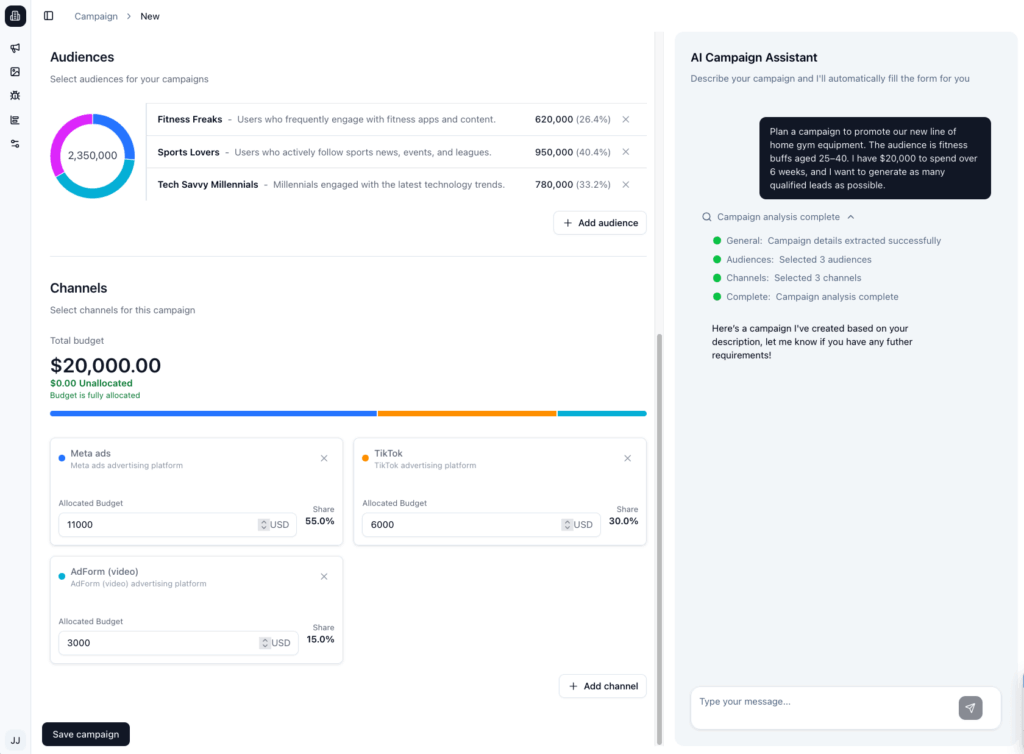
An example of how agentic AI can be used in campaign planning.
Source: Spyrosoft AdTech’s AI Media Planner
To power this decisioning, agentic AI systems utilising agents – individual parts of the system responsible for carrying out certain decisions.
For example, one agent defines marketing objectives, another creates audience segments, and a third recommends the digital channels. These agents collaborate rather than operate in isolation.
But these agents do not simply process data – they learn from it and make decisions based on it.
The outcome is faster campaign creation and turnaround, better-performing media plans, and a more streamlined process.
02. Bid optimisation
Bid optimisation is another prominent agentic AI use case.
Current real-time bidding (RTB) platforms rely on snapshot decisions, with each impression evaluated independently within a 100-millisecond auction window. Agentic AI introduces continuous learning.
These agentic systems monitor performance in real time and adjust bidding strategies based on live signals across channels. They balance reach, cost, and quality simultaneously rather than optimising for a single metric.
As outlined in our article on what agentic AI changes in programmatic advertising, this marks a move away from periodic optimisation towards continuous adaptation.
03. Autonomous audience segmentation
Autonomous audience segmentation represents a privacy-aware agentic AI use case driven by the deprecation of third-party cookies.
Instead of tracking individual users across the web, agents identify audience patterns using contextual signals and first-party data. They analyse social platforms, extract demographic indicators, and build dynamic segments without relying on personal identity data.
Traditional segments tend to be static, built once and applied over time. Agentic systems continuously refine segments based on what is driving performance in practice.
This agentic AI use case supports effective targeting whilst reducing compliance complexity and aligning with evolving privacy regulations.
04. Autonomous demand- and supply-path optimisation
Autonomous demand-path optimisation (DPO) and supply-path optimisation (SPO) are agentic AI use cases that focus on reducing inefficiencies in programmatic advertising supply chains.
Supply-path optimisation agents analyse delivery routes continuously, helping advertisers and agencies identify which paths generate the best performance and which consume budget without contributing to outcomes. They can also detect and remove made-for-advertising placements that inflate costs.
Conversely, demand-path optimisation agents help publishers and media companies identify the most efficient and profitable routes.
Beyond cost efficiency, this agentic AI use case contributes to improved brand placement and more reliable measurement.
05. Fraud detection and response automation
Fraud detection and response automation is a risk-focused agentic AI use case addressing brand safety and invalid traffic.
Agentic systems use contextual understanding rather than pattern matching. An agent powered by large language models (LLMs) can distinguish between a financial planning article discussing market volatility and genuine crisis reporting.
In addition to brand safety, these agents support real-time fraud detection by monitoring anomalies, identifying bot traffic, and automating incident response.
This agentic AI use case results in fewer false positives, stronger protection against genuine threats, and reduced manual effort for operational teams.
06. Automated deal management and negotiation
Automated deal management is a growing agentic AI use case in AdTech as publishers and advertisers look to scale direct and preferred deals more efficiently.
In this scenario, agentic AI systems manage the deal lifecycle by analysing inventory availability, historical performance, pricing benchmarks, and advertiser demand.
Within predefined commercial boundaries, agents can propose deal terms, adjust pricing, and negotiate conditions with buy-side platforms.
Unlike rule-based automation, these agents learn from outcomes over time.
They adapt negotiation strategies based on which terms close faster and which partners deliver stronger performance.
This use case is strongly connected to the Ad Context Protocol (AdCP), a proposed standard aimed at introducing agentic AI into programmatic ad deals.
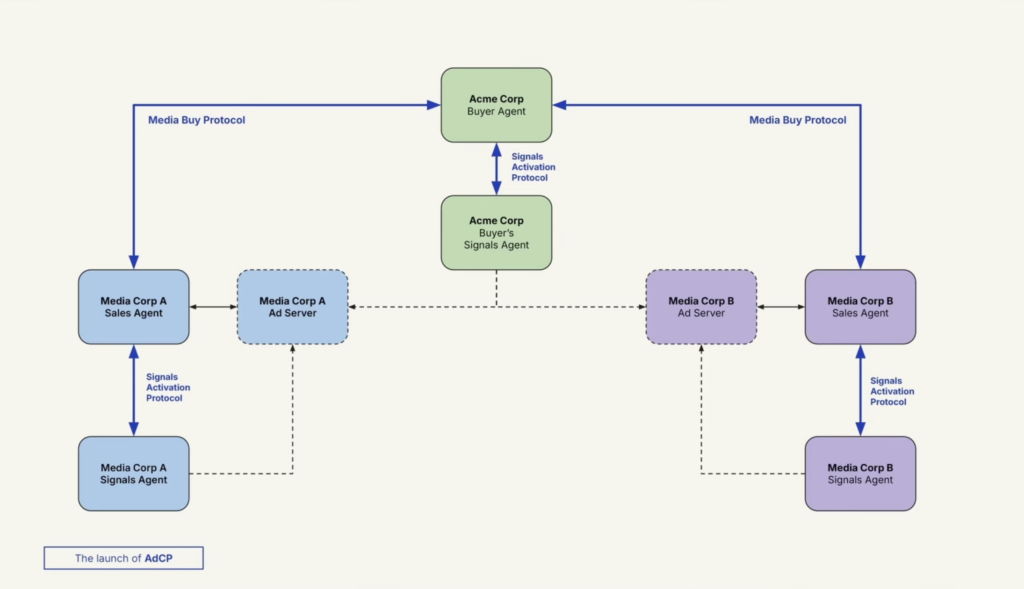
A technical diagram illustrating how the Advertising Context Protocol (AdCP) works.
Source: Introducing AdCP: The Open Standard for Agentic Advertising
This agentic AI use case reduces manual effort for sales and AdOps teams while improving deal velocity and alignment with real-time market conditions.
07. Creative optimisation and dynamic ad generation
Creative optimisation is one of the most visible agentic AI use cases in AdTech, particularly as campaign performance becomes increasingly dependent on creative relevance and speed.
In this use case, agentic AI systems manage the end-to-end optimisation of ad creatives. Agents analyse performance signals such as engagement, conversion rates, and contextual relevance, then automatically generate and test creative variations across formats, channels, and audiences.
Rather than relying on predefined A/B tests, agents adapt creative strategies continuously. They learn which messages, visuals, and formats perform best in specific contexts and reallocate spend towards the most effective combinations in real time.
This agentic AI use case helps marketing teams scale creative production, respond faster to performance changes, and maintain relevance without increasing manual workload.
What these agentic AI use cases have in common
Across these agentic AI use cases, a consistent pattern emerges: the shift from executing predefined instructions to pursuing defined outcomes.
Advertisers, agencies, publishers, and media companies determine what success looks like and agents then determine how to pursue it within agreed boundaries.
But human oversight remains essential.
Teams set objectives, guardrails, and success metrics, while agents operate within those constraints. This allows people to focus on strategy rather than day-to-day execution.
For organisations assessing how agentic AI fits into their AdTech stack, these agentic AI use cases highlight where measurable results are already being achieved.